

Your Pipeline Is 28.5h Behind: Catching Real Estate Sentiment Leads with Pulsebit
We've just identified a striking anomaly: a 24h momentum spike of +0.276 in the real estate sector. This sudden shift in sentiment warrants our attention, especially considering the leading language of coverage is English, with a 28.5-hour lag compared to the sentiment peak. The implications are clear — there’s a significant delay in how our models are capturing sentiment trends in this area.
This discovery highlights a critical structural gap in pipelines that don't effectively manage multilingual origin or entity dominance. Your model missed this spike by a staggering 28.5 hours, which means you were likely unaware of the growing buzz around the trending topic of real estate, specifically related to a story about a broker cheating an ex-serviceman out of ₹55 lakh. Ignoring these nuances can lead to missed opportunities in rapidly shifting markets.

English coverage led by 28.5 hours. So at T+28.5h. Confidence scores: English 0.85, Spanish 0.85, French 0.85 Source: Pulsebit /sentiment_by_lang.
To catch such insights, we can leverage our API effectively. Here’s a Python snippet that demonstrates how to filter for English-language articles and evaluate sentiment around the identified cluster story.
import requests
# Parameters
topic = 'real estate'
score = -0.300
confidence = 0.85
momentum = +0.276
lang = 'en'
# API call to fetch articles
response = requests.get(
f"https://api.pulsebit.io/v1/articles?topic={topic}&lang={lang}&momentum={momentum}&confidence={confidence}"
)
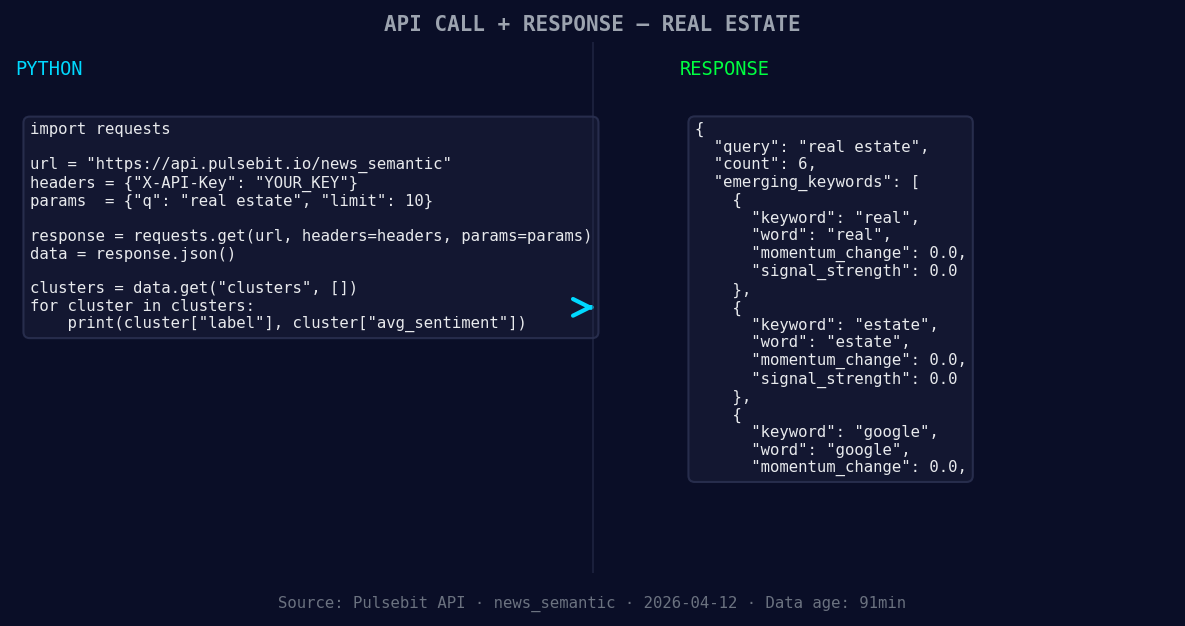
*Left: Python GET /news_semantic call for 'real estate'. Right: returned JSON response structure (clusters: 3). Source: Pulsebit /news_semantic.*
articles = response.json()
# Extracting relevant data
print(f"Fetched {len(articles)} articles related to '{topic}' in {lang}.")
# Meta-sentiment moment
cluster_reason = "Clustered by shared themes: real, estate, broker, cheating, ex-serviceman."
sentiment_response = requests.post(
"https://api.pulsebit.io/v1/sentiment",
json={"text": cluster_reason}
)
sentiment_score = sentiment_response.json().get('score', None)
print(f"Meta sentiment score for cluster reason: {sentiment_score}")
In this code, we first filter articles by setting the lang parameter to en, ensuring we're capturing the relevant English-language sentiment. The second part of our code runs the cluster reason string through a sentiment analysis endpoint, allowing us to evaluate the narrative framing itself. This approach sheds light on how interconnected themes influence overall sentiment.
Now, let’s explore three specific builds we can implement based on this discovery:
- Geo-Filtered Sentiment Dashboard: Use the geographic origin filter to create a real-time dashboard displaying sentiment scores around the "real estate" topic. Set a threshold where sentiment scores below -0.200 trigger alerts for potential anomalies in the region.

Geographic detection output for real estate. India leads with 5 articles and sentiment -0.27. Source: Pulsebit /news_recent geographic fields.
Meta-Sentiment Alert System: Develop a monitoring system that utilizes the meta-sentiment loop. Trigger alerts when the sentiment score for clustered themes like "real", "estate", and "broker" dips below -0.250 while the momentum remains positive. This could indicate an emerging issue worth investigating further.
Trending Topics Aggregator: Build an aggregator that tracks forming themes such as "real(+0.00)", "estate(+0.00)", and "google(+0.00)" vs mainstream topics. Use our API to dynamically identify these shifts, helping you stay ahead of breaking stories that could impact market sentiment.
If you're eager to start tapping into this data, visit pulsebit.lojenterprise.com/docs. You’ll be able to copy, paste, and run this code in under 10 minutes to integrate these insights into your workflows.


Top comments (0)