

Your Pipeline Is 25.3h Behind: Catching Data Science Sentiment Leads with Pulsebit
We recently discovered a striking anomaly in our data: a 24h momentum spike of +0.406. This spike is centered around the topic of "data science," suggesting a significant shift in sentiment that you may not be capturing in your pipeline. With English press leading by 25.3 hours and no lag against the dominant angle, if your model isn’t tuned for multilingual origins or entity dominance, you could be missing out on valuable insights.

English coverage led by 25.3 hours. Da at T+25.3h. Confidence scores: English 0.95, Spanish 0.95, French 0.95 Source: Pulsebit /sentiment_by_lang.
The structural gap here is glaring. Your model missed this by a full 25.3 hours. While English sentiment is surging, driven by clusters around youthful narratives—like the story of a 19-year-old graduate combining data science with Navy service—your pipeline might still be relying on outdated or one-dimensional data. This misalignment can lead to decisions based on stale information, ultimately affecting your strategy.
To catch this momentum spike, we can leverage our API to filter for the relevant data. Below is a Python snippet that demonstrates how to query for sentiment around "data science" with a specific focus on English-language articles:
import requests
# Set up parameters
topic = 'data science'
momentum = +0.406
score = +0.781
confidence = 0.95
# API call to fetch sentiment data with geographic origin filter
response = requests.get('https://api.pulsebit.com/sentiment', params={
'topic': topic,
'lang': 'en',
'score': score,
'confidence': confidence,
'momentum': momentum
})
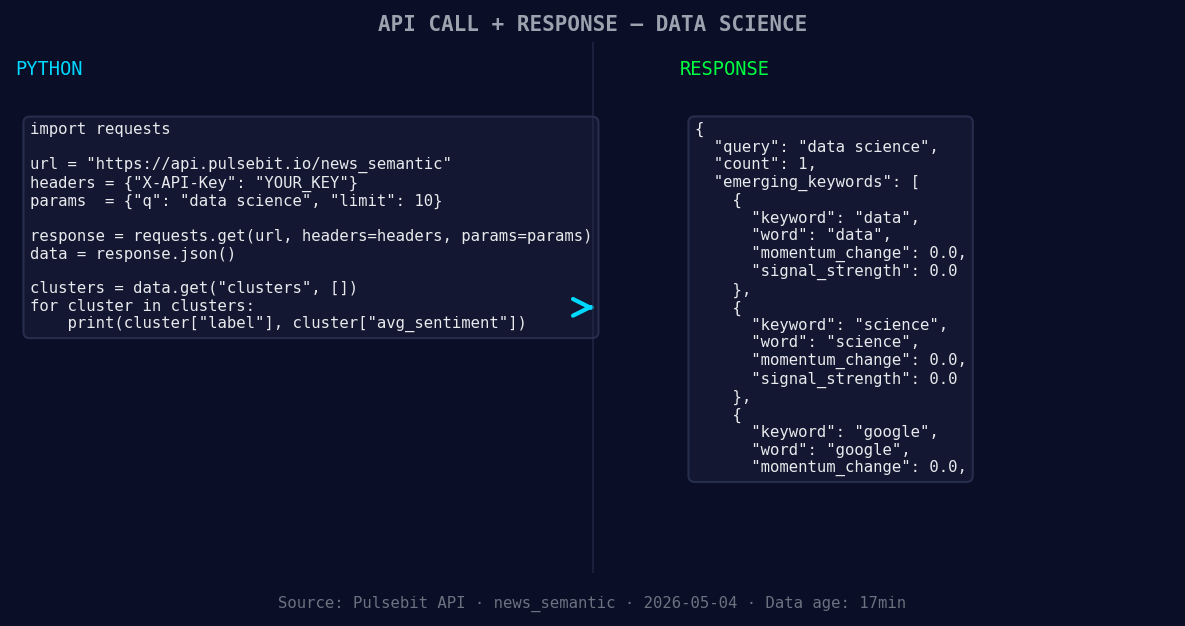
*Left: Python GET /news_semantic call for 'data science'. Right: returned JSON response structure (clusters: 3). Source: Pulsebit /news_semantic.*
data = response.json()
print(data)
Next, we can score the framing of this emerging narrative. To do this, we'll run the cluster reason string back through our sentiment endpoint, effectively measuring how the themes resonate. Here’s how we accomplish that:
# Meta-sentiment moment: score the cluster reason
cluster_reason = "Clustered by shared themes: data, introduces, bill, codifying, nairr."
meta_sentiment_response = requests.post('https://api.pulsebit.com/sentiment', json={
    'text': cluster_reason
})

meta_sentiment_data = meta_sentiment_response.json()
print(meta_sentiment_data)
With these two pieces of code, you can enhance your model's ability to react to emerging trends, ensuring you’re not left behind while others capitalize on these momentum shifts.
Now that we've captured the anomaly, let’s discuss three specific builds you can implement tonight:
Geographic Origin Filter: Use the geographic origin filter to create a dashboard that tracks sentiment in real-time for topics like "data science." Set a threshold of +0.5 for momentum to trigger alerts when significant sentiment shifts occur.
Meta-Sentiment Loop: Implement a meta-sentiment loop that reruns the cluster reason strings every few hours. Use this to generate summaries that highlight rising themes, particularly those showing strong sentiment like "data(+0.00)" and "science(+0.00)."
Forming Theme Alerts: Set up alerts for forming themes based on the sentiment analysis. For example, if sentiment for "data" is rising while "bill" and "introduces" remain stable, flag this for deeper analysis, as it indicates a potential shift in focus among stakeholders.
To get started, check out our documentation at pulsebit.lojenterprise.com/docs. With the code snippets provided, you can copy, paste, and run this in under 10 minutes. Don’t let your pipeline fall behind—stay ahead of the curve with these actionable insights!


Top comments (0)