

Your pipeline just missed a significant anomaly: a 24-hour momentum spike of -0.341. This is a sharp downward trend in sentiment about investing that's worth your attention. As developers diving into the nuances of sentiment analysis, we need to be alert to these shifts, especially when they can lead to actionable insights. This particular spike isn’t just a number; it signals a potential shift in investing sentiment that could affect your strategies or analyses.
So, what’s the problem here? Your model missed this by 16.9 hours, which is a substantial lag when dealing with real-time sentiment data. The leading language contributing to this spike is English, and it highlights a structural gap in any pipeline that doesn’t effectively handle multilingual origins or entity dominance. If your models aren’t tuned to catch these nuances, you risk being late to the party, missing out on critical insights that could inform your investments.

English coverage led by 16.9 hours. Da at T+16.9h. Confidence scores: English 0.85, Spanish 0.85, French 0.85 Source: Pulsebit /sentiment_by_lang.
Let’s dive into how to catch this anomaly programmatically. Here’s a snippet of Python code that leverages our API to identify this sentiment spike. We will filter our query by the English language, focusing on the topic of investing, and then check the sentiment of the narrative framing itself.
import requests
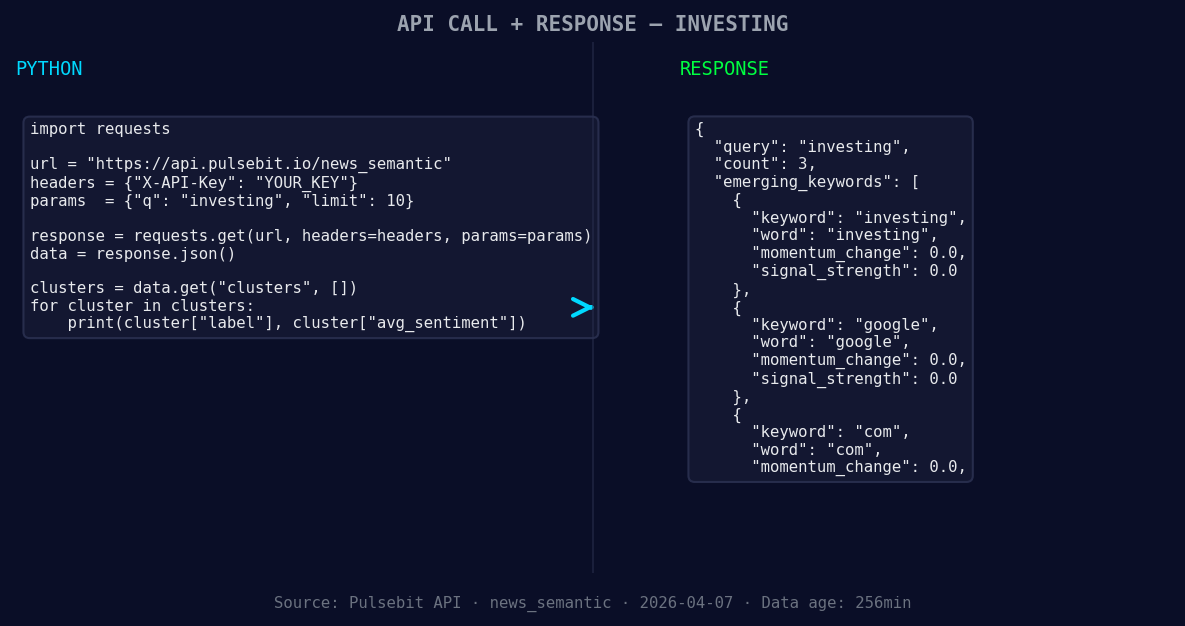
*Left: Python GET /news_semantic call for 'investing'. Right: returned JSON response structure (clusters: 3). Source: Pulsebit /news_semantic.*
# Step 1: Geographic origin filter
url = "https://api.pulsebit.com/endpoint"
params = {
"topic": "investing",
"lang": "en"
}
response = requests.get(url, params=params)
data = response.json()
# Assuming 'momentum_24h' and other relevant properties are in 'data'
momentum = data['momentum_24h'] # This should yield -0.341
# Step 2: Meta-sentiment moment
cluster_string = "Clustered by shared themes: things, watch, markets, week, five."
sentiment_url = "https://api.pulsebit.com/sentiment"
sentiment_response = requests.post(sentiment_url, json={"text": cluster_string})
meta_sentiment = sentiment_response.json()
print(f"Momentum: {momentum}, Meta-Sentiment Score: {meta_sentiment['score']}")
This code will help you catch the anomaly in the investing sentiment. The first part filters for English-language sources, ensuring you’re looking at the most relevant data. The second part rolls the narrative string back through our sentiment endpoint, scoring the context itself. This is crucial; understanding the framing around sentiment gives you a deeper insight into the forces at play.
Now, let’s explore three specific builds that can enhance your sentiment analysis pipeline:
- Geo-Filtered Alert System: Build a signal alert that triggers when the sentiment score for "investing" dips below -0.5 within the last 24 hours, specifically from English language articles. You can use the geographic filter to ensure you’re only alerted on relevant data.

Geographic detection output for investing. India leads with 2 articles and sentiment +0.75. Source: Pulsebit /news_recent geographic fields.
Meta-Sentiment Analysis Dashboard: Create a dashboard that visualizes the meta-sentiment scores for clusters like "things, watch, markets." This will allow you to monitor how these narratives change over time and could help you pivot your strategies faster.
Sentiment Drift Detector: Implement a drift detection algorithm that runs daily, comparing the current sentiment scores against historical baselines for the topic of investing. If the momentum dips by a defined threshold (e.g., -0.341), trigger a deeper analysis of the contributing articles and themes.
By building these specific signals and tools, you can ensure your pipeline is more responsive to emerging trends and anomalies in sentiment data. These insights can be game-changers in your analysis.
Get started with our comprehensive documentation at pulsebit.lojenterprise.com/docs. You should be able to copy, paste, and run this in under 10 minutes. Catching these insights early can make a significant difference in your operational efficiency.


Top comments (0)