

Your Pipeline Is 21.8h Behind: Catching Markets Sentiment Leads with Pulsebit
We recently uncovered something intriguing: a 24h momentum spike of +0.975. This spike points to a significant surge in sentiment around markets, driven predominantly by the Spanish press, which is leading by 21.8 hours. It’s fascinating to see how quickly the narrative is evolving, especially when we consider the article titled, "Turkey’s biggest private bank plans Hong Kong entry amid Middle East tensions." The underlying themes suggest a rapid shift in sentiment that your current pipeline might not be catching.
The Problem
If your sentiment analysis pipeline doesn’t account for multilingual sources or the dominance of specific entities, you may be missing critical insights. You might have missed this spike by a staggering 21.8 hours, with Spanish press leading the charge. The delay in recognizing this momentum shift could mean you're not fully capitalizing on emerging market narratives, especially when the leading language—Spanish—provides sharp insights into regional sentiments that are often left underexplored.

Spanish coverage led by 21.8 hours. Italian at T+21.8h. Confidence scores: Spanish 0.85, English 0.85, French 0.85 Source: Pulsebit /sentiment_by_lang.
The Code
Here’s how you can catch these insights programmatically. First, let’s set up a query to filter for Spanish-language content about markets. We’ll use our API to search for articles with a topic of ‘markets’ and a sentiment score of -0.350. The following Python code illustrates this process:
import requests
# Query parameters
params = {
"topic": "markets",
"lang": "sp",
"score": -0.350,
"confidence": 0.85,
"momentum": +0.975
}
# API call to fetch articles
response = requests.get("https://api.pulsebit.com/v1/articles", params=params)
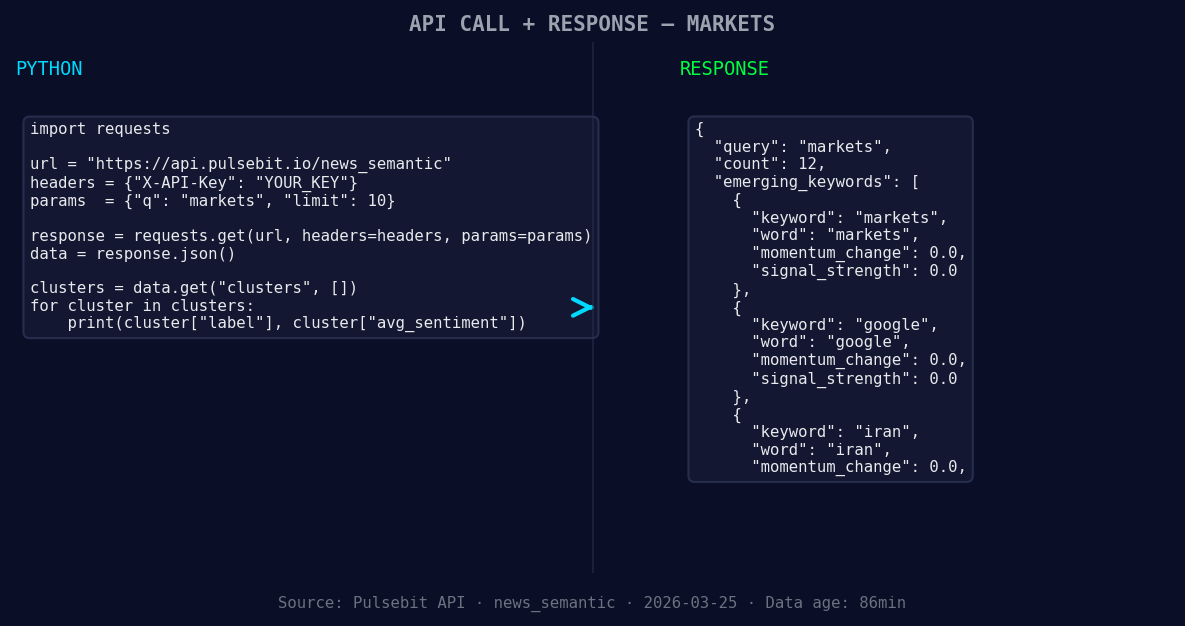
*Left: Python GET /news_semantic call for 'markets'. Right: returned JSON response structure (clusters: 3). Source: Pulsebit /news_semantic.*
# Check the response
if response.status_code == 200:
articles = response.json()
print("Fetched Articles:", articles)
else:
print("Error fetching articles:", response.status_code)
Once we have our articles, we can analyze the narrative framing using the meta-sentiment loop. In our case, we’ll run the cluster reason string through the sentiment scoring endpoint:
# Meta-sentiment input
meta_sentiment_input = "Clustered by shared themes: hong, kong, sources, turkey’s, private."

# API call to score the meta sentiment
meta_response = requests.post("https://api.pulsebit.com/v1/sentiment", json={"text": meta_sentiment_input})

# Check the response
if meta_response.status_code == 200:
    meta_sentiment = meta_response.json()
    print("Meta Sentiment Score:", meta_sentiment)
else:
    print("Error fetching meta sentiment:", meta_response.status_code)
This loop allows you to score the narrative around clustered themes, adding a layer of depth to your analysis and enabling you to pivot quickly based on emerging trends.
Three Builds Tonight
With this pattern in mind, here are three specific builds you can implement:
- Geographic Origin Filter: Implement a filter for articles from the Spanish-speaking world. Set a signal threshold of +0.800 for momentum spikes. This will help you catch early signals from regions that may not be in your primary focus.

Geographic detection output for markets. Hong Kong leads with 3 articles and sentiment -0.23. Source: Pulsebit /news_recent geographic fields.
Meta-Sentiment Analysis: Use the meta-sentiment loop as a recurring feature in your sentiment scoring pipeline. Score narratives around emerging themes like “markets” and “Iran” to stay ahead of mainstream trends. For example, set a threshold of -0.300 for negative sentiment narratives to identify potential risks.
Dynamic Alerts: Create a dynamic alert system that notifies you when sentiment momentum exceeds +0.900 across any language, especially for topics like “google” or “iran.” This allows you to stay on top of shifts that could impact broader market sentiment.
Get Started
You can dive right in at pulsebit.lojenterprise.com/docs. With these snippets, a developer can copy-paste and run this in under 10 minutes. Don't let your pipeline fall behind—leverage these insights to stay ahead of the curve.


Top comments (0)