

Your Pipeline Is 26.2h Behind: Catching Inflation Sentiment Leads with Pulsebit
We recently stumbled upon a striking anomaly: a 24-hour momentum spike of -1.150 around the topic of inflation. This indicates a significant downturn in sentiment, and what makes this even more compelling is that the leading language driving this narrative is English, lagging behind Hindi by 26.2 hours. As developers, this kind of insight reveals critical gaps in our sentiment analysis pipelines, particularly in handling multilingual content and varying entity dominance.

English coverage led by 26.2 hours. Hindi at T+26.2h. Confidence scores: English 0.95, Spanish 0.95, French 0.95 Source: Pulsebit /sentiment_by_lang.
If your model isn’t designed to accommodate these nuances, it might have missed this sentiment shift by over a day. The English press is currently grappling with issues surrounding inflation, while the Hindi discussions are several hours ahead—this disparity in processing time can lead to missed opportunities in understanding how sentiment evolves across languages. When your pipeline lacks the ability to track this effectively, you risk making decisions based on outdated or incomplete data.
To catch this sentiment shift, we can leverage our API to create an effective solution. First, let’s filter our query by language and country to focus exclusively on the English articles. We can do this using the following code snippet:

Geographic detection output for inflation. India leads with 1 articles and sentiment +0.00. Source: Pulsebit /news_recent geographic fields.
import requests
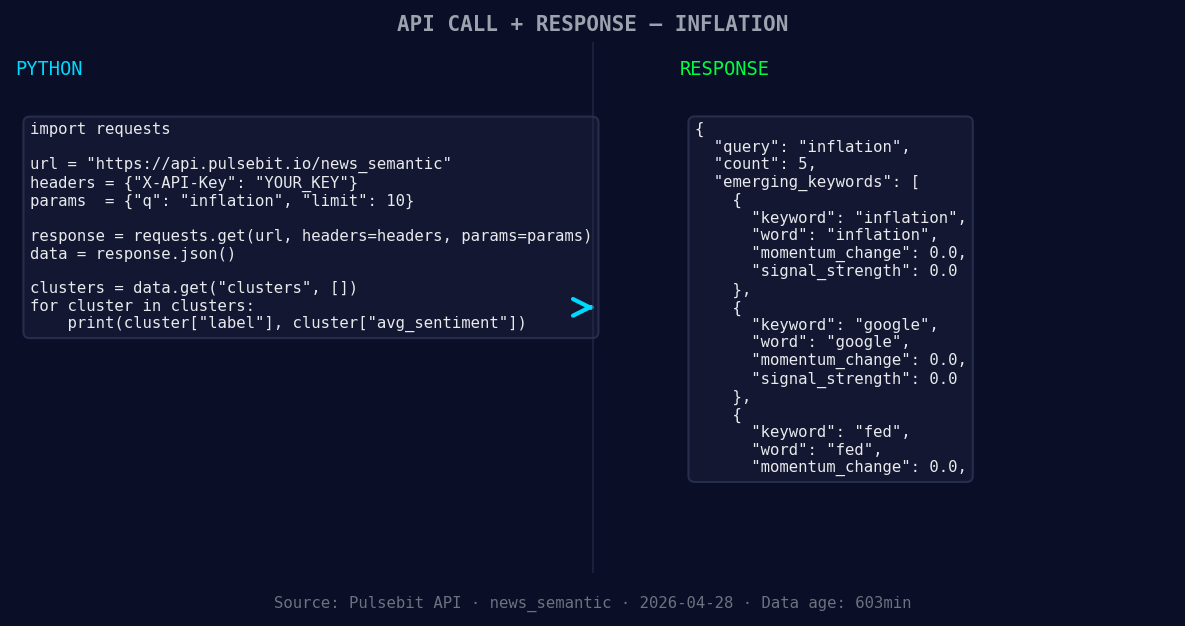
*Left: Python GET /news_semantic call for 'inflation'. Right: returned JSON response structure (clusters: 3). Source: Pulsebit /news_semantic.*
topic = 'inflation'
url = "https://api.pulsebit.com/sentiment"
params = {
"topic": topic,
"lang": "en" # Geographic origin filter
}
response = requests.get(url, params=params)
print(response.json())
With this call, we ensure that we’re processing the right content. After we gather the articles, we can also run the cluster reason string through our sentiment analysis endpoint to score the narrative framing itself:
cluster_reason = "Clustered by shared themes: hikes, possible, due, inflation, resurgence."
sentiment_response = requests.post(url, json={"text": cluster_reason})
print(sentiment_response.json())
This approach allows us to not only observe sentiment trends for inflation but also understand how specific themes are being discussed—essential for making informed decisions based on the evolving narrative.
Now, let’s talk about three specific builds you can implement using this pattern. First, you can set up a signal monitor that triggers alerts when sentiment scores drop below a certain threshold, like -0.2, specifically for inflation. This gives you an early warning system for potential market shifts.
Second, implement a geo-filtered sentiment dashboard that displays sentiment scores and trends for different languages. This way, you can visualize how sentiment varies across regions, allowing you to see that 26.2-hour lag in real-time.
Lastly, integrate a meta-sentiment analysis loop that processes cluster themes continuously. Use the aforementioned cluster reasons to score narratives and compare them against historical data. For example, track how discussions around inflation, Google, and the Fed evolve in relation to mainstream themes like hikes and possibilities.
By utilizing these builds, you’re not just reacting to sentiment; you’re proactively engaging with it, ensuring your models are up-to-date and equipped to handle the complexities of multilingual content.
If you're ready to dive deeper, check out our documentation at pulsebit.lojenterprise.com/docs. You can copy-paste the provided code and run it in under 10 minutes to start capturing these critical insights.


Top comments (0)