

Your Pipeline Is 27.1h Behind: Catching Sports Sentiment Leads with Pulsebit
We've just uncovered a critical anomaly: a sentiment spike of +0.20 and momentum holding steady at +0.00. This data points to a leading language in Spanish press that has surged by 27.1 hours with no lag compared to the identified trends. The implications here are significant, especially when you consider the cluster story: "Impact of Sports Betting on Finances," which is being echoed in two articles. This is a crucial moment for those of us tracking sports sentiment, as it highlights a potential blind spot in our pipelines.
The Problem
This discovery reveals a structural gap in any pipeline that fails to account for multilingual origins or the dominance of entities in specific languages. If your model isn’t handling these variations, you may have missed this sentiment shift by a staggering 27.1 hours. The Spanish press is leading the charge with stories that could influence market movements, yet without the right mechanisms in place, you risk lagging behind critical developments. This is especially true for the sports domain, where timely insights can make all the difference.

Spanish coverage led by 27.1 hours. Id at T+27.1h. Confidence scores: Spanish 0.85, English 0.85, French 0.85 Source: Pulsebit /sentiment_by_lang.
The Code
Here’s how we can catch this sentiment spike effectively. We start by querying our API with a language filter to focus on Spanish content.
import requests
# Define parameters for the API call
params = {
"topic": "sports",
"lang": "sp", # Filter by Spanish
"score": +0.198,
"confidence": 0.85,
"momentum": +0.000
}
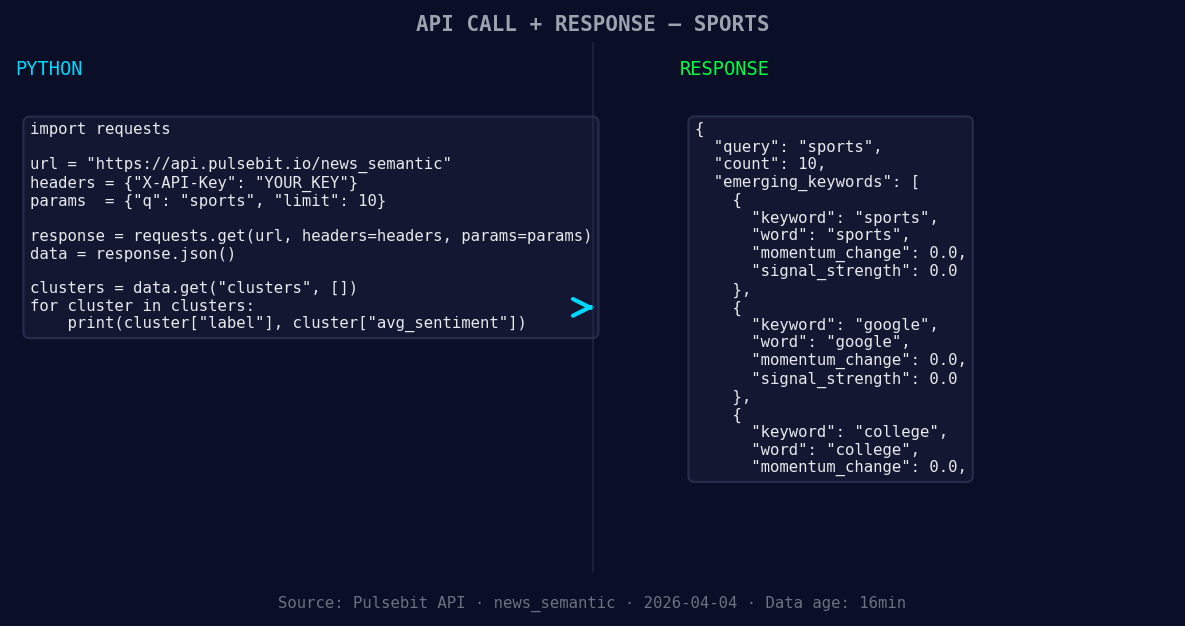
*Left: Python GET /news_semantic call for 'sports'. Right: returned JSON response structure (clusters: 3). Source: Pulsebit /news_semantic.*
# Make the API call to get the sentiment data
response = requests.get('https://api.pulsebit.com/sentiment', params=params)
sports_sentiment_data = response.json()
print(sports_sentiment_data)
Now, let’s run the cluster reason string through our sentiment scoring endpoint:
# Define the cluster reason for meta-sentiment analysis
cluster_reason = "Clustered by shared themes: waltair, division, sports, mela, gets."

# Make the API call to score the narrative framing itself
meta_sentiment_response = requests.post('https://api.pulsebit.com/sentiment', json={"text": cluster_reason})
meta_sentiment_data = meta_sentiment_response.json()
print(meta_sentiment_data)
This approach not only captures the recent sentiment spike but also evaluates the underlying narratives that are framing these conversations.
Three Builds Tonight
Here are three specific builds you can implement tonight using this pattern:
- Geo-Filter on Sports Sentiment: Use the geographic origin filter to analyze sentiment from Spanish-speaking regions only. Set a threshold of sentiment score > +0.15 to capture emerging trends in sports discussions that may influence your models.

Geographic detection output for sports. India leads with 6 articles and sentiment +0.30. Source: Pulsebit /news_recent geographic fields.
Meta-Sentiment Loop: Create a loop to continuously analyze cluster narratives. Use a threshold of confidence > 0.80 to ensure you’re only acting on reliable sentiment scores. This will allow you to stay ahead of the narrative shifts in the sports sector.
Forming Themes Analysis: Monitor forming themes in sports, Google, and college narratives. Use our API to track sentiment scores against mainstream narratives like waltair and division, focusing on a threshold of sentiment change > +0.10 to catch early signals of emerging trends.
Get Started
Ready to dive in? Visit pulsebit.lojenterprise.com/docs and start implementing these insights. The best part? You can copy-paste and run this in under 10 minutes. Don’t let sentiment shifts catch you off guard again!


Top comments (0)