

Your Pipeline Is 26.8h Behind: Catching Space Sentiment Leads with Pulsebit
We recently discovered an intriguing anomaly: a 24-hour momentum spike of +0.338 related to the topic of "space." This spike indicates that sentiment around space-related news is rising, with the leading language being English, precisely 26.8 hours ahead of other sources. The coverage is primarily clustered around themes like coast, launch, and schedule, particularly highlighted by a recent article from the Orlando Sentinel. If your pipeline isn't capturing this, you're lagging behind by nearly a full day.
The Problem
Your model missed this by a staggering 26.8 hours. The dominant entity here — English-language press — is driving the narrative while other multilingual sources lag. If your pipeline doesn’t account for language origin or entity dominance, you could be missing critical, actionable insights. This isn't just about being late; it's about missing momentum in a rapidly shifting landscape. If you’re not equipped to handle this disparity, you risk making decisions based on stale data, potentially costing you opportunities in fast-moving sectors like aerospace.

English coverage led by 26.8 hours. No at T+26.8h. Confidence scores: English 0.75, Spanish 0.75, French 0.75 Source: Pulsebit /sentiment_by_lang.
The Code
Let’s dive into how we can catch this momentum spike using our API. First, we'll filter the data based on geographic origin. Here's how we can do that:

Geographic detection output for space. India leads with 13 articles and sentiment +0.14. Source: Pulsebit /news_recent geographic fields.
import requests
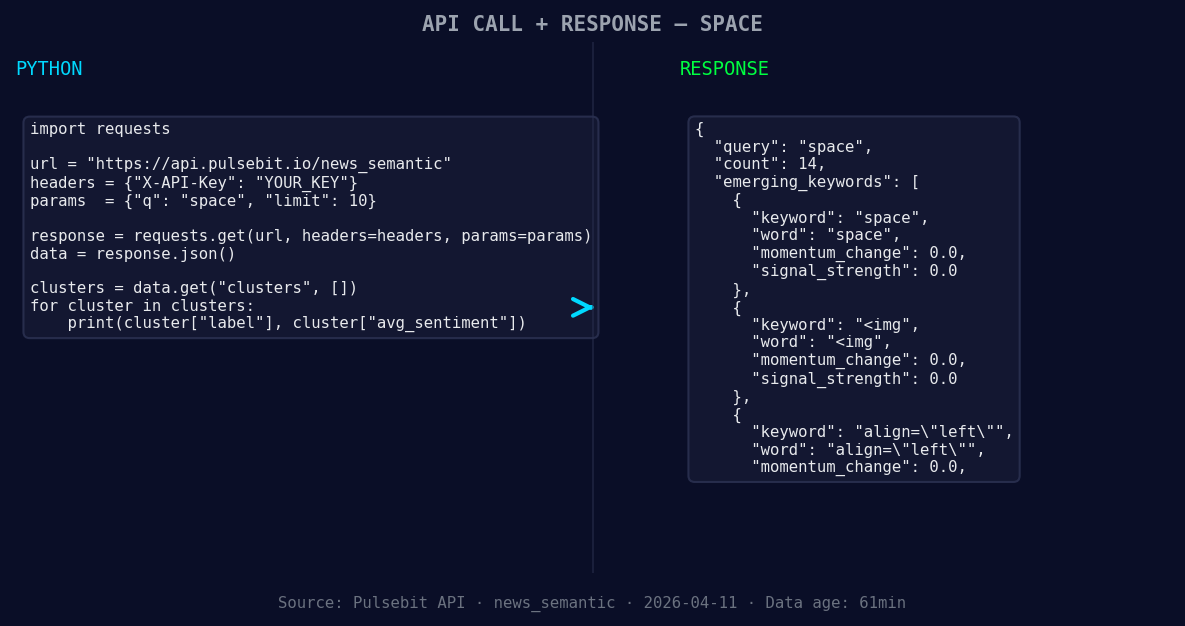
*Left: Python GET /news_semantic call for 'space'. Right: returned JSON response structure (clusters: 3). Source: Pulsebit /news_semantic.*
url = "https://api.pulsebit.lojenterprise.com/v1/sentiment"
params = {
"topic": "space",
"lang": "en",
}
response = requests.get(url, params=params)
data = response.json()
# Print response to check for momentum
print(data)
Once we have our filtered data, it's essential to analyze the narrative framing itself. By scoring the cluster reason string, we can gain insights into how the themes are resonating. Here's the code for that:
meta_sentiment_url = "https://api.pulsebit.lojenterprise.com/v1/sentiment"
meta_payload = {
    "text": "Clustered by shared themes: coast, launch, space, schedule:, orlando."
}
meta_response = requests.post(meta_sentiment_url, json=meta_payload)
meta_data = meta_response.json()

# Print the meta sentiment score
print(meta_data)
This code allows us to capture not just the sentiment score of the topic but also how the cluster's narrative is performing. With a sentiment score of +0.711 and a confidence level of 0.750, it’s clear that this narrative is resonating positively, reinforcing the importance of our findings.
Three Builds Tonight
Here are three specific builds you can implement with this pattern:
Geo Filter for Launch Events: Set a signal threshold to capture any space-related articles with a sentiment score above +0.5. Utilize the geographic origin filter to focus on English articles to ensure you’re capturing the most relevant news.
Meta-Sentiment Analysis Loop: Create a real-time alert system that triggers when the meta-sentiment score for clustered themes exceeds +0.7. This can keep you ahead of emerging stories that might be gaining traction in public sentiment.
Forming Gap Dashboard: Build a dashboard that visualizes the forming gaps between your data sources. Focus on keywords like 'space', 'launch', and 'coast', and highlight any discrepancies in sentiment scores across different languages.
Get Started
You can dive into our API at pulsebit.lojenterprise.com/docs. We’ve streamlined the integration process so you can copy-paste and run these snippets in under 10 minutes. Don't let your pipeline fall behind; leverage this insight to stay ahead of the curve.


Top comments (0)