

Your Pipeline Is 26.4h Behind: Catching Healthcare Sentiment Leads with Pulsebit
We just unearthed a fascinating anomaly: a 24-hour momentum spike of +0.985 in healthcare sentiment. This spike is particularly intriguing because it’s been led by English press coverage, which is currently sitting at a 0.0-hour lag compared to Hindi, clocking in at 26.4 hours. What does this mean? It highlights a critical gap in how we process multilingual data and detect emerging sentiment trends.

English coverage led by 26.4 hours. Hindi at T+26.4h. Confidence scores: English 0.90, Spanish 0.90, French 0.90 Source: Pulsebit /sentiment_by_lang.
If your pipeline isn't equipped to handle the nuances of multilingual sources, you might be missing out on significant insights. In this case, your model missed a key opportunity to capture the healthcare narrative by over 26 hours. That’s a lot of time when sentiment is shifting rapidly, especially when English-language articles are driving the conversation. If you’re not tracking these leading indicators, your insights could be stale by the time they reach you.
To catch this momentum spike, here’s how we can leverage our API effectively. First, we’ll filter for English-language articles to ensure that we're capturing the right sentiment. Here's the Python code to do just that:
import requests
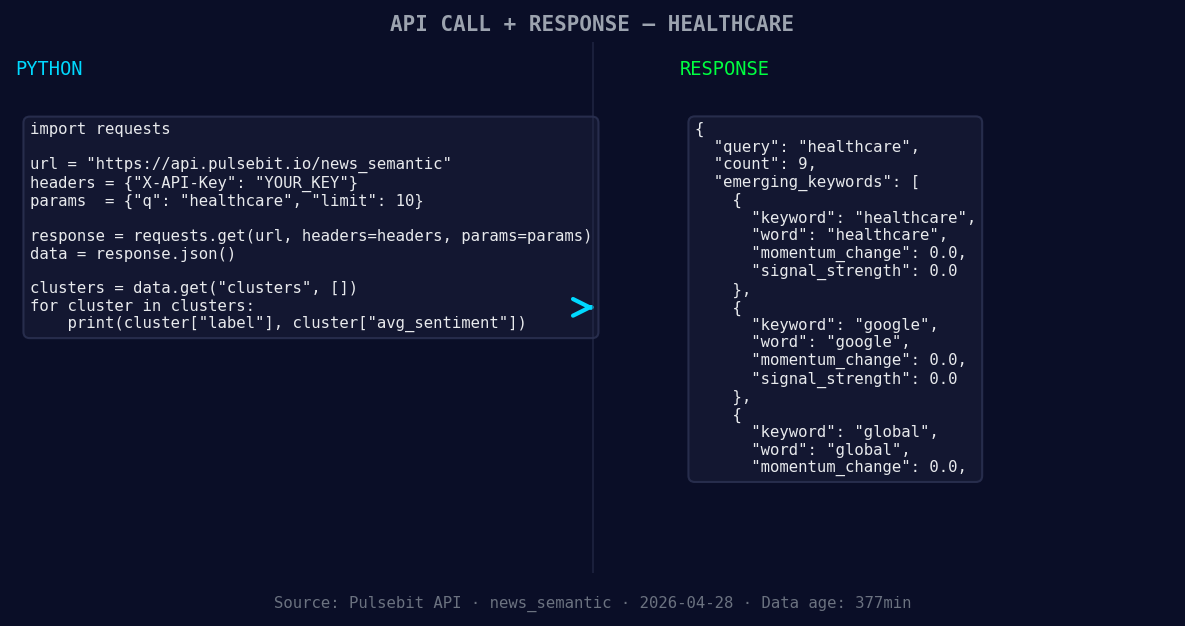
*Left: Python GET /news_semantic call for 'healthcare'. Right: returned JSON response structure (clusters: 3). Source: Pulsebit /news_semantic.*
# Define our parameters
topic = 'healthcare'
score = -0.800
confidence = 0.90
momentum = +0.985
lang = 'en'
# Step 1: Geographic origin filter
url = f"https://api.pulsebit.io/v1/sentiment?topic={topic}&lang={lang}"
response = requests.get(url)
data = response.json()
print(data)
Next, we need to analyze the narrative framing of the clustered stories. We’ll run the reason string back through the sentiment endpoint to evaluate how the themes are shaping the overall sentiment score. Here’s how we do that:
# Step 2: Meta-sentiment moment
cluster_reason = "Clustered by shared themes: healthcare, telangana, chief, minister, hyderabad."
meta_sentiment_url = "https://api.pulsebit.io/v1/sentiment"
meta_response = requests.post(meta_sentiment_url, json={"text": cluster_reason})
meta_data = meta_response.json()

print(meta_data)
With this code, you can directly fetch insights on how narratives are forming around critical topics. In our case, the themes emerging are focused on healthcare, with a notable absence of mainstream coverage around Telangana and its chief minister. This is a clear signal that we need to pay attention to.
Now, let’s talk about three specific builds you can implement using this momentum spike:
- Signal Detection: Set a threshold of +0.900 for healthcare sentiment. Use the geographic filter mentioned above to ensure you’re tracking sentiment from English-language sources. This will help you catch rising narratives before they hit the mainstream.

Geographic detection output for healthcare. India leads with 6 articles and sentiment +0.57. Source: Pulsebit /news_recent geographic fields.
Meta-Sentiment Loop: Use the sentiment scoring from the cluster reason strings to create a dynamic feedback loop. For instance, when you see a cluster like “healthcare, google, global,” run it through our sentiment endpoint to score how this narrative influences public perception over time.
Gap Analysis: Compare sentiment scores between regions and languages. For instance, analyze how English sentiment on healthcare compares to that in Hindi. This can reveal underlying trends that may not be obvious otherwise, such as a forming gap around the themes of healthcare and governance.
By leveraging these insights, you can ensure your data pipeline stays ahead of the curve, catching emerging trends before they become mainstream.
Ready to get started? Check out our API documentation at pulsebit.lojenterprise.com/docs. You can copy-paste and run this code in under 10 minutes, giving you a powerful edge in sentiment analysis.


Top comments (0)