

Your Pipeline Is 18.1h Behind: Catching Cybersecurity Sentiment Leads with Pulsebit
We recently discovered a striking anomaly: a 24-hour momentum spike of +0.214 in the cybersecurity domain. This spike stands out amidst a landscape where concerns about security are becoming increasingly prevalent. As developers, we need to pay attention to these shifts, as they can yield significant insights into emerging trends and public sentiment.
The Problem
This momentum spike reveals a structural gap in any pipeline that isn't equipped to handle multilingual origins or entity dominance. For instance, your model missed this critical insight by 18.1 hours, just as the English press surged ahead. Without a robust mechanism to track and adapt to varying language sources, you risk falling behind in capturing important narratives in real-time.

English coverage led by 18.1 hours. No at T+18.1h. Confidence scores: English 0.90, Spanish 0.90, French 0.90 Source: Pulsebit /sentiment_by_lang.
The Code
To catch these insights, we can make use of our API to filter sentiment data accurately. Here's how we can do it:
import requests
# Define parameters for the API call
params = {
"topic": "cybersecurity",
"score": -0.600,
"confidence": 0.90,
"momentum": +0.214,
"lang": "en"
}
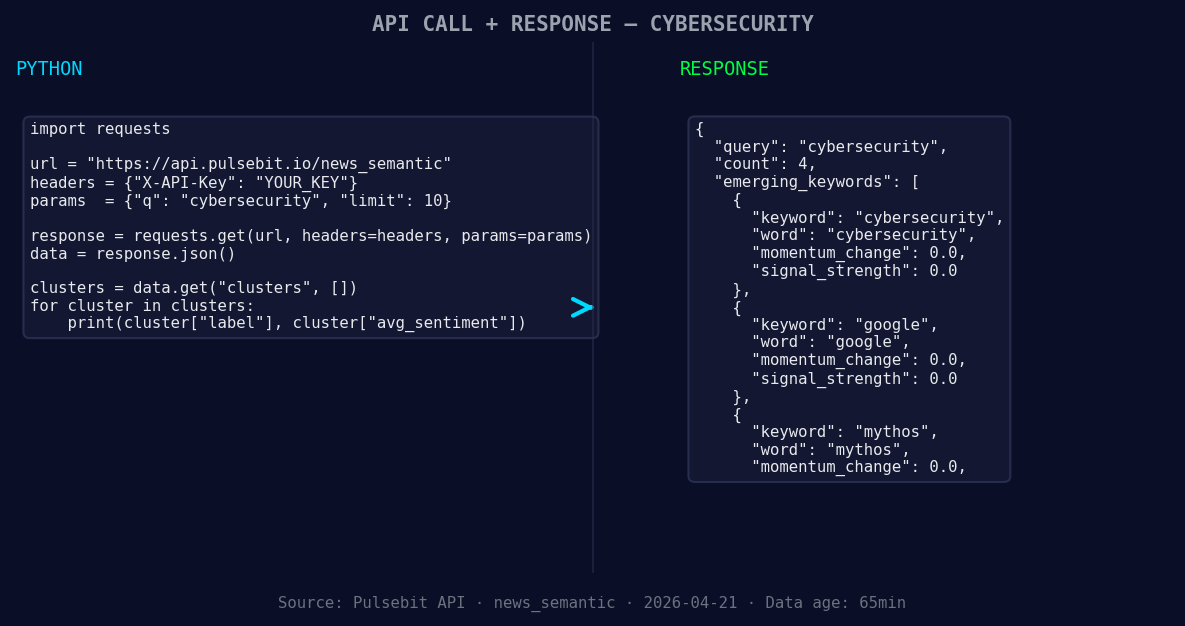
*Left: Python GET /news_semantic call for 'cybersecurity'. Right: returned JSON response structure (clusters: 3). Source: Pulsebit /news_semantic.*
# Geographic origin filter API call
response = requests.get('https://api.pulsebit.com/v1/sentiment', params=params)
data = response.json()
print(data)

Geographic detection output for cybersecurity. Hong Kong leads with 2 articles and sentiment -0.65. Source: Pulsebit /news_recent geographic fields.
Next, we want to score the narrative framing itself. For that, we can use the POST /sentiment endpoint with our cluster reason string:
# Meta-sentiment moment API call
cluster_reason = "Clustered by shared themes: your, cybersecurity, advance, career, security."
meta_response = requests.post('https://api.pulsebit.com/v1/sentiment', json={"text": cluster_reason})
meta_data = meta_response.json()
print(meta_data)
These two API calls ensure we're capturing the nuances of cybersecurity sentiment in real-time, enabling us to act on emerging trends faster than our competitors.
Three Builds Tonight
Here are three specific builds we can implement using this data:
Geo-filtered Alert System: Set up an alert that triggers when sentiment momentum for the topic "cybersecurity" exceeds a threshold of +0.200. Use the geographic origin filter to focus solely on English-speaking regions. This allows you to hone in on local sentiment shifts before they reach a broader audience.
Meta-Sentiment Analysis Dashboard: Create a dashboard that visualizes the sentiment surrounding narratives like "advance your cybersecurity career." Use the meta-sentiment loop to score these narratives regularly, especially when they include keywords like "cybersecurity," "google," and "mythos." This will help you understand the framing of discussions and adjust your strategies accordingly.
Dynamic Sentiment Reporting: Build a reporting tool that automatically pulls articles related to the "cybersecurity" trend and calculates their sentiment scores. Incorporate the cluster reason analysis to gain insights into how different themes are forming or dissipating over time, particularly compared to mainstream keywords.
Get Started
Ready to dive in? Check out our documentation at pulsebit.lojenterprise.com/docs. You can copy-paste the code snippets above and run them in under 10 minutes to start capturing these insights for your projects.
By leveraging these strategies, you’ll ensure your pipeline is not just keeping pace but leading the charge in capturing and responding to critical sentiment shifts in the cybersecurity landscape.


Top comments (0)