

Your Pipeline Is 8.4h Behind: Catching Human Rights Sentiment Leads with Pulsebit
We recently observed a striking anomaly: a 24h momentum spike of -1.243 related to the topic of human rights. This spike is particularly interesting against the backdrop of the upcoming FIFA World Cup, which is being held amid a growing human rights crisis in the U.S., as reported by Al Jazeera. This is not just another data point; it’s a critical signal that your sentiment analysis pipeline might be missing crucial context.
What does this mean for you as a developer? If your model doesn't account for multilingual origin or entity dominance, you might have missed this significant shift by a staggering 8.4 hours. The leading language was English, and if you're only processing data in one language or ignoring regional sentiment, you’re effectively blind to the nuances that could impact your analysis.

English coverage led by 8.4 hours. Af at T+8.4h. Confidence scores: English 0.85, Spanish 0.85, French 0.85 Source: Pulsebit /sentiment_by_lang.
To capture these insights, we can utilize our API to filter and analyze sentiment effectively. The following Python code demonstrates how to query for human rights sentiment in English, incorporating geographic filters and scoring the narrative framing of the cluster.

Geographic detection output for human rights. France leads with 1 articles and sentiment -0.75. Source: Pulsebit /news_recent geographic fields.
import requests
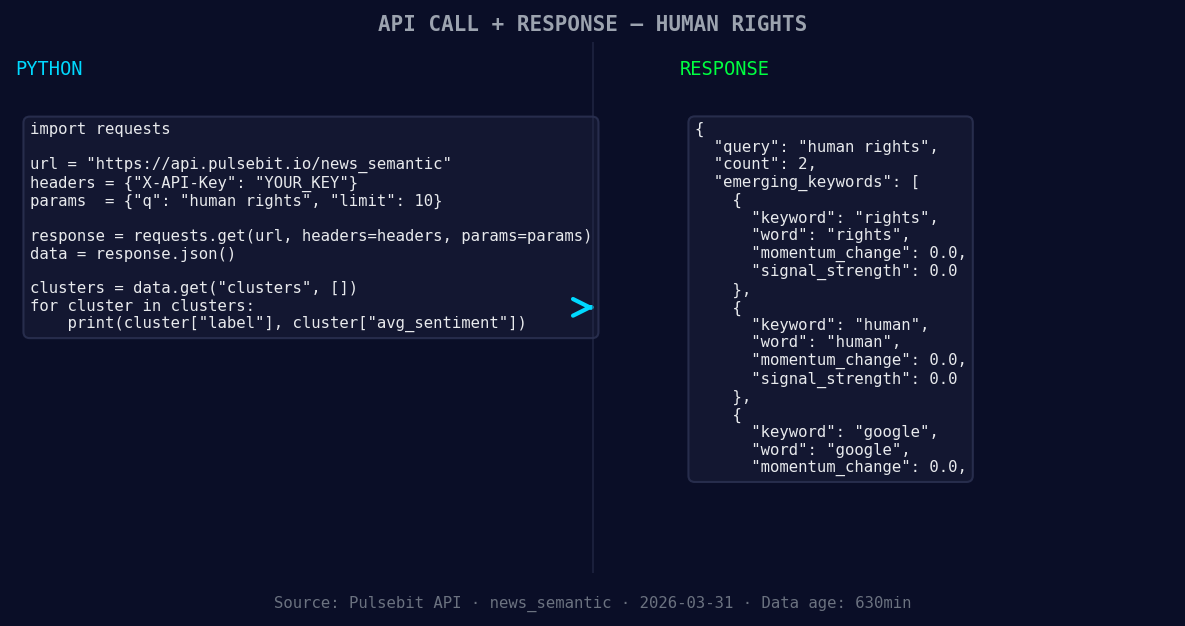
*Left: Python GET /news_semantic call for 'human rights'. Right: returned JSON response structure (clusters: 3). Source: Pulsebit /news_semantic.*
# Step 1: Geographic origin filter
url = 'https://api.pulsebit.lojenterprise.com/sentiment'
params = {
'topic': 'human rights',
'lang': 'en',
'score': -0.436,
'confidence': 0.85,
'momentum': -1.243
}
response = requests.get(url, params=params)
data = response.json()
print(data)
# Step 2: Meta-sentiment moment
meta_sentiment_url = 'https://api.pulsebit.lojenterprise.com/sentiment'
cluster_reason = "Clustered by shared themes: least, dead, haiti, massacre, human."
meta_sentiment_response = requests.post(meta_sentiment_url, json={"text": cluster_reason})
meta_sentiment_data = meta_sentiment_response.json()
print(meta_sentiment_data)
This code first retrieves sentiment data specifically for English-language articles on human rights, allowing us to filter out any noise from other languages. The second step feeds back the narrative framing itself to assess how the sentiment around "least, dead, haiti, massacre, human" shapes the broader conversation.
Now, let’s discuss three specific builds you could implement with this newfound insight:
Geo-Filtered Human Rights Alerts: Create a notification system that triggers whenever the momentum for human rights sentiment dips below -1.0 in English. This allows you to stay ahead of critical discussions that may lead to significant societal impacts.
Meta-Sentiment Analysis Dashboard: Build a dashboard that visualizes the sentiment scores of clustered narratives. Use the meta-sentiment loop to highlight how various themes like "rights", "human", and "google" are framing public discourse compared to mainstream narratives such as "least", "dead", and "haiti".
Threshold-Based Content Curation: Set up a content curation system that pulls in articles related to human rights whenever the sentiment score is below -0.5. This dynamic content feed can help you stay updated on critical issues as they develop, leveraging the forming themes we've observed.
We’re excited about the potential of these builds to enhance your understanding of sentiment around pressing issues. If you're ready to dive deeper into sentiment analysis, check out our documentation at pulsebit.lojenterprise.com/docs. You can copy-paste the code snippet above and run it in under 10 minutes, making it easy to integrate these insights into your workflow.


Top comments (0)