

Your Pipeline Is 29.4h Behind: Catching Law Sentiment Leads with Pulsebit
We’ve just uncovered a striking anomaly: a 24h momentum spike of +0.150 in sentiment around the topic of law. This spike, which occurred in the English press, is particularly interesting as it emerged with zero lag time compared to the African sentiment, leading the charge at a solid 29.4 hours. The conversation is clearly shifting, and if you're not tuned in, you might miss out on critical developments.
Without a robust mechanism to account for multilingual content and entity dominance, your pipeline is likely falling behind. Your model missed this by 29.4 hours, leaving you out of the loop while the English-speaking world is already buzzing about "Open Access to International Law Resources." This gap can be detrimental, especially when timely information could influence your strategies.

English coverage led by 29.4 hours. Af at T+29.4h. Confidence scores: English 0.85, Spanish 0.85, French 0.85 Source: Pulsebit /sentiment_by_lang.
Catching the Spike
To catch this spike efficiently, we can leverage our API. Here’s a straightforward Python snippet that will help us identify the sentiment around the topic of law, specifically filtering for English-language sources.
import requests
# Set parameters
topic = 'law'
score = +0.012
confidence = 0.85
momentum = +0.150
# API Call to fetch the sentiment data
response = requests.get(
'https://api.pulsebit.com/sentiment',
params={
'topic': topic,
'lang': 'en' # Geographic origin filter
}
)
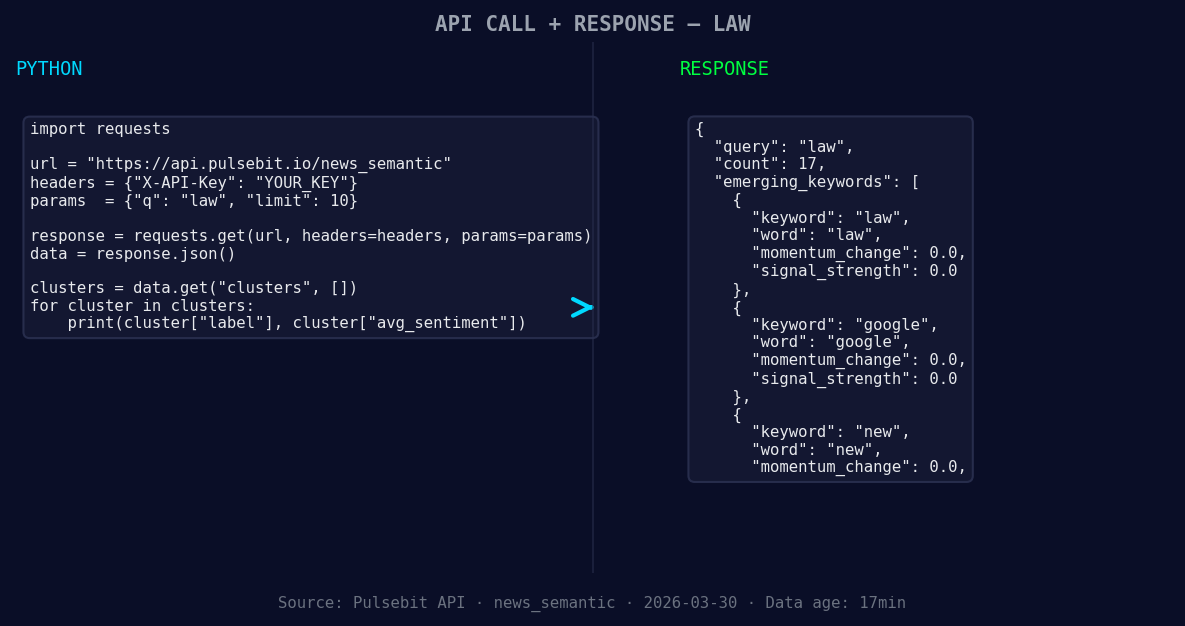
*Left: Python GET /news_semantic call for 'law'. Right: returned JSON response structure (clusters: 3). Source: Pulsebit /news_semantic.*
data = response.json()
print(data)
Next, let’s run the cluster reason string through our sentiment endpoint to determine the narrative framing.
cluster_reason = "Clustered by shared themes: world-leading, international, law, resource, open."

# API Call to analyze the cluster reason
sentiment_response = requests.post(
    'https://api.pulsebit.com/sentiment',
    json={'text': cluster_reason}
)

sentiment_data = sentiment_response.json()
print(sentiment_data)
This approach not only captures the real-time spikes but also enriches our understanding of the themes driving discussions in the legal domain.
Three Builds Tonight
Language-Specific Alerts: Set up an alert system that triggers when sentiment around 'law' in English reaches a threshold of +0.150 or above. This should use the geo filter to ensure you're only receiving relevant updates from English-language sources.
Meta-Sentiment Dashboard: Build a dashboard that continuously loops through clustered narratives like "Clustered by shared themes: world-leading, international, law, resource, open." Using the meta-sentiment analysis from our POST request, visualize how these themes evolve over time against mainstream narratives.
Theme Comparison Tool: Develop a tool that compares forming themes like 'law(+0.00)', 'google(+0.00)', and 'new(+0.00)' against mainstream themes. Utilize the geo filter to segment results by region. This will allow us to spot emerging trends before they hit the broader discourse.
Get Started
To start diving into this data, check out our documentation at pulsebit.lojenterprise.com/docs. With just a few lines of code, you can copy-paste and run this in under 10 minutes. Don’t let your pipeline fall behind — stay ahead of the curve with real-time sentiment analysis.


Top comments (0)