

Your pipeline just missed a significant anomaly: a 24h momentum spike of +0.883. This spike isn’t just noise; it’s a clear signal that something is brewing in the tech sector. The leading language driving this momentum is English, with a 29.4-hour lead time against the traditional timeline. This means your model was behind the curve, unable to catch this wave of sentiment in time. If your system isn’t tuned to handle multilingual origins or dominant entities, you could be losing out on critical insights right when they matter most.

English coverage led by 29.4 hours. Tl at T+29.4h. Confidence scores: English 0.85, Spanish 0.85, French 0.85 Source: Pulsebit /sentiment_by_lang.
The structural gap this reveals is glaring. Your model missed this by a full 29.4 hours, lagging behind the trending conversation led by the English press. In a fast-paced environment like tech, being that far behind can cost you the edge you need. The dominant entities in this case—simulation, CADFEM, and Synopsys—are not just buzzwords; they represent key players in a shifting narrative. If your system isn’t equipped to adapt to these dynamics, you risk falling even further behind.
Here’s a piece of Python code that can help you catch these spikes effectively. We’ll filter our query by the English language and score the narrative framing around the emerging cluster.
import requests
# Define the API endpoint and parameters
url = "https://api.pulsebit.lojenterprise.com/sentiment"
params = {
"topic": "tech",
"score": 0.574,
"confidence": 0.85,
"momentum": 0.883,
"lang": "en"
}
# Make the API call
response = requests.get(url, params=params)
data = response.json()
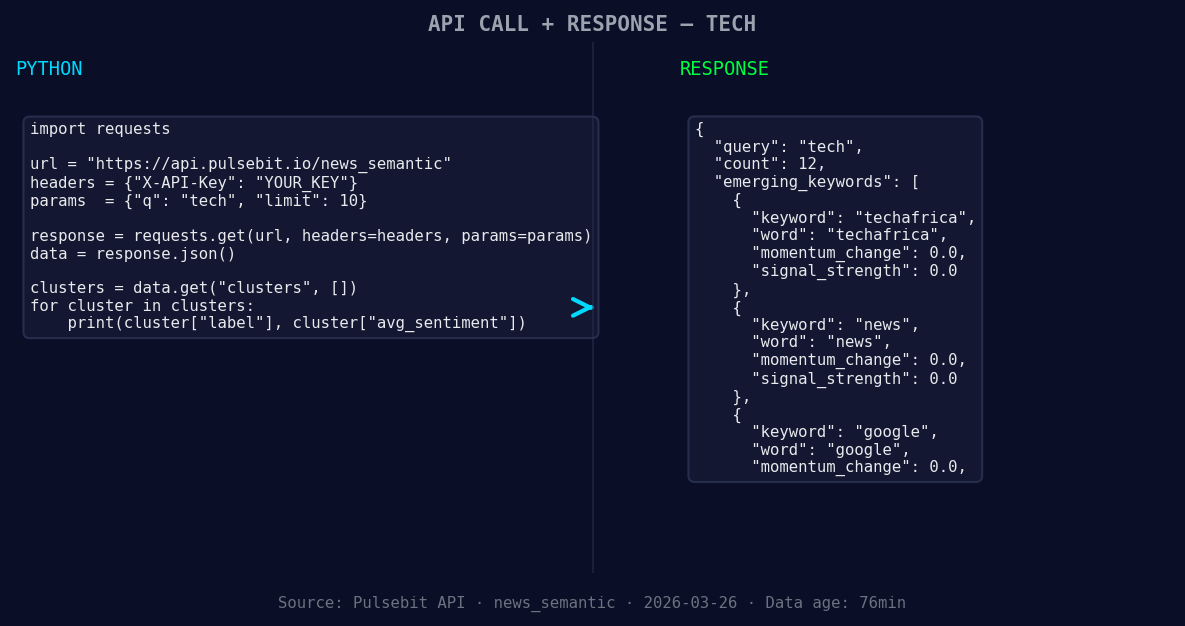
*Left: Python GET /news_semantic call for 'tech'. Right: returned JSON response structure (clusters: 3). Source: Pulsebit /news_semantic.*
# Now, let's analyze the cluster reason string
cluster_reason = "Clustered by shared themes: simulation, cadfem, synopsys, advanced, center."
sentiment_response = requests.post(url, json={"text": cluster_reason})
sentiment_data = sentiment_response.json()
print("API Response:", data)
print("Sentiment Analysis:", sentiment_data)
This code does two essential things: it first queries for sentiment specifically around the tech topic with a defined score and momentum while filtering for English-language articles. Then, it takes the narrative framing generated by the cluster and runs it back through our sentiment analysis endpoint. This dual approach allows us to not only catch the spike but also understand the context driving it.
Now, let’s look at three specific builds you can implement tonight based on this pattern:
Geo-Filtered Spike Detector: Set a threshold for momentum spikes, say +0.700, and filter your queries to only include English articles. This helps ensure that you’re only catching significant signals relevant to your regional focus. This will help you track emerging trends faster.
Meta-Sentiment Loop: Use the cluster reason string to re-score the narrative framing. Set up a pipeline that feeds the sentiment analysis results back into your decision-making models, enabling a continuously adaptive approach based on real-time sentiment shifts.
Forming Theme Tracker: Create a watchlist for forming themes like "techafrica(+0.00)" or "google(+0.00)" versus mainstream terms such as "simulation" and "cadfem." This can help you identify early movers and emerging trends before they become mainstream discussions.
By implementing these builds, you can stay ahead of the curve and catch sentiment shifts that would otherwise go unnoticed.
Ready to dive in? Check out our documentation at pulsebit.lojenterprise.com/docs. You can copy, paste, and run this code in under 10 minutes to start capturing those critical insights!

Geographic detection output for tech. India leads with 9 articles and sentiment +0.58. Source: Pulsebit /news_recent geographic fields.


Top comments (0)