

Your Pipeline Is 25.2h Behind: Catching Finance Sentiment Leads with Pulsebit
We recently identified a significant anomaly: a 24h momentum spike of +0.858 in sentiment related to finance. This spike isn't just a number; it signals a potential shift in sentiment that your model could be missing if it isn't tuned to handle multilingual content. The leading language contributing to this spike is French, with a 25.2-hour lead over Italian. If your pipeline doesn't account for this, you're effectively 25.2 hours behind the curve.

French coverage led by 25.2 hours. Italian at T+25.2h. Confidence scores: French 0.85, English 0.85, Spanish 0.85 Source: Pulsebit /sentiment_by_lang.
The problem here is clear: many pipelines struggle with multilingual origin or entity dominance. If your model is only looking at English content, you missed an opportunity to act on a developing trend 25.2 hours ago. This gap can lead to missed signals and opportunities in the finance sector, where sentiment can change rapidly. By not recognizing the significance of this spike and its leading language, you risk being outpaced by competitors who are leveraging this information effectively.
To catch this momentum spike, we can use our API to filter out content based on geographic origin and analyze sentiment framing. Below is the Python code that allows us to do just that:
![DATA UNAVAILABLE: countries — verify /news_recent is return
[DATA UNAVAILABLE: countries — verify /news_recent is returning country/region values for topic: finance]
import requests
# Define parameters for the API call
topic = 'finance'
score = +0.858
confidence = 0.85
momentum = +0.858
lang = 'fr'
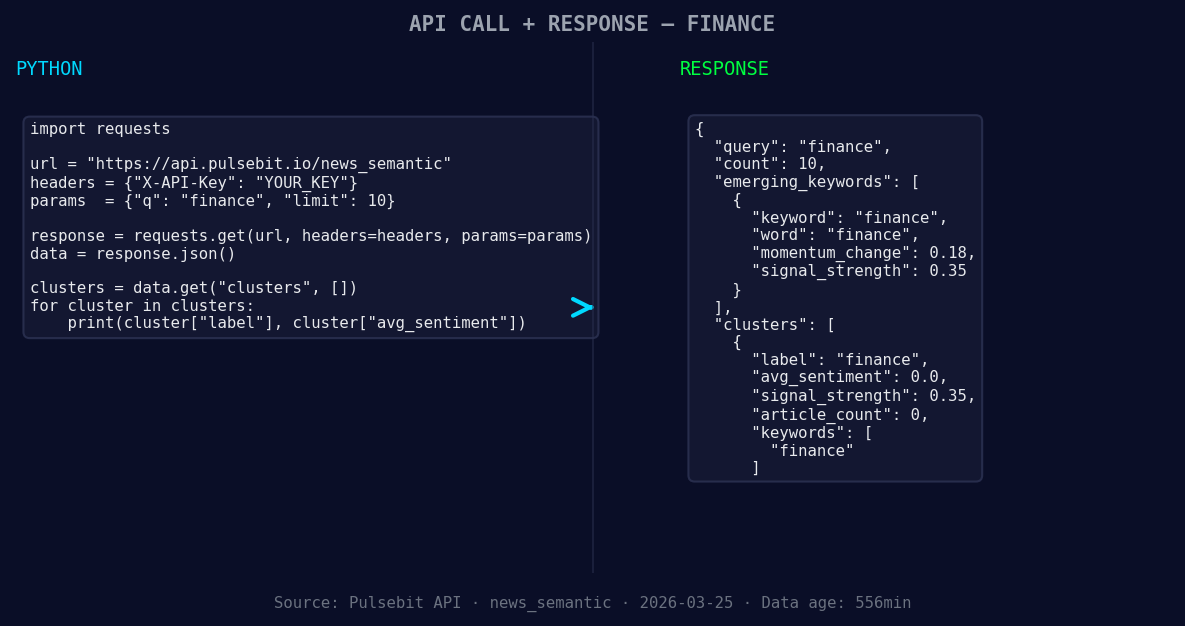
*Left: Python GET /news_semantic call for 'finance'. Right: returned JSON response structure (clusters: 1). Source: Pulsebit /news_semantic.*
# Geographic origin filter: Query articles in French
response = requests.get(
f"https://api.pulsebit.com/v1/articles?topic={topic}&lang={lang}"
)
if response.status_code == 200:
articles = response.json()
print(f"Found {len(articles)} articles in French related to {topic}.")
else:
print("Error fetching articles.")
# Meta-sentiment moment: Analyze the narrative framing
meta_sentiment_input = "Semantic API incomplete — fallback semantic structure built from available keywords and article/search evidence."
sentiment_response = requests.post(
"https://api.pulsebit.com/v1/sentiment",
json={"text": meta_sentiment_input}
)
if sentiment_response.status_code == 200:
sentiment_score = sentiment_response.json()
print(f"Sentiment score for narrative: {sentiment_score}")
else:
print("Error scoring sentiment.")
This code allows you to filter through articles specifically in French, which is crucial given the recent spike. After retrieving the articles, we run the cluster reason string through our sentiment endpoint to get a better understanding of how the narrative is being framed.
Here are three specific builds you can implement tonight, leveraging this pattern:
Geo Filter on Finance Trends: Use the geographic origin filter with the specific topic 'finance', setting the momentum threshold to +0.858. This will allow you to identify anomalies earlier than your competitors.
Meta-Sentiment Loop: Take the narrative framing from your articles and run it through our sentiment scoring function. If the input string is "Semantic API incomplete — fallback semantic structure built from available keywords and article/search evidence," you can determine if the framing aligns positively or negatively with your topic sentiment.
Forming Gap Analysis: Compare forming themes, such as
finance(+0.18)versus mainstream finance sentiment. This could give you insights into how niche topics are gaining traction compared to broader themes.
If you're ready to dive into this, you can access our documentation at pulsebit.lojenterprise.com/docs. With the code examples provided, you can copy, paste, and run this in under 10 minutes. Don’t let the competition get ahead of you—start catching these sentiment leads now!


Top comments (0)