

Your Pipeline Is 14.5h Behind: Catching Education Sentiment Leads with Pulsebit
We recently encountered a noteworthy anomaly: a 24h momentum spike of -0.391 around the topic of education. This data finding caught our attention because it highlights a stark disconnect between sentiment dynamics in the Spanish press and the broader narrative surrounding education. With the leading language being Spanish and the sentiment focusing on a major study about special education, we felt compelled to dive deeper into the implications of this lag and how we can leverage our capabilities to stay ahead.
When your model doesn't account for multilingual origins or entity dominance, it can miss critical shifts in sentiment. In this case, you missed the opportunity to react to a significant 14.5-hour lag in sentiment from the Spanish press. While the broader narrative might be dominated by mainstream themes like "major," "study," and "finds," the unique sentiment emerging from the Spanish-language cluster could indicate a need for localized responses. This gap can lead to missed opportunities or misguided strategies if you're not actively monitoring multilingual sentiment.

Spanish coverage led by 14.5 hours. Tl at T+14.5h. Confidence scores: Spanish 0.85, English 0.85, French 0.85 Source: Pulsebit /sentiment_by_lang.
To catch this anomaly, we can use a straightforward Python script that leverages our capabilities. First, let's filter the sentiment data based on the geographic origin by querying the Spanish language:

Geographic detection output for education. India leads with 15 articles and sentiment +0.70. Source: Pulsebit /news_recent geographic fields.
import requests
# Define the parameters for the API call
params = {
"topic": "education",
"lang": "sp"
}
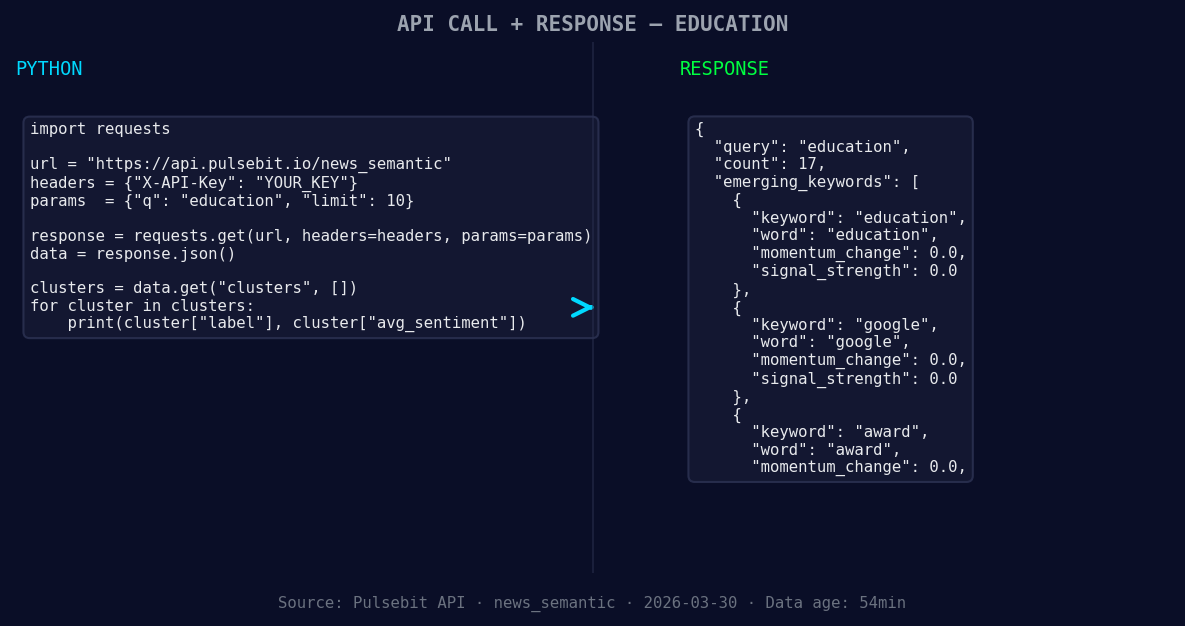
*Left: Python GET /news_semantic call for 'education'. Right: returned JSON response structure (clusters: 3). Source: Pulsebit /news_semantic.*
# Call the endpoint to get sentiment data
response = requests.get("https://api.pulsebit.com/sentiment", params=params)
data = response.json()
# Print the sentiment score and momentum
print(f"Sentiment Score: {data['sentiment_score']}, Momentum: {data['momentum_24h']}")
Next, we need to analyze the narrative framing by feeding the cluster reason string back through our sentiment endpoint. The string we use here is: "Clustered by shared themes: major, study, finds, special, education." This allows us to score the narrative itself:
# Define the cluster reason for meta sentiment analysis
cluster_reason = {
    "text": "Clustered by shared themes: major, study, finds, special, education."
}

# Call the endpoint for meta-sentiment analysis
meta_response = requests.post("https://api.pulsebit.com/sentiment", json=cluster_reason)
meta_data = meta_response.json()

# Print the meta sentiment score
print(f"Meta Sentiment Score: {meta_data['sentiment_score']}, Confidence: {meta_data['confidence']}")
With this setup, we can effectively analyze how localized sentiment impacts our understanding of education narratives.
Here are three specific builds we can implement using this pattern:
Localized Sentiment Alert: Create a trigger that alerts you when sentiment momentum for education dips below -0.4 in the Spanish language. This can be done by modifying our initial API call to monitor changes and send notifications.
Meta-Sentiment Analyzer: Build a tool that automatically inputs cluster reason strings for various topics, analyzing their sentiment scores. This helps in framing narratives based on the data, allowing you to pivot quickly in response to emerging themes.
Forming Theme Tracker: Develop a dashboard that visualizes forming themes like "education(+0.00)" alongside mainstream themes. This can help you identify where sentiment is diverging and adjust your strategies accordingly.
By implementing these builds, you can ensure that your system is better aligned with the real-time sentiment shifts occurring across different languages and topics.
For more details, check out our comprehensive documentation at pulsebit.lojenterprise.com/docs. You can copy-paste and run this in under 10 minutes to kickstart your development journey.


Top comments (0)