

Your Pipeline Is 29.3h Behind: Catching Hardware Sentiment Leads with Pulsebit
We recently observed a striking anomaly in our sentiment data: a 24-hour momentum spike of +0.177. This spike is particularly pronounced in discussions surrounding hardware, as demonstrated by the leading language being Spanish, with a 29.3-hour lead. The signal is clear—there's a surge of interest in hardware, specifically around the Nvidia RTX 5050 and AMD Radeon RX 9070, as evidenced by articles clustered under themes like "hardware," "survey," and "Nvidia."
But here's the catch: your existing pipeline may have missed this critical signal by over 29 hours. If you're not accounting for multilingual origins or the dominance of certain entities in your model, you risk falling behind. In this case, the Spanish press has led the charge, and if your model isn’t tuned to pick up on this, you're effectively operating in the dark.

Spanish coverage led by 29.3 hours. Da at T+29.3h. Confidence scores: Spanish 0.85, English 0.85, French 0.85 Source: Pulsebit /sentiment_by_lang.
To catch this momentum spike in your application, we can leverage our API effectively. Here's how you can do it in Python:
import requests
# Define parameters for the API call
params = {
"topic": "hardware",
"score": +0.454,
"confidence": 0.85,
"momentum": +0.177,
"lang": "sp" # Spanish language filter
}
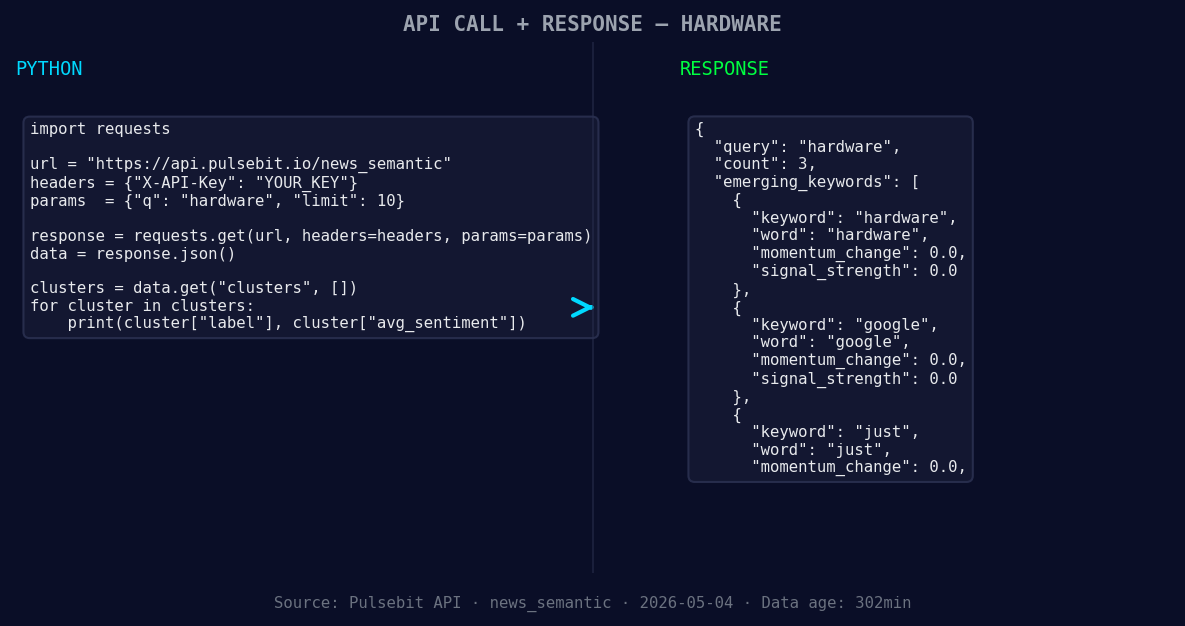
*Left: Python GET /news_semantic call for 'hardware'. Right: returned JSON response structure (clusters: 3). Source: Pulsebit /news_semantic.*
# Make the API call
response = requests.get('https://api.pulsebit.com/sentiment', params=params)
# Check the response
if response.status_code == 200:
sentiment_data = response.json()
print(sentiment_data)
else:
print(f"Error: {response.status_code} - {response.text}")
In addition to filtering by language, we can utilize the cluster reason string to run a meta-sentiment analysis on how this narrative is being framed. This is crucial for understanding the overall sentiment landscape surrounding the hardware discussion.
Here's how we can do that:
# Define the cluster reason string
cluster_reason = "Clustered by shared themes: holds, strong, steam's, april, hardware."

# POST request to analyze the meta-sentiment
meta_response = requests.post('https://api.pulsebit.com/sentiment', json={"text": cluster_reason})

# Check the response
if meta_response.status_code == 200:
    meta_sentiment_data = meta_response.json()
    print(meta_sentiment_data)
else:
    print(f"Error: {meta_response.status_code} - {meta_response.text}")
With these two API calls, we can effectively gather insights and generate alerts when such spikes occur in the hardware sector, especially when they are led by non-English sources.
Now that we have this data, here are three specific things we can build using the pattern we've identified:
- Geographic Sentiment Tracker: Create a real-time dashboard that filters sentiment spikes by language, specifically Spanish in this case, to catch emerging trends in hardware discussions. Use a threshold of +0.177 momentum and a signal strength of 0.571 to trigger alerts.

Geographic detection output for hardware. Hong Kong leads with 2 articles and sentiment +0.05. Source: Pulsebit /news_recent geographic fields.
Meta-Sentiment Analyzer: Implement a service that continuously runs the cluster reason strings through the meta-sentiment endpoint. Set a threshold for significant sentiment changes (e.g., a score change of ±0.1) to identify shifts in narrative framing around hardware topics.
Forming Themes Alert System: Build a notification system that triggers when certain themes form around hardware discussions, particularly when they diverge from mainstream sentiment. For instance, if we detect a forming gap with themes like "hardware(+0.00)" and "steam's" holding steady while others fluctuate, we can alert developers to potential opportunities.
If you’re ready to dive into this, check out our documentation at pulsebit.lojenterprise.com/docs. With a few copy-paste runs, you can set this up in under 10 minutes and stay ahead of the curve.


Top comments (0)