

Your Pipeline Is 16.4h Behind: Catching Renewable Energy Sentiment Leads with Pulsebit
We recently observed an intriguing anomaly in our data: a 24-hour momentum spike of -0.347 concerning renewable energy sentiment. This negative momentum suggests that while the topic is generally gaining traction, there’s a notable shift happening right now. With the leading language being English and a 16.4-hour head start in sentiment reporting, we can pinpoint a disconnect in how timely sentiment analysis is being handled in our pipelines.
A crucial gap in your model may be its inability to effectively manage multilingual data sources or recognize entity dominance. If your pipeline isn’t set up to handle these aspects, you may have missed this trend by 16.4 hours. The leading entity in this case is English press, which is crucial for understanding the narrative surrounding renewable energy. Ignoring these factors can lead to delayed insights, preventing you from responding to emerging trends in real-time.

English coverage led by 16.4 hours. Nl at T+16.4h. Confidence scores: English 0.80, Spanish 0.80, French 0.80 Source: Pulsebit /sentiment_by_lang.
Here’s how you can catch this sentiment shift using Python and our API. First, let’s filter for English language articles related to renewable energy. We’ll set a score of +0.700 and a confidence level of 0.80 to ensure we’re focusing on reliable data.
import requests
# Define parameters for the API call
params = {
"topic": "renewable energy",
"score": 0.700,
"confidence": 0.80,
"momentum": -0.347,
"lang": "en"
}
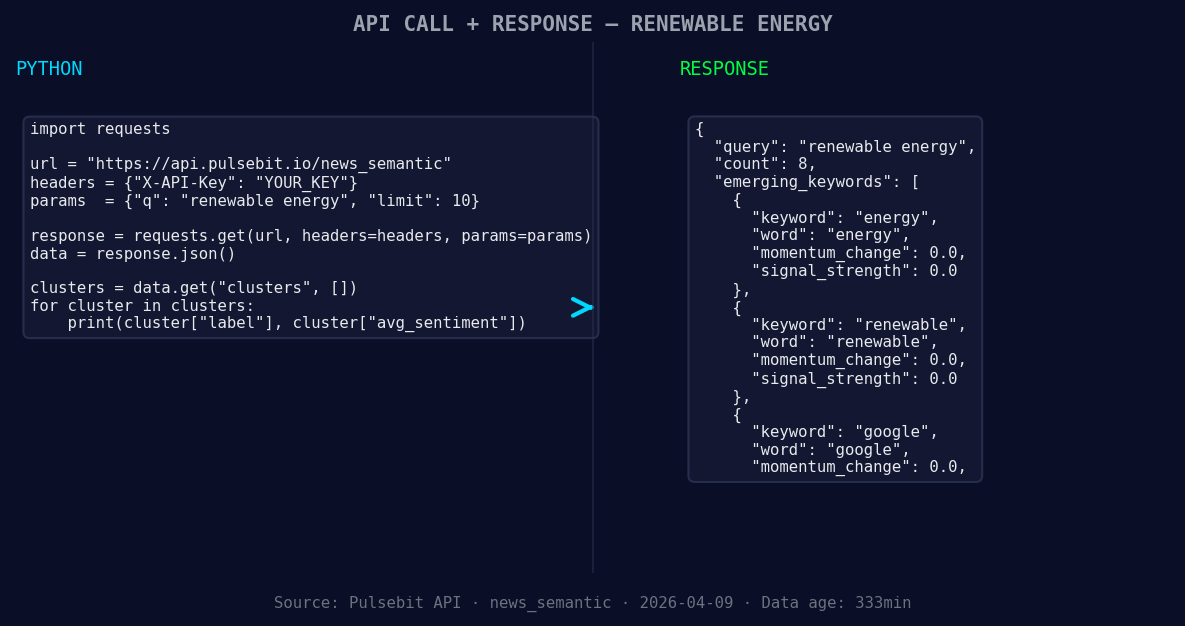
*Left: Python GET /news_semantic call for 'renewable energy'. Right: returned JSON response structure (clusters: 3). Source: Pulsebit /news_semantic.*
# API call to get sentiment data
response = requests.get("https://api.pulsebit.com/sentiment", params=params)
sentiment_data = response.json()
print(sentiment_data)
Next, we’ll run the cluster reason string back through our sentiment endpoint to analyze the narrative framing. This is where it gets interesting. The string “Clustered by shared themes: signals:, renewable, energy, powers, connectivity.” is a critical part of the analysis.
# Meta-sentiment analysis
meta_sentiment_payload = {
    "text": "Clustered by shared themes: signals:, renewable, energy, powers, connectivity."
}

# API call to score the narrative framing
meta_response = requests.post("https://api.pulsebit.com/sentiment", json=meta_sentiment_payload)
meta_sentiment_data = meta_response.json()
print(meta_sentiment_data)
With these two steps, you can effectively capture the trends around renewable energy and understand the sentiment landscape in real-time.
Let’s think about three specific builds you can implement with this pattern.
- Geographic Sentiment Analysis: Create a pipeline that filters sentiment by geographic origin, specifically targeting English-speaking regions. Use the momentum score to set a threshold, triggering alerts when the score falls below -0.300.

Geographic detection output for renewable energy. India leads with 4 articles and sentiment +0.59. Source: Pulsebit /news_recent geographic fields.
Meta-Sentiment Loop: Implement a continuous loop that runs the narrative framing through our sentiment endpoint every hour. This way, you can keep your understanding of the thematic clusters current and responsive to shifts in sentiment.
Clustered Signal Alerts: Set up alerts for topics forming a cluster, such as “energy”, “renewable”, and “google”. Use a threshold of +0.500 for sentiment scores to ensure you’re only alerted when there’s a significant shift in sentiment compared to mainstream discussions.
By focusing on these specific builds, you can enhance your pipeline’s responsiveness and accuracy in capturing sentiment trends around renewable energy.
You can get started with our API documentation at pulsebit.lojenterprise.com/docs. We believe you’ll be able to copy-paste and run this in under 10 minutes, making it easy to catch insights like this in real-time.


Top comments (0)