

Your pipeline has just missed a critical anomaly: a 24h momentum spike of -0.344 in the real estate sector. This drop suggests a significant shift in market sentiment that could be pivotal for your trading strategies. With the leading language being English and a reported cluster story about Morgan Stanley focusing on selectivity in real estate investing, this is more than just a blip—it's a signal that can't be ignored.
If your model doesn't account for multilingual origins or entity dominance, you're effectively operating with a blind spot. You missed this crucial insight by 18.4 hours. The sentiment surrounding "real estate" is being shaped by English-language articles, yet it’s clear that the narrative is complex and evolving rapidly. The dominant themes are revolving around selectivity and investment strategies, which means failing to integrate this data can lead to costly oversights in decision-making.

English coverage led by 18.4 hours. Et at T+18.4h. Confidence scores: English 0.85, French 0.85, Spanish 0.85 Source: Pulsebit /sentiment_by_lang.
Let's dive into the code that could have saved you from this missed opportunity. We can query our API to capture the sentiment associated with "real estate" in real-time. The following Python code snippet demonstrates how to do this, applying a geographic origin filter for English language articles:

Geographic detection output for real estate. Hong Kong leads with 3 articles and sentiment +0.77. Source: Pulsebit /news_recent geographic fields.
import requests
# Define parameters for the API call
params = {
"topic": "real estate",
"lang": "en"
}
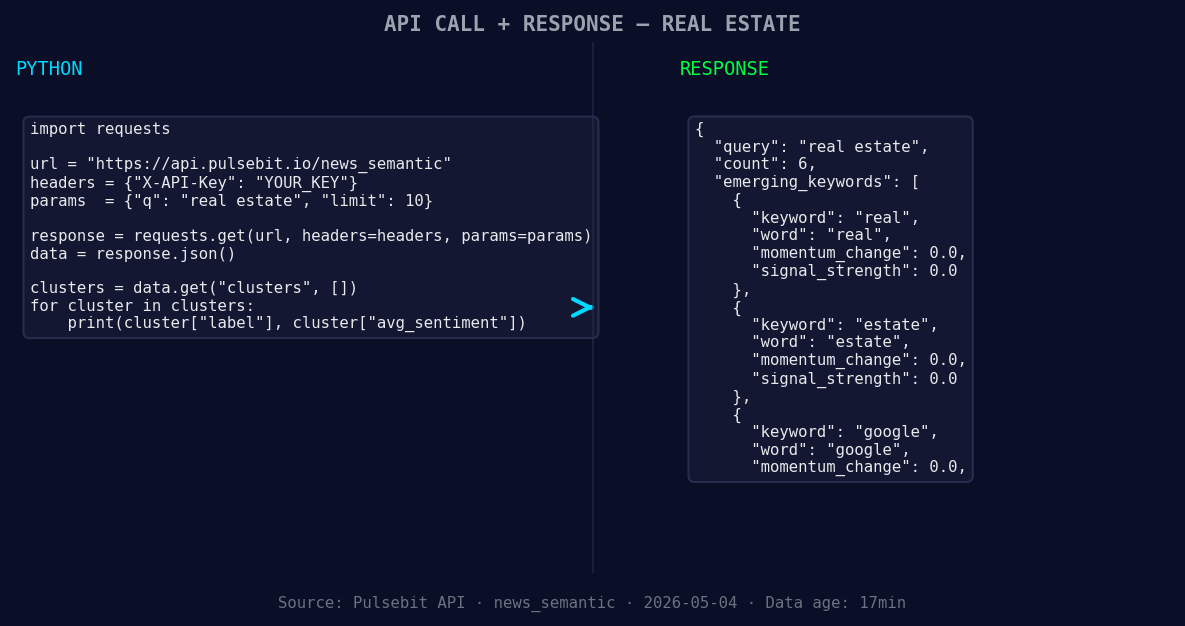
*Left: Python GET /news_semantic call for 'real estate'. Right: returned JSON response structure (clusters: 3). Source: Pulsebit /news_semantic.*
# Make the API call to fetch sentiment data
response = requests.get("https://api.pulsebit.com/sentiment", params=params)
data = response.json()
# Output the relevant sentiment score and momentum
print(f"Sentiment Score: {data['sentiment_score']}, Momentum: {data['momentum_24h']}")
Now, to deepen our understanding of the narrative framing, we can rerun the cluster reason string through the sentiment endpoint. This will help us analyze how the themes are contributing to the overall sentiment:
# Define the cluster reason string
cluster_reason = "Clustered by shared themes: real, estate, stanley, investing, selectivity."

# Make the API call to fetch sentiment on the meta-narrative
meta_response = requests.post("https://api.pulsebit.com/sentiment", json={"text": cluster_reason})
meta_data = meta_response.json()

# Output the meta-sentiment score
print(f"Meta-Sentiment Score: {meta_data['sentiment_score']}, Confidence: {meta_data['confidence']}")
With these two pieces in place, you can begin to build actionable insights from this data. Here are three specific builds we can create from the current spike:
Geo-Filtered Alerting: Set a threshold to trigger alerts when the sentiment score for "real estate" dips below +0.35 within English-language articles. This will help you stay ahead of shifts in sentiment before they impact your portfolio.
Meta-Sentiment Dashboard: Create a dashboard that visualizes the sentiment scores of narratives derived from cluster reasons like "real, estate, stanley, investing, selectivity." This can help you understand how different themes are influencing market perceptions.
Dynamic Content Strategy: Use the sentiment analysis over time to inform your content strategy. If you see a forming gap with topics like "google" showing zero momentum against mainstream narratives, it might be time to pivot your content focus to align with emerging interests.
Ready to get started? Head over to our documentation at pulsebit.lojenterprise.com/docs and you can copy-paste this code to run it in under 10 minutes. Don’t let another vital signal slip through the cracks.


Top comments (0)