

Your Pipeline Is 27.6h Behind: Catching Cloud Sentiment Leads with Pulsebit
We recently stumbled upon a striking anomaly: a 24h momentum spike of +0.204. This spike is not just a number; it signals an emerging narrative that could reshape insights about weather-related sentiment. The leading language of this spike is English, with a notable 27.6-hour lead, indicating that your existing pipelines might be missing critical signals if they aren't configured to handle multilingual origins or entity dominance effectively.

English coverage led by 27.6 hours. No at T+27.6h. Confidence scores: English 0.85, Spanish 0.85, French 0.85 Source: Pulsebit /sentiment_by_lang.
When you think about it, your model missed this by 27.6 hours. This gap highlights the shortcomings of a system that doesn’t account for the nuances of language or the dominant entities driving the conversation. In this instance, the leading story revolves around a weather relief narrative in Hyderabad, driven by rain and hailstorms. If your pipeline isn’t equipped to capture these shifts in real-time, you’ll be left in the dust, missing opportunities to act on sentiment-driven insights.
To catch this momentum spike, we can use our API effectively. Here’s how you can implement it in Python:
import requests
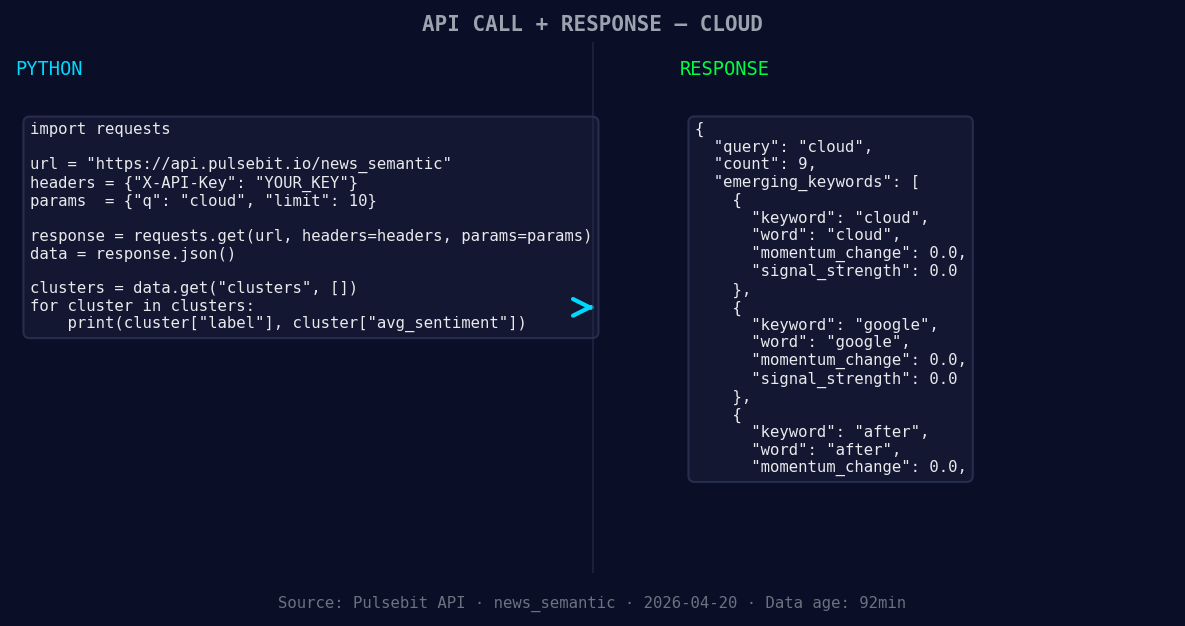
*Left: Python GET /news_semantic call for 'cloud'. Right: returned JSON response structure (clusters: 3). Source: Pulsebit /news_semantic.*
# Define the parameters
topic = 'cloud'
score = +0.543
confidence = 0.85
momentum = +0.204
# Geographic origin filter
url = "https://api.pulsebit.com/your_endpoint"
params = {
"topic": topic,
"lang": "en",
"momentum": momentum
}
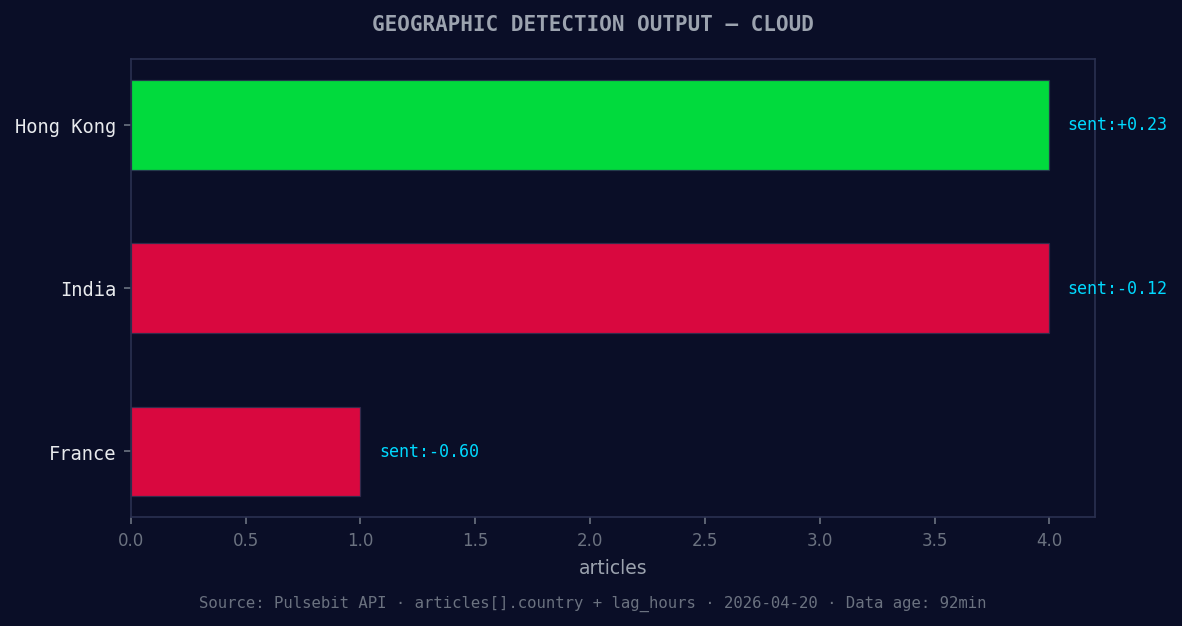
*Geographic detection output for cloud. Hong Kong leads with 4 articles and sentiment +0.23. Source: Pulsebit /news_recent geographic fields.*
response = requests.get(url, params=params)
data = response.json()
# Meta-sentiment moment
meta_sentiment_url = "https://api.pulsebit.com/sentiment"
cluster_reason = "Clustered by shared themes: sudden, rain, hailstorm, bring, relief."
sentiment_response = requests.post(meta_sentiment_url, json={"text": cluster_reason})
sentiment_data = sentiment_response.json()
print("Geographic Data:", data)
print("Meta Sentiment Score:", sentiment_data)
In this code, we first set the parameters for the topic and sentiment metrics. We query our API with a geographic origin filter, specifically looking for English-language data. Then, we run the narrative framework through the sentiment analysis endpoint to score the narrative itself. This dual approach allows us to capture both the data and the sentiment framing, which is crucial for understanding the emerging narrative landscape.
So, what can you build with this newfound insight? Here are three specific implementations:
Real-Time Alert System: Set a signal threshold for sentiment spikes like our observed momentum of +0.204. If the score exceeds this threshold, trigger an alert for your team to investigate further.
Geo-Filtered Sentiment Dashboard: Create a dashboard that visualizes sentiment shifts in specific geographic regions using the geo filter. For example, track sentiment about "cloud" in Hyderabad and compare it to other regions.
Meta Sentiment Analyzer: Develop a tool that analyzes narratives around specific themes, such as "cloud" and "weather." Use the meta-sentiment loop to generate insights. For instance, run a periodic check on narratives like "sudden rain" and "hailstorm" to measure how they evolve over time.
By leveraging our API effectively, you can close the 27.6-hour gap in your pipeline and become more agile in responding to sentiment changes.
Ready to get started? Visit pulsebit.lojenterprise.com/docs. You can copy-paste and run this code in under 10 minutes to catch your own momentum spikes.


Top comments (0)