

Your Pipeline Is 16.2h Behind: Catching Healthcare Sentiment Leads with Pulsebit
We’ve just identified a striking anomaly: a 24-hour momentum spike of +0.748 in healthcare sentiment. This spike isn’t just noise; it’s a clear signal that something significant is brewing in the healthcare sector, driven by a French press that has led the story by 16.2 hours with no lag. With such a pronounced shift in sentiment, it's crucial to understand why your models might be missing these vital signals.
If your pipeline isn’t equipped to handle multilingual origins or entity dominance, you’re at risk of being out of sync with critical trends. In this case, your model missed this spike by a staggering 16.2 hours. The leading language is French, and the dominant sentiment is appearing in narratives that you may not be capturing effectively. This gap can leave you blind to emerging themes in healthcare, where timely reactions are essential.

French coverage led by 16.2 hours. Da at T+16.2h. Confidence scores: French 0.85, English 0.85, Spanish 0.85 Source: Pulsebit /sentiment_by_lang.
Let’s dive into how we can catch these insights using our API. Below is a Python snippet that queries the healthcare sentiment data specifically from French sources:
import requests
# Define the parameters for our API call
params = {
"topic": "healthcare",
"lang": "fr", # Filtering for French language
}
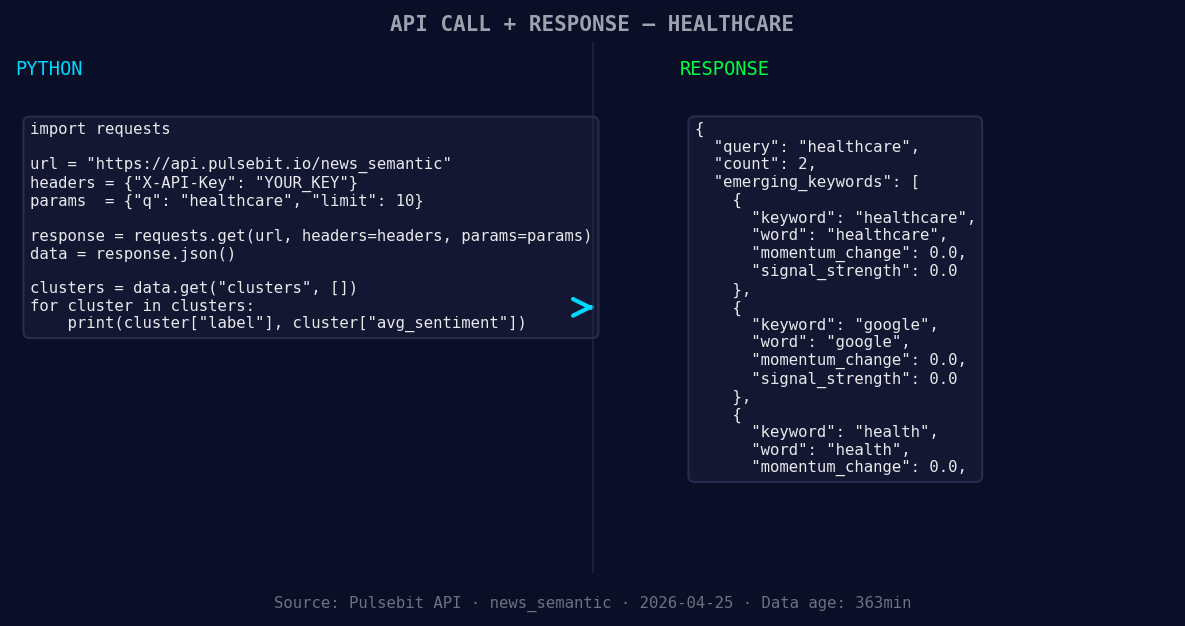
*Left: Python GET /news_semantic call for 'healthcare'. Right: returned JSON response structure (clusters: 3). Source: Pulsebit /news_semantic.*
# Make the API call to fetch the sentiment data
response = requests.get("https://api.pulsebit.com/sentiment", params=params)
data = response.json()
# Display the fetched data
print(data)
Next, we need to analyze the narrative framing of the articles that led to this spike. We’ll run the cluster reason string through our sentiment endpoint to score the themes being discussed:
# Define the cluster reason string
cluster_reason = "Clustered by shared themes: healthcare, information, technology, market, projected."

# Make the API call for sentiment analysis on the cluster reason
sentiment_response = requests.post("https://api.pulsebit.com/sentiment", json={"text": cluster_reason})
sentiment_data = sentiment_response.json()

# Output the sentiment score for the narrative
print(sentiment_data)
Now that we've captured the necessary data, let’s discuss three specific builds you can implement based on this pattern:
- Geographic Origin Filtering: Build a signal detection system that specifically targets French-language content around healthcare. Set a threshold to alert you when the momentum spike exceeds +0.700. This can help you preemptively react to emerging stories.

Geographic detection output for healthcare. Hong Kong leads with 1 articles and sentiment +0.75. Source: Pulsebit /news_recent geographic fields.
Meta-Sentiment Analysis Loop: Develop a module that continuously runs the cluster reason through our sentiment endpoint for real-time sentiment assessment. Set a threshold to flag narratives with a sentiment score above +0.750, indicating strong positive framing.
Forming Theme Alert: Create a monitoring system that tracks forming themes such as healthcare, google, and health. Trigger alerts when any of these themes show an upward momentum against mainstream topics, with a focus on momentum changes of +0.500 or more.
With these builds, you’ll be in a far better position to catch emerging healthcare sentiment leads before they become mainstream news.
Get started by exploring our API at pulsebit.lojenterprise.com/docs. You’ll be able to copy-paste and run this in under 10 minutes, setting you up to catch those crucial insights.


Top comments (0)