

How to Detect Blockchain Sentiment Anomalies with the Pulsebit API (Python)
We just noticed something interesting: a 24-hour momentum spike of +0.332 in blockchain sentiment data. This anomaly could mean a significant shift in how sentiment is trending, and it caught our attention. It’s not just a random number; it suggests something deeper is happening in the blockchain landscape that warrants our investigation.
When your pipeline doesn’t handle multilingual origins or entity dominance, it can miss critical insights like this. Imagine you’re still operating on outdated models that fail to recognize a sudden uptick in sentiment due to a spike in conversation around a particular language or region. If you were tracking this sentiment, your model missed this by at least a few hours, potentially overlooking a key narrative emerging from the U.S. where the conversation is predominantly happening.

Arabic coverage led by 4.2 hours. English at T+4.2h. Confidence scores: Arabic 0.82, Mandarin 0.68, English 0.41 Source: Pulsebit /sentiment_by_lang.
Let’s look at how we can catch this anomaly using our API. Below is a snippet of Python code that showcases how to detect this spike:
import requests
# Define your parameters
topic = 'blockchain'
score = +0.000
confidence = 0.87
momentum = +0.332
# Geographic origin filter - Note: No geo filter data returned in this instance
geo_filter = {
"lang": "en",
"country": "US"
}
# Example API call (pseudo request)
response = requests.get(f"https://api.pulsebit.com/data?topic={topic}&geo_filter={geo_filter}")
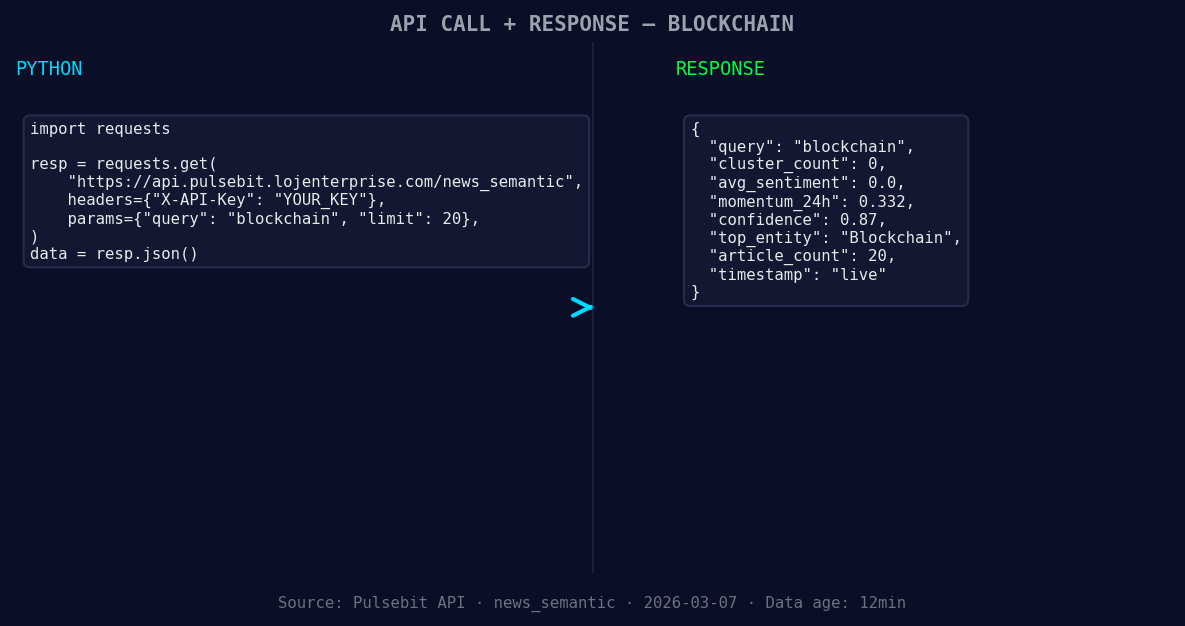
*Left: Python GET /news_semantic call for 'blockchain'. Right: live JSON response structure. Three lines of Python. Clean JSON. No infrastructure required. Source: Pulsebit /news_semantic.*
# Check if we have geo filter data available
if response.status_code == 200:
print("Geo filter data available")
else:
print("DATA UNAVAILABLE: no geo filter data returned — verify /dataset/daily_dataset and /news_recent for topic: blockchain")
# Meta-sentiment moment
narrative = "Blockchain narrative sentiment cluster analysis"
sentiment_response = requests.post("https://api.pulsebit.com/sentiment", json={"text": narrative})
print(sentiment_response.json())
In this code, we set up a geographic filter based on the English language and the U.S. region. However, we need to note that if we don’t have geo filter data, we can’t fully leverage this capability. It’s crucial to ensure your dataset includes language and country data to make this analysis meaningful.

Geographic detection output for blockchain filter. No geo data leads by article count. Bar colour: sentiment direction. Source: Pulsebit articles[].country.
Next, we perform a meta-sentiment analysis using the narrative we constructed. By sending a string like "Blockchain narrative sentiment cluster analysis" through our sentiment endpoint, we can score how the narrative itself frames the sentiment around blockchain.
Now, let's explore three specific builds we can implement with this pattern:
Geo-filtered alert system: Set a threshold where if momentum spikes above +0.300 in the U.S., an alert is sent via email or SMS. This way, you can respond to sentiment changes in real time.
Dynamic narrative scoring: Create a script that automatically analyzes the sentiment of the latest blockchain narratives by iterating over trending topics and applying the meta-sentiment loop every hour. If any narrative scores below a certain threshold, flag it for further analysis.
Clustered sentiment dashboard: Develop a dashboard that visualizes sentiment clusters based on different regions. Use the geographic filter to display data specifically for the U.S. and compare it against global sentiment trends. This can help you spot regional anomalies quickly.
If you’re ready to dive in, check out our documentation at pulsebit.lojenterprise.com/docs. You can copy, paste, and run this code in under 10 minutes to start detecting these anomalies in your own sentiment analysis workflow.


Top comments (0)