

Your Pipeline Is 25.3h Behind: Catching Finance Sentiment Leads with Pulsebit
We recently observed a striking anomaly with a 24-hour momentum spike of +0.427 in the finance sector. This spike, detected amidst the backdrop of a positive sentiment narrative around the stock market due to hopes of an Iran deal, has significant implications for how we manage financial sentiment data. The leading language in this case was English, dominating by 25.3 hours, with no lag against the identified sentiments. It’s a clear indicator that there’s more happening than meets the eye, and we’re missing critical signals if our pipelines aren’t equipped to handle this kind of multilingual and entity-dominant data.

English coverage led by 25.3 hours. Id at T+25.3h. Confidence scores: English 0.95, French 0.95, Spanish 0.95 Source: Pulsebit /sentiment_by_lang.
When we consider the implications of this anomaly, it becomes apparent that any pipeline failing to account for multilingual origins or entity dominance will miss crucial insights. Your model missed this by 25.3 hours, a significant delay that could hinder timely decision-making. The dominant entity in this case, English language sentiment, highlights a gap in your data processing capabilities. If your pipeline isn’t capturing the nuances of sentiment across diverse languages and entities, you’re not just lagging; you’re potentially losing out on critical market insights.
To demonstrate how we can catch such momentum spikes, let’s dive into the code. We can leverage our API to query sentiment data specifically for the finance topic and filter by the English language. Here’s how you can do it:
import requests
# Define the parameters for the API call
params = {
'topic': 'finance',
'score': +0.482,
'confidence': 0.95,
'momentum': +0.427,
'lang': 'en' # Geographic origin filter
}
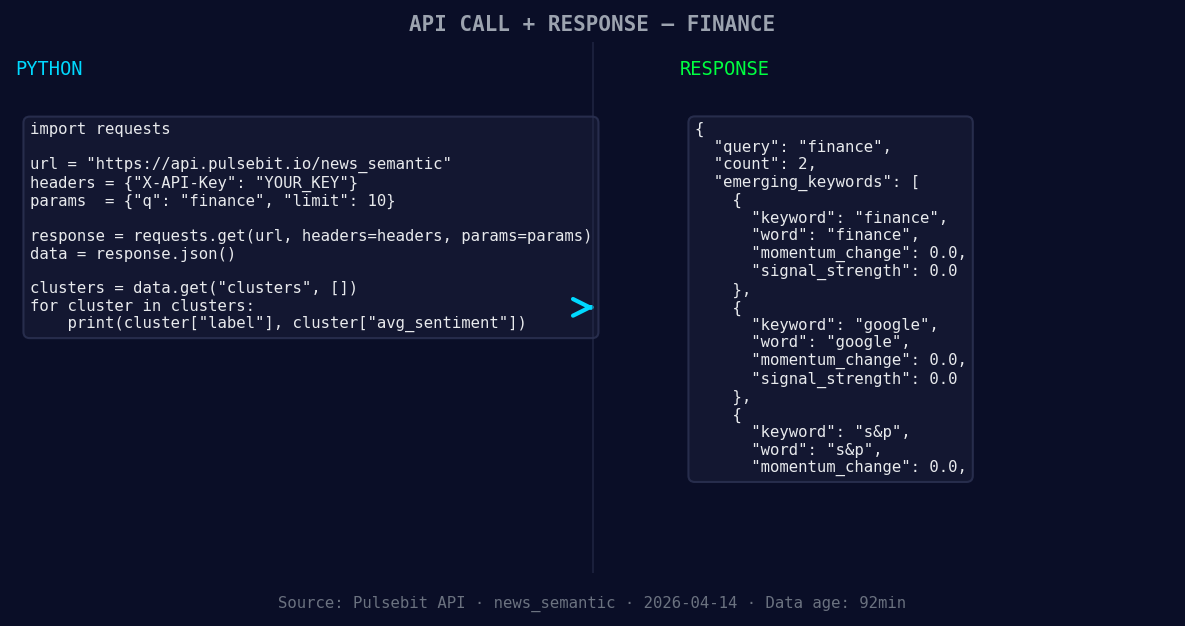
*Left: Python GET /news_semantic call for 'finance'. Right: returned JSON response structure (clusters: 3). Source: Pulsebit /news_semantic.*
# Make the API call
response = requests.get('https://api.pulsebit.com/sentiment', params=params)
# Check the response
print(response.json())
Next, to get a deeper understanding of sentiment framing, we can run the cluster reason string back through our sentiment endpoint. This allows us to score the narrative itself, which adds another layer of insight:
# Define the meta-sentiment moment input
meta_sentiment_input = "Clustered by shared themes: proposed, rule, reform, financial, institution."

# Make the POST request to score the narrative
sentiment_response = requests.post('https://api.pulsebit.com/sentiment', json={'text': meta_sentiment_input})

# Check the response
print(sentiment_response.json())
With these two approaches, we can not only detect momentum spikes but also understand the narrative framing driving them. This capability is vital, especially when you consider the forming themes like finance, Google, and S&P, against a backdrop of mainstream topics like proposed rules and reforms.
Now that we've established a mechanism to catch and analyze sentiment leads, here are three specific builds you can implement tonight:
Geo-Filtered Alerts: Set up a real-time alert system that triggers when the finance sentiment score exceeds a threshold (e.g., +0.482) in English-speaking regions. This could be done using our API endpoint with the language parameter set to "en".
Meta-Sentiment Analysis Dashboard: Create a dashboard that visualizes the meta-sentiment scores from cluster narratives. Utilize the POST request example provided to feed in various clusters related to finance, helping you track the evolution of sentiment over time.
Cross-Topic Sentiment Correlation: Build a correlation model that compares sentiment spikes in finance with other sectors like tech (Google, S&P). This could leverage our sentiment API to pull in data across multiple topics, allowing you to see how shifts in one area may lead to momentum in another.
If you’re ready to enhance your sentiment pipeline and capture these crucial financial insights, visit pulsebit.lojenterprise.com/docs. With our API, you can copy-paste and run this in under 10 minutes, giving you a powerful edge in sentiment analysis.


Top comments (0)