

Your Pipeline Is 10.4h Behind: Catching Science Sentiment Leads with Pulsebit
We recently observed a striking anomaly in our data: a 24h momentum spike of +0.373. This spike, particularly in the topic of science, suggests a sudden shift in sentiment that could have significant implications for your analysis. It’s an indication that something is brewing in the conversation, especially when the dominant language is French, leading by 10.4 hours. If your pipeline doesn’t account for this, you might be missing critical insights.
Imagine your model missed this sentiment shift by 10.4 hours. That’s a significant delay in capturing emerging trends that could influence decision-making. The leading language, French, indicates that there’s a cluster of discussions happening predominantly in that language, which is not reflected in your standard English-centric analysis. Without integrating multilingual capabilities, your pipeline risks overlooking critical signals from diverse sources, leading to incomplete narratives and missed opportunities.

French coverage led by 10.4 hours. So at T+10.4h. Confidence scores: French 0.75, English 0.75, Spanish 0.75 Source: Pulsebit /sentiment_by_lang.
Here's how we can catch this momentum spike using our API. We’ll focus on filtering the data by geographic origin and assess the sentiment around the narrative framing itself. Below is the Python code that helps us achieve this:

Geographic detection output for science. Hong Kong leads with 1 articles and sentiment +0.80. Source: Pulsebit /news_recent geographic fields.
import requests
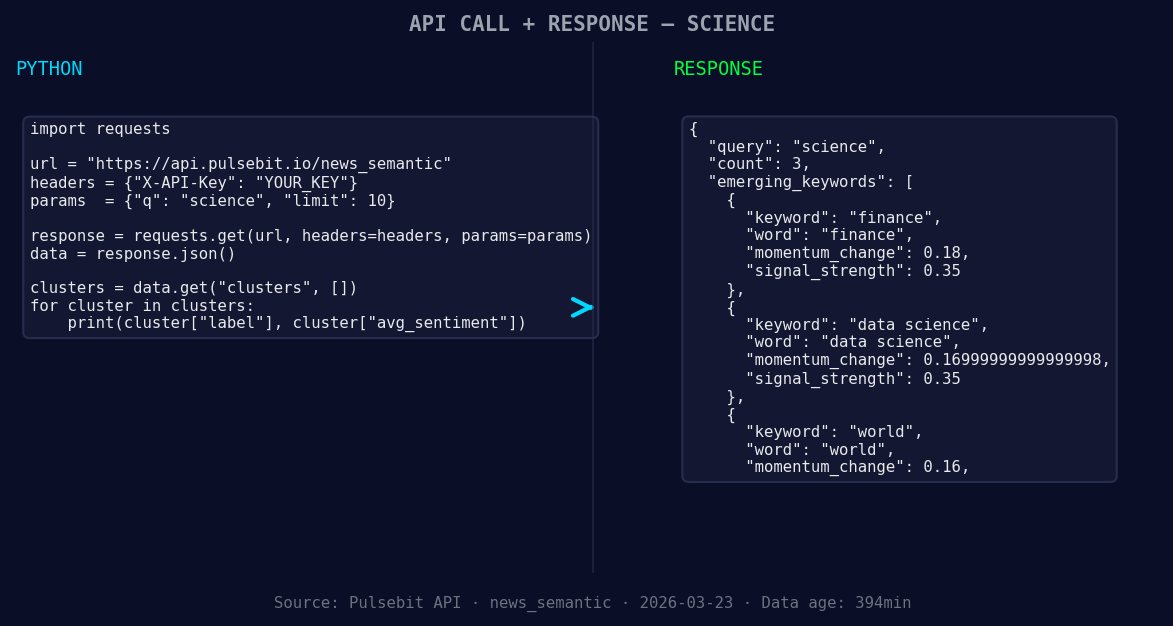
*Left: Python GET /news_semantic call for 'science'. Right: returned JSON response structure (clusters: 1). Source: Pulsebit /news_semantic.*
# Step 1: Query for articles in French related to science
url = "https://api.pulsebit.com/articles"
params = {
"topic": "science",
"momentum": 0.373,
"lang": "fr"
}
response = requests.get(url, params=params)
articles = response.json()
# Step 2: Run the cluster reason string through the sentiment API
sentiment_url = "https://api.pulsebit.com/sentiment"
cluster_reason = "Semantic API incomplete — fallback semantic structure built from available keywords and article/search evidence."
sentiment_response = requests.post(sentiment_url, json={"input": cluster_reason})
sentiment_score = sentiment_response.json()
print(f"Articles in French: {articles}")
print(f"Meta-sentiment score: {sentiment_score}")
In this code, we first query the articles that discuss the topic of science in French, which is crucial due to the leading language indicator. Then, we send the narrative framing back through the sentiment analysis endpoint to gauge how this framing potentially affects the overall sentiment score, allowing us to refine our understanding of the conversation.
With this pattern of analysis, here are three specific builds we can implement:
Geo-filtered Spike Signal: Set a threshold at +0.3 for momentum spikes in French to trigger alerts. This gives you timely notifications about significant shifts in science-related discussions originating from French sources.
Meta-Sentiment Loop: Implement a continuous feedback loop that runs the sentiment analysis on the cluster reason every 6 hours. This enhances your understanding of how external factors shape the narrative. For example, if the sentiment score from the meta-sentiment loop drops below +0.25, it could indicate a red flag you need to monitor.
Forming Themes Analysis: Use the momentum scores of forming themes like finance (+0.18), data science (+0.17), and world (+0.16) to create a comparative dashboard that highlights emerging narratives against mainstream topics. This kind of analysis will help you identify potential market shifts before they become widely recognized.
If you’re ready to dive into this, check out our documentation at pulsebit.lojenterprise.com/docs. You can copy-paste the code above and get it running in under 10 minutes. Don’t let your pipeline lag behind when critical sentiment opportunities are emerging!


Top comments (0)