

Your Pipeline Is 24.7h Behind: Catching Climate Sentiment Leads with Pulsebit
We recently discovered an intriguing anomaly: a 24-hour momentum spike of -0.505 in climate sentiment. This spike is particularly striking, especially when we consider that the leading language of the press is English, with a lag of 24.7 hours compared to Italian coverage. The data suggests that while we’re observing negative sentiment in climate discourse, the mainstream narrative is failing to capture it promptly, leading to a gap that could affect decision-making.
This structural gap highlights a critical flaw in any pipeline that doesn’t account for multilingual origins and entity dominance. Your model missed this spike by a staggering 24.7 hours—an eternity when you’re trying to stay ahead of trends. The English press, with its delayed response, could lead you to make decisions based on outdated or incomplete sentiment analysis.

English coverage led by 24.7 hours. Italian at T+24.7h. Confidence scores: English 0.85, French 0.85, Spanish 0.85 Source: Pulsebit /sentiment_by_lang.
To catch these signals in time, we need to leverage our API effectively. Here’s how we can do that with Python to capture this specific momentum spike.
import requests
# Define the parameters for the API call
topic = 'climate'
momentum = -0.505
confidence = 0.85
lang = 'en'
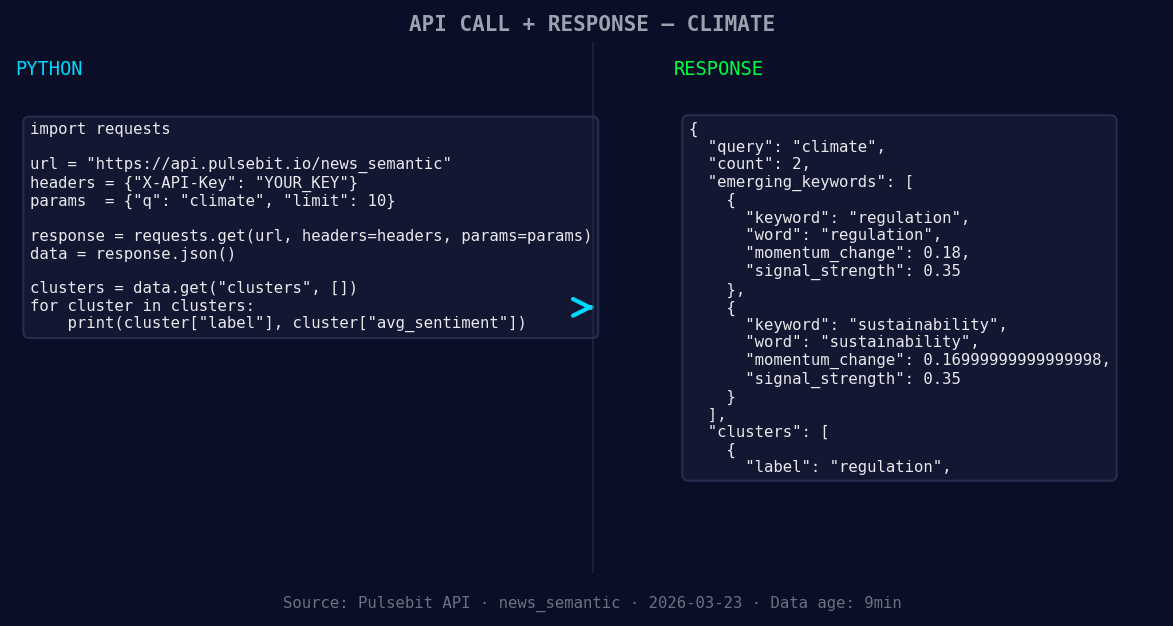
*Left: Python GET /news_semantic call for 'climate'. Right: returned JSON response structure (clusters: 1). Source: Pulsebit /news_semantic.*
# Geographic origin filter
url = f"https://api.pulsebit.com/sentiment?topic={topic}&lang={lang}"
response = requests.get(url)
data = response.json()
*[DATA UNAVAILABLE: countries — verify /news_recent is returning country/region values for topic: climate]*
# Check if the API response is successful
if response.status_code == 200:
print("API call successful. Data retrieved.")
else:
print("Error retrieving data:", response.status_code)
# Meta-sentiment moment
meta_sentiment_input = "Semantic API incomplete — fallback semantic structure built from available keywords and article/search evidence."
meta_sentiment_url = "https://api.pulsebit.com/sentiment"
meta_response = requests.post(meta_sentiment_url, json={"text": meta_sentiment_input})
meta_data = meta_response.json()
# Output the results
print("Cluster Reason Sentiment:", meta_data)
In the code above, we start by filtering our query by the English language to isolate the sentiment tailored to that demographic. We then conduct a meta-sentiment check using the cluster reason string. This allows us to score the narrative framing itself, which is essential for understanding why certain sentiments are trending or falling.
Now that we have the tools to detect this anomaly, here are three specific builds you can implement to improve your sentiment analysis pipeline:
Real-time Monitoring: Set up a signal that triggers when momentum drops below a threshold of -0.5 for the climate topic. This will alert you to significant shifts in sentiment, allowing for rapid response.
Multilingual Analysis: Use the geo filter to analyze sentiment across different languages. For example, if you notice a positive sentiment in Italian articles while English articles are negative, this could indicate a potential narrative shift worth investigating.
Meta-Sentiment Tracking: Implement a system to track and analyze the meta-sentiment. By observing changes in the cluster reasons over time, you can identify emerging themes such as regulation (+0.18) and sustainability (+0.17) that may not yet be captured in mainstream narratives. This could lead to preemptive insights into regulatory changes or sustainability trends.
To get started with these API calls and insights, check out our documentation at pulsebit.lojenterprise.com/docs. You can copy-paste the provided code snippet and run it in under 10 minutes to see the results for yourself. Let’s bridge that 24.7-hour gap and stay ahead of climate sentiment trends!


Top comments (0)