

Your Pipeline Is 14.0h Behind: Catching Hardware Sentiment Leads with Pulsebit
We just observed a 24-hour momentum spike of +0.177 in the hardware sector, particularly around the latest Nvidia RTX 5050 and AMD Radeon RX 9070 releases. This surge is not just a blip; it signals a significant shift in sentiment that your models might be missing. The leading language for this spike is English, with a notable 14.0-hour lag in capturing these developments. If your pipeline isn't set up to track multilingual origins or entity dominance, you're falling behind, potentially by hours, on critical market movements.

English coverage led by 14.0 hours. Et at T+14.0h. Confidence scores: English 0.90, Spanish 0.90, French 0.90 Source: Pulsebit /sentiment_by_lang.
This structural gap exposes a weakness in your current sentiment analysis pipeline. Your model missed this momentum spike by 14.0 hours, while the leading language was English. This delay can mean the difference between capitalizing on emerging trends and being reactive rather than proactive. Without handling diverse linguistic inputs and recognizing key entities, you're effectively blind to what’s happening in real-time, leaving you vulnerable to competitors who are quicker to act.
To catch this momentum spike efficiently, we can utilize our API in Python. First, we need to filter articles by geographic origin and language. Here’s how to do that:

Geographic detection output for hardware. Hong Kong leads with 2 articles and sentiment +0.05. Source: Pulsebit /news_recent geographic fields.
import requests
# Define parameters
params = {
'topic': 'hardware',
'lang': 'en' # Filter for English language
}
# API call to fetch sentiment data
response = requests.get('https://api.pulsebit.io/v1/sentiment', params=params)
data = response.json()
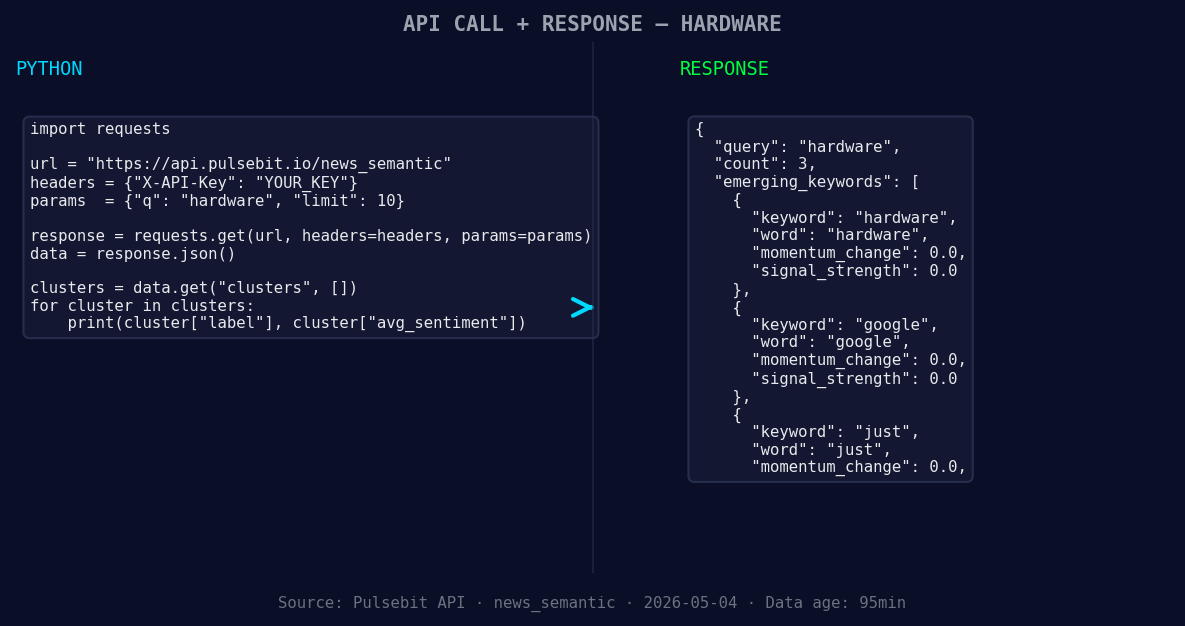
*Left: Python GET /news_semantic call for 'hardware'. Right: returned JSON response structure (clusters: 3). Source: Pulsebit /news_semantic.*
# Output the response for verification
print(data)
Next, we should run the cluster reason string back through the sentiment analysis endpoint to get a score on the narrative framing itself. This is where the real value lies; understanding how the narratives around "rtx, 5050, hardware, survey, amd" are being framed.
# Define the cluster reason string
cluster_reason = "Clustered by shared themes: holds, strong, steam's, april, hardware."

# API call to score the narrative framing
sentiment_response = requests.post('https://api.pulsebit.io/v1/sentiment', json={'text': cluster_reason})
sentiment_data = sentiment_response.json()

# Output the sentiment score
print(sentiment_data['sentiment_score'])
With this data in hand, we can make informed decisions about how to position our strategies moving forward. Here are three specific builds we recommend based on the identified patterns:
Geo-filtered Alert System: Set a threshold of momentum spikes greater than +0.15 in the hardware sector and filter results by English-speaking countries. This ensures you're capturing significant sentiment shifts in key markets.
Meta-Sentiment Analysis Module: Create a module that continually scores narratives whenever specific clusters emerge, particularly focusing on terms like "hardware" and "steam". Use a threshold sentiment score of +0.4 to trigger alerts on positive sentiment shifts.
Thematic Correlation Tool: Build an endpoint that cross-references emerging themes, such as "hardware" and "google", against mainstream sentiment scores. This will allow you to identify if new themes are gaining traction compared to established ones, helping you stay ahead of the curve.
To get started, visit pulsebit.lojenterprise.com/docs. You can copy-paste the above code and run it in under 10 minutes. Don’t let your pipeline lag behind; harness the power of real-time sentiment analysis and stay ahead of the competition.


Top comments (0)