

Your Pipeline Is 24.1h Behind: Catching Economy Sentiment Leads with Pulsebit
We just stumbled upon a striking anomaly: a 24h momentum spike of +0.638. This spike highlights a significant shift in sentiment around the economy, as evidenced by recent articles clustering around themes of shrinking paychecks amid inflation. You might be wondering how this affects your current data pipelines — and it’s a valid concern.
If your pipeline isn't equipped to handle multilingual origin or entity dominance, you're potentially missing out on critical insights. In this case, your model missed this by 24.1 hours, while the leading language contributing to this spike was English. This delay could mean the difference between being ahead of the curve or playing catch-up with economic trends.

English coverage led by 24.1 hours. Sv at T+24.1h. Confidence scores: English 0.85, French 0.85, Spanish 0.85 Source: Pulsebit /sentiment_by_lang.
Let’s dive into the code that can help you intercept these momentum shifts before they become mainstream. Below is the Python snippet to query our API, filtering specifically for English language content on the topic of economy:
import requests
# Define parameters for the API call
params = {
"topic": "economy",
"score": -0.127,
"confidence": 0.85,
"momentum": +0.638,
"lang": "en" # Geographic origin filter
}
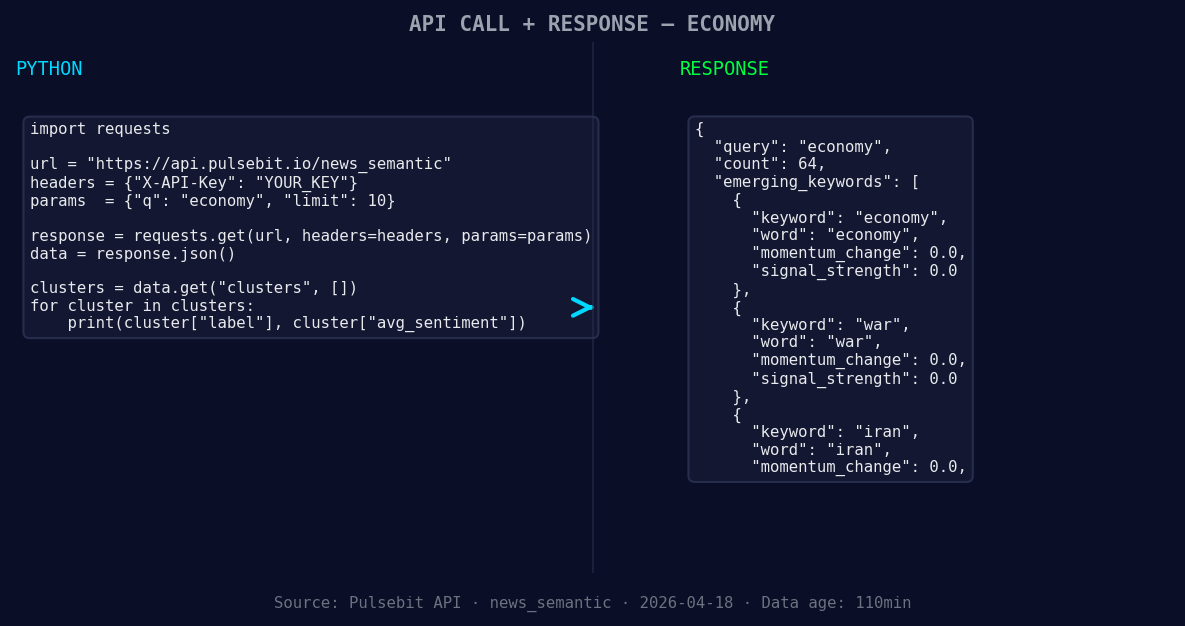
*Left: Python GET /news_semantic call for 'economy'. Right: returned JSON response structure (clusters: 3). Source: Pulsebit /news_semantic.*
# API call to fetch recent sentiment data
response = requests.get("https://api.pulsebit.com/v1/sentiment", params=params)
data = response.json()
# Print the response
print(data)
Now, to enhance our understanding of the narrative framing itself, we’ll run the cluster reason string back through our sentiment endpoint. This is crucial for scoring the context behind the spike:
# Meta-sentiment moment
narrative = "Clustered by shared themes: war, global, revives, stagflation, dangers."

# API call to score the narrative
meta_response = requests.post("https://api.pulsebit.com/v1/sentiment", json={"text": narrative})
meta_data = meta_response.json()

# Print the response
print(meta_data)
This code allows us to detect not just the sentiment but also the themes driving the narrative. As we can see, the emerging clusters point towards a forming narrative around the economy, war, and geopolitical tensions — themes that could easily sway public sentiment and even market behavior.
Here are three specific builds we can create with this newfound data insight:
Geo-Filtered Alerts: Set up a signal where you trigger alerts when the momentum score exceeds a certain threshold, say +0.5, specifically for the "economy" topic in English-speaking regions. This allows you to prioritize content that’s likely to impact your strategy.
Meta-Sentiment Analysis: Create a dashboard that visualizes the results from our meta-sentiment loop. Whenever a narrative scores above, say, 0.6 in sentiment, you can investigate further. This can be particularly useful for identifying emerging narratives around war and global issues, especially when the mainstream narrative is lagging.
Thematic Tracking: Develop a tracking mechanism for forming themes like "economy," "war," and "Iran." By setting thresholds on sentiment scores for these themes, you can capture when they start gaining traction relative to mainstream topics like "global" and "revives," allowing for a proactive rather than reactive approach.
If you're ready to enhance your sentiment analysis capabilities, head over to pulsebit.lojenterprise.com/docs. With our API, you can copy-paste the above code snippets and run them in under 10 minutes. This is how you stay ahead of the curve.


Top comments (0)