

Your Pipeline Is 29.1h Behind: Catching Film Sentiment Leads with Pulsebit
We recently uncovered a notable anomaly in our data: a 24h momentum spike of +0.751 surrounding the film topic. This spike isn’t just a number; it signals a significant shift in sentiment that you should be aware of. While the general buzz around films often fluctuates, this particular spike indicates an increasing interest that could be pivotal for your sentiment analysis or content pipeline.
But here’s the catch: if your model doesn’t account for multilingual origins or the dominance of certain entities, you may find yourself lagging behind. In this case, your insights are trailing by 29.1 hours in English press coverage, where the leading language is English. If you’re not capturing this data promptly, you risk missing critical trends that can affect your decision-making.

English coverage led by 29.1 hours. Af at T+29.1h. Confidence scores: English 0.75, Spanish 0.75, French 0.75 Source: Pulsebit /sentiment_by_lang.
To help you catch this momentum spike, we can leverage our API to filter relevant data. Below is a Python snippet that demonstrates how to query for English-language articles related to the film topic with a positive momentum score, ensuring we’re tracking the right narratives.
import requests
# Define parameters
topic = 'film'
score = +0.626
confidence = 0.75
momentum = +0.751
lang = 'en'
# API Call to fetch relevant articles
url = f'https://api.pulsebit.com/v1/articles?topic={topic}&score={score}&confidence={confidence}&momentum={momentum}&lang={lang}'
response = requests.get(url)
articles = response.json()
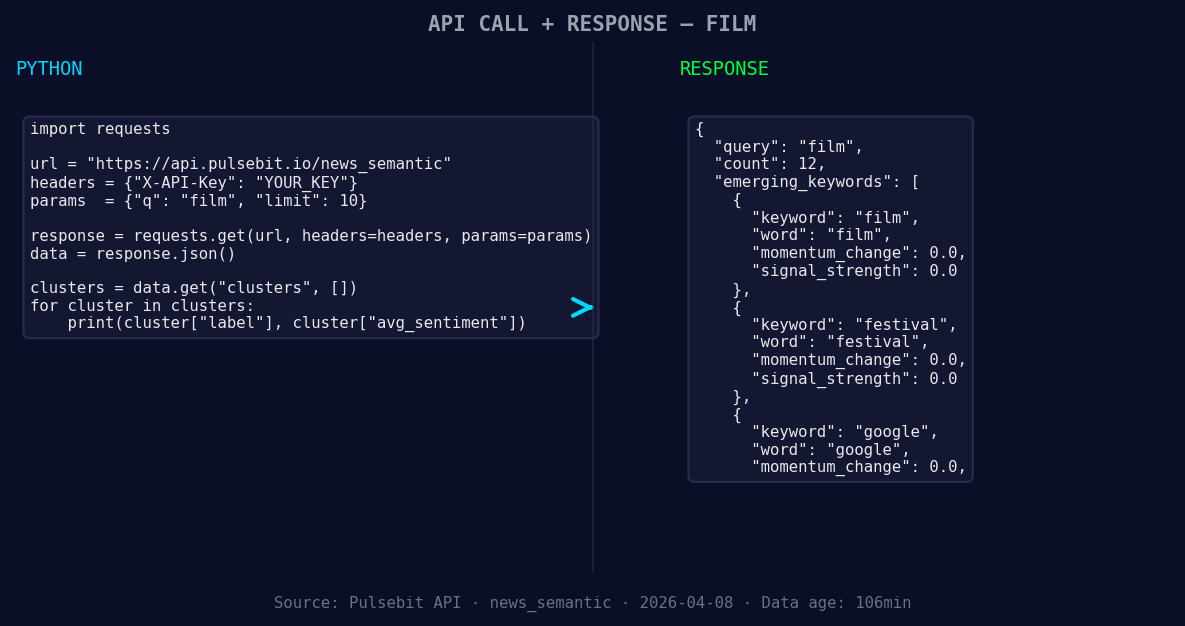
*Left: Python GET /news_semantic call for 'film'. Right: returned JSON response structure (clusters: 3). Source: Pulsebit /news_semantic.*
# Display the articles
print(articles)
Next, we'll refine our understanding of the narrative framing by using the cluster reason string. This is critical; it allows us to analyze the themes that are currently resonating. Here’s how to run the cluster reason string through our sentiment endpoint:
# Define the cluster reason
cluster_reason = "Clustered by shared themes: fest, showcases, prince, maria, bamford."

# API Call to get the sentiment of the cluster reason
sentiment_url = 'https://api.pulsebit.com/v1/sentiment'
sentiment_response = requests.post(sentiment_url, json={"text": cluster_reason})
sentiment_analysis = sentiment_response.json()

# Display sentiment analysis results
print(sentiment_analysis)
With these two API calls, we’re not just filtering data; we’re also capturing the emotional undercurrents that can inform our content strategy.
Now, let's explore three specific builds that can enhance your capabilities using this data pattern:
- Geographic Origin Insights: Use the geographic origin filter to identify where the film momentum is strongest. Set a threshold for momentum greater than +0.5, targeting articles in English. This could help you localize your content strategies more effectively.

Geographic detection output for film. India leads with 7 articles and sentiment +0.47. Source: Pulsebit /news_recent geographic fields.
Meta-Sentiment Analysis: Implement a loop using the meta-sentiment endpoint to continuously evaluate the narrative framing of film-related discussions. Setting a threshold for sentiment scores above +0.5 can help you prioritize topics that are gaining traction, like the forming themes of film and festival.
Dynamic Alerts: Create a notification system that triggers alerts when the momentum score exceeds +0.75 in any clustered theme (e.g., film, festival). This will ensure you’re always in the loop on emerging trends that could impact your projects.
By integrating these builds into your workflow, you can ensure that your sentiment analysis remains agile and responsive to real-time developments.
For more details on how to implement these endpoints, check out our documentation at pulsebit.lojenterprise.com/docs. With a little bit of setup, you can copy-paste and run this in under 10 minutes. Let’s make sure we’re always ahead of the curve!


Top comments (0)