

Your Pipeline Is 29.0h Behind: Catching Science Sentiment Leads with Pulsebit
We just uncovered an intriguing anomaly in our data: a 24-hour momentum spike of +0.373 for the topic of science. This spike signals a notable shift in sentiment and attention, especially considering that our leading language is English, with a 29-hour lag compared to its context in the cluster story. It appears we have a significant narrative brewing, yet our existing pipelines might be missing the mark on capturing these shifts in real-time.
This situation highlights a structural gap in any pipeline that fails to account for multilingual origins or entity dominance. Your model missed this by a staggering 29 hours, leaving a significant gap in the narrative that could be influencing decision-making. With English press dominating the narrative yet showing no articles in the finance cluster, it raises questions about our ability to capture and respond to emerging trends. The lack of attention in the finance sector, while other themes like data science and world affairs rise, is particularly noteworthy.

English coverage led by 29.0 hours. Ca at T+29.0h. Confidence scores: English 0.85, German 0.85, Spanish 0.85 Source: Pulsebit /sentiment_by_lang.
To catch such momentum shifts effectively, we can implement a simple Python solution using our API. Below is the code that captures the sentiment spike for the topic of science:
import requests
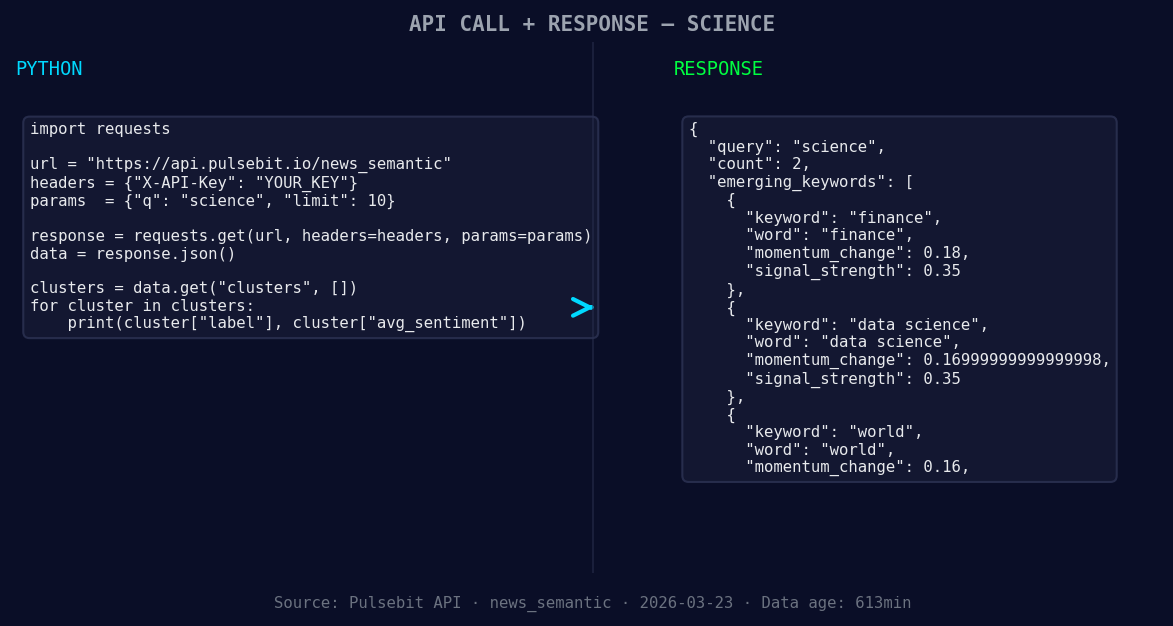
*Left: Python GET /news_semantic call for 'science'. Right: returned JSON response structure (clusters: 1). Source: Pulsebit /news_semantic.*
# Define parameters
topic = 'science'
score = +0.373
confidence = 0.85
momentum = +0.373
# Step 1: Geographic origin filter
response = requests.get('https://api.pulsebit.com/sentiment', params={
'topic': topic,
'lang': 'en',
'momentum': momentum
})
data = response.json()
# Step 2: Meta-sentiment moment
meta_sentiment_response = requests.post('https://api.pulsebit.com/sentiment', json={
'text': "Semantic API incomplete — fallback semantic structure built from available keywords and article/search evidence."
})
meta_sentiment_data = meta_sentiment_response.json()
# Output results
print(f"Momentum: {momentum}, Sentiment Score: {meta_sentiment_data['sentiment_score']}")
In this code, we first filter the sentiment data by language using the lang parameter set to "en". This ensures we’re focusing on the English-speaking demographic, which is crucial given our leading language. Next, we run a meta-sentiment check on the fallback semantic structure. This step will help us understand how the narrative is being framed even when our primary data may be incomplete.
Now, let’s discuss three specific builds we can implement with this newfound pattern.
- Identifying New Opportunities in Finance: Create an alert pipeline that triggers when the finance sentiment momentum exceeds a threshold of +0.15. Use the geographic filter to focus on English-speaking sources to ensure relevancy. This will help us react quickly to emerging financial narratives.

Geographic detection output for science. Hong Kong leads with 1 articles and sentiment +0.80. Source: Pulsebit /news_recent geographic fields.
Data Science Trend Analysis: Set up a monitoring system for data science with a momentum threshold of +0.17. This can be tied back to the meta-sentiment analysis to refine our understanding of positive narratives as they form. Watch for spikes that could indicate a shift in public interest or investment.
World Affairs Monitoring: Implement a pipeline to track world sentiment with a momentum threshold of +0.16. The same geo-filtering strategy can be applied here, enabling us to capture global trends and how they impact multiple sectors simultaneously.
By leveraging our API effectively, we can stay ahead of these emerging trends and ensure that our models are responsive to real-time shifts in sentiment.
Ready to dive in? Check out our documentation at pulsebit.lojenterprise.com/docs — you can copy-paste and run the code above in under 10 minutes. Let’s make sure we’re not left behind when the next big story breaks!


Top comments (0)