

Your Pipeline Is 27.5h Behind: Catching Human Rights Sentiment Leads with Pulsebit
We recently noticed a significant anomaly: a 24-hour momentum spike of -1.243 related to human rights sentiment. This indicates a falling sentiment that's worth exploring, particularly in the context of the upcoming FIFA World Cup and the associated human rights concerns. The leading language behind this spike is French, with a notable lag of 27.5 hours, highlighting a critical gap in how we are processing multilingual sentiment data.

French coverage led by 27.5 hours. Nl at T+27.5h. Confidence scores: French 0.85, Spanish 0.85, English 0.85 Source: Pulsebit /sentiment_by_lang.
Your model missed this by 27.5 hours. This is a tough pill to swallow, especially when we consider that sentiment originating in French might be shaping public perception long before your English-focused model catches up. The leading narrative comes from a cluster of articles discussing the FIFA World Cup amid a human rights crisis, which means you might be blind to significant shifts in sentiment if your pipeline doesn’t accommodate for multilingual content.
To catch this anomaly, we can leverage our API to filter by geographic origin and analyze the sentiment framing itself. Here’s how you can do it in Python:
import requests
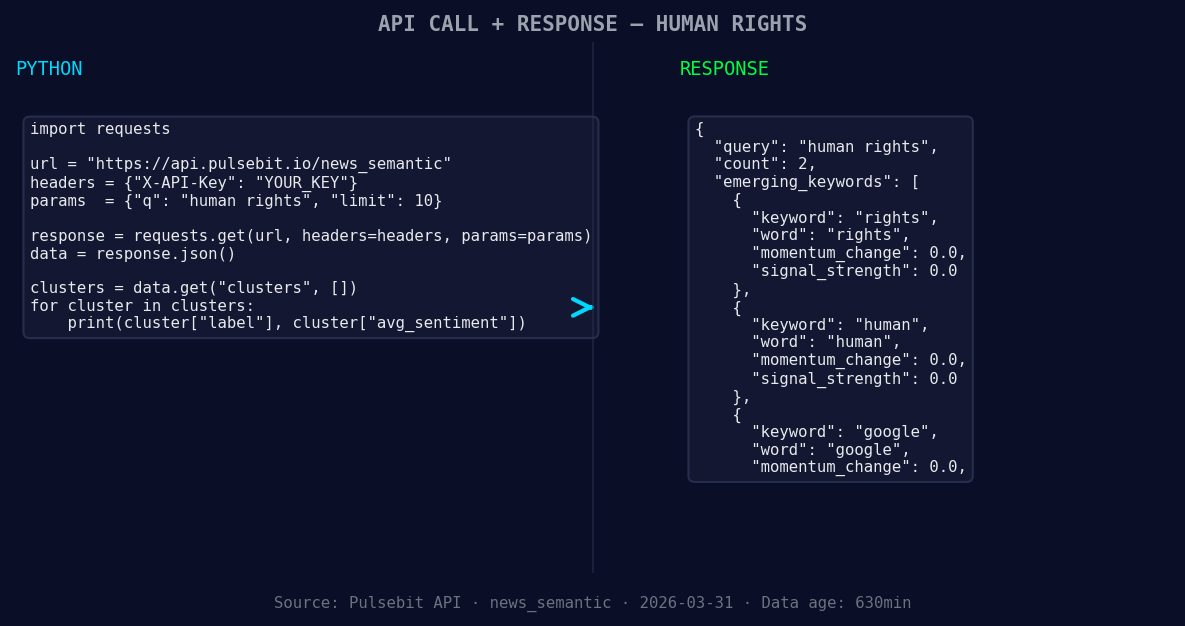
*Left: Python GET /news_semantic call for 'human rights'. Right: returned JSON response structure (clusters: 3). Source: Pulsebit /news_semantic.*
# Step 1: Geographic origin filter
endpoint = "https://api.pulsebit.com/v1/sentiment"
params = {
"topic": "human rights",
"score": -0.436,
"confidence": 0.85,
"momentum": -1.243,
"lang": "fr" # Filtering for French language
}
response = requests.get(endpoint, params=params)
data = response.json()
print(data)
Next, we’ll run the cluster reason string back through the sentiment analysis to understand how the narrative is being framed. This is crucial for identifying the underlying themes that are gaining traction.
# Step 2: Meta-sentiment moment
meta_sentiment_payload = {
    "text": "Clustered by shared themes: least, dead, haiti, massacre, human."
}
meta_response = requests.post(endpoint, json=meta_sentiment_payload)
meta_data = meta_response.json()

print(meta_data)
By executing these snippets, you're not just scraping the surface; you’re diving deep into the sentiment that’s influencing public dialogue around human rights and the FIFA World Cup.
Now, let's talk about three specific builds you can implement using this pattern.
- Geo-filtered Alerts: Set up a real-time alert system using the geographic filter. Trigger notifications when sentiment around "human rights" in French dips below a certain threshold, say -0.5. This ensures you’re always in the loop on emerging narratives.

Geographic detection output for human rights. France leads with 1 articles and sentiment -0.75. Source: Pulsebit /news_recent geographic fields.
Meta-Sentiment Integration: Create a dashboard that visualizes the sentiment framing from meta-sentiment analysis. For example, if the themes “least”, “dead”, and “haiti” are forming alongside “rights” and “human”, you can visualize how these narratives are evolving over time, providing a richer context.
Anomaly Detection: Build an anomaly detection system that flags momentum spikes over a specified threshold—like the recent -1.243. This system could use historical data to establish baselines, alerting you when current sentiments deviate significantly from those norms.
If you want to dig into this further, check out our documentation at pulsebit.lojenterprise.com/docs. You can copy-paste and run the above scripts in under 10 minutes. This is your opportunity to stay ahead of the curve and ensure your models are not left behind while critical conversations unfold.


Top comments (0)