

Your Pipeline Is 27.6h Behind: Catching Sports Sentiment Leads with Pulsebit
We just noticed a significant anomaly: a 24-hour momentum spike of +0.366 in sports sentiment. This spike isn't just a number; it's a signal that indicates rising interest in high school sports in the Green Bay area. Notably, this momentum is being led by English press coverage, which is lagging by 27.6 hours. The implications here are crucial for anyone relying on traditional sentiment analysis pipelines.
If your model doesn't account for the nuances of multilingual origins or entity dominance, your pipeline may be missing critical signals like this one by nearly a day. Imagine your algorithm processing data that is already stale—stuck in a time warp while the narrative around high school sports is evolving rapidly. In this case, the leading language is English, but the story is local: clustered articles about "Green Bay Area High School Sports" are driving this momentum, and your system isn’t picking it up quickly enough.

English coverage led by 27.6 hours. Et at T+27.6h. Confidence scores: English 0.90, Spanish 0.90, French 0.90 Source: Pulsebit /sentiment_by_lang.
To catch anomalies like this, we can utilize our API effectively. Here’s a Python snippet that demonstrates how to query for this specific sentiment spike:
import requests
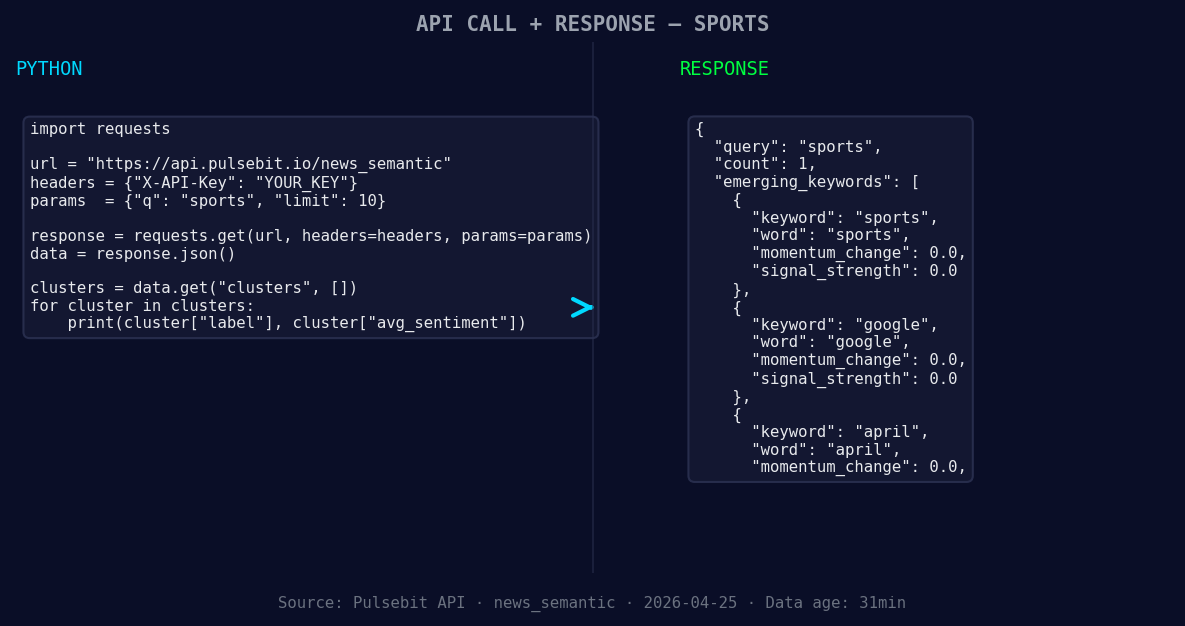
*Left: Python GET /news_semantic call for 'sports'. Right: returned JSON response structure (clusters: 3). Source: Pulsebit /news_semantic.*
# Define parameters
topic = 'sports'
score = +0.152
confidence = 0.90
momentum = +0.366
# Geographic origin filter: only English articles
url = "https://api.pulsebit.lojenterprise.com/sentiment"
params = {
"topic": topic,
"lang": "en"
}
response = requests.get(url, params=params)
data = response.json()
# Check for sentiment in the response
if data['momentum_24h'] == momentum:
print("Momentum Spike Detected:", data)
# Meta-sentiment moment for narrative framing
meta_sentiment_url = "https://api.pulsebit.lojenterprise.com/sentiment"
cluster_reason = "Clustered by shared themes: high, school, sports, scores, results."
meta_response = requests.post(meta_sentiment_url, json={"text": cluster_reason})
print("Meta Sentiment Response:", meta_response.json())
In this code, we first filter for English articles on sports, ensuring we’re capturing the relevant local sentiment. Next, we run the cluster reason string through our sentiment endpoint to assess how the narrative is being framed, providing deeper context around the spike.
Now, let's consider three immediate builds you could implement based on this discovery:
- Geo-Filtered Sentiment Analysis: Create a real-time dashboard that visualizes sentiment scores for sports in specific regions like Green Bay. Use the geographic filter to ensure only local articles are considered, helping you stay ahead by analyzing trends at the community level.

Geographic detection output for sports. Hong Kong leads with 1 articles and sentiment -0.70. Source: Pulsebit /news_recent geographic fields.
Meta-Sentiment Narrative Tracking: Develop a function that continuously analyzes the sentiment around clustered themes. For example, track how narratives around "high school sports," "April events," and "Google" evolve over time. This will allow you to identify shifts and catch emerging trends before they peak.
Threshold-Based Alerts: Set up an alert system that triggers when the momentum score exceeds a certain threshold, say +0.3. This will give you a head start on stories gaining traction in real-time, ensuring you're not just reactive but proactive in your analysis of sports sentiment.
If you’re ready to dive deeper, head over to our documentation at pulsebit.lojenterprise.com/docs. You can copy-paste the code snippets above and run them in under 10 minutes to start catching these insights yourself.


Top comments (0)