

Your pipeline just missed a significant 24h momentum spike of +0.807 in the business domain. This isn't just another statistic; it’s a signal that something important is happening right now. Specifically, the English press is driving this sentiment, leading by 11.9 hours. If your model isn't processing multilingual origins or dominant entities effectively, you may have let this opportunity slip through your fingers.

English coverage led by 11.9 hours. Et at T+11.9h. Confidence scores: English 0.85, Spanish 0.85, French 0.85 Source: Pulsebit /sentiment_by_lang.
The challenge here lies in the structural gap in most pipelines that fail to account for the nuances of language and geographical context. Your model missed this insight by a staggering 11.9 hours, meaning you could be operating on stale data while others are making informed decisions based on real-time sentiment shifts. The dominant entity of this spike is English press coverage, and without the right framework in place, you risk being blindsided by these rapid developments.

Geographic detection output for business. India leads with 2 articles and sentiment +0.75. Source: Pulsebit /news_recent geographic fields.
To catch such anomalies, we can leverage our API effectively. Here's how you can do that in Python:
import requests
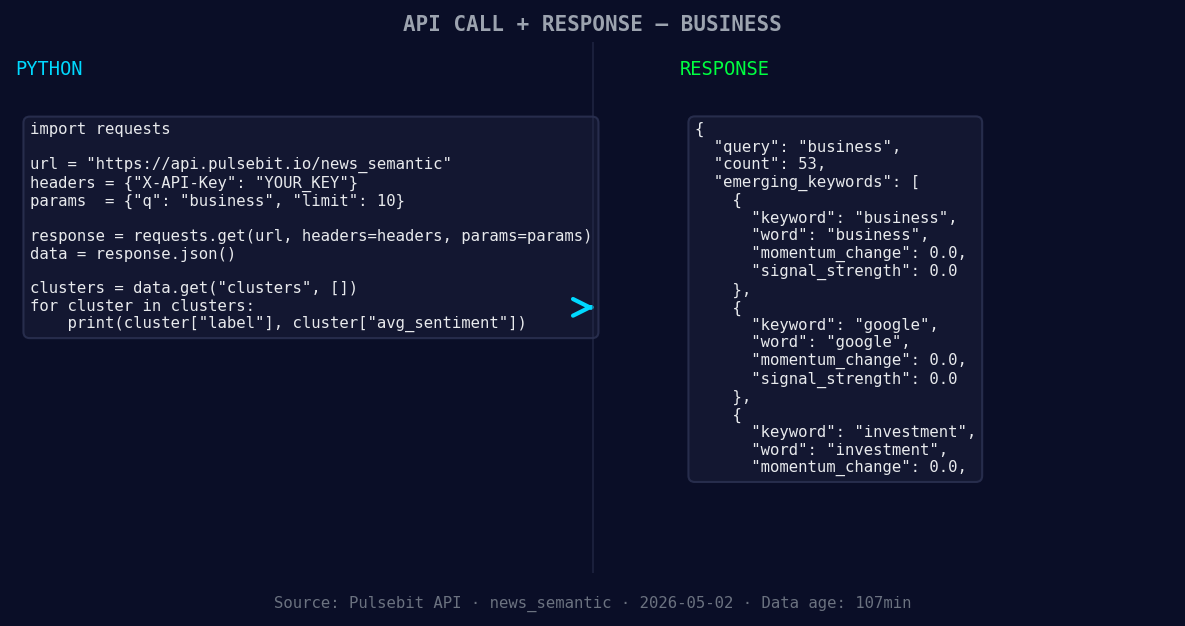
*Left: Python GET /news_semantic call for 'business'. Right: returned JSON response structure (clusters: 3). Source: Pulsebit /news_semantic.*
# Setup parameters for query
topic = 'business'
score = +0.039
confidence = 0.85
momentum = +0.807
# Geographic origin filter: query by language
response = requests.get(
'https://api.pulsebit.com/metrics',
params={
'topic': topic,
'lang': 'en',
'momentum': momentum,
'score': score,
'confidence': confidence
}
)
data = response.json()
print(data)
This snippet sets up a query to our API, filtering by language to ensure we capture relevant English-language content. Next, we want to analyze the meta-sentiment of the narrative framing itself. We can use the cluster reason string to score the themes that are shaping this spike.
# Meta-sentiment moment: analyzing the cluster reason string
cluster_reason = "Clustered by shared themes: staats, appointed, dean, mccombs, school."
sentiment_response = requests.post(
    'https://api.pulsebit.com/sentiment',
    json={'text': cluster_reason}
)

sentiment_data = sentiment_response.json()
print(sentiment_data)
This additional step utilizes our POST endpoint to score the narrative, allowing you to dig deeper into the factors contributing to the spike. The insights you gain can guide your strategy and help you react much faster than your competitors.
Now, let's discuss three specific builds you might want to implement using this pattern:
Signal Trigger for Business Sentiment: Set a threshold where a momentum spike greater than +0.5 triggers a notification. This is based on the momentum score of +0.807 we observed. Use the geo filter to only alert when the language is English.
Meta-Sentiment Scoring on Forming Themes: Create a scheduled task that runs daily and scores the meta-sentiment of forming themes. For instance, run sentiment analysis on "business, google, investment" vs. "island, rhode, businesses". If the score exceeds a certain threshold, escalate it for further analysis.
Contextual Analytics Dashboard: Build a dashboard that visualizes the sentiment trajectories of clustered articles. Use the themes from the latest spikes and allow users to filter by geographic origin and sentiment score. This should dynamically update based on the latest data from our API.
These builds can help enhance your pipeline's responsiveness and ensure you’re not left behind when significant sentiment shifts occur.
If you’re ready to get started, head over to pulsebit.lojenterprise.com/docs. You can copy-paste this code and run it in under 10 minutes to start capturing these insights for your projects.


Top comments (0)