

Your pipeline just missed a significant anomaly: a 24h momentum spike of +0.500 in sentiment surrounding the topic of the economy. This spike is noteworthy, especially considering it has emerged amidst discussions about the "Iran War's Impact on Global Economy." With Spanish press leading the charge, this insight is critical for anyone looking to stay ahead of sentiment trends.
But here's the catch: if your model doesn't account for multilingual sources or dominant entities, you could be lagging behind by 16.1 hours. The leading language in this case is Spanish, which signals that there's a narrative developing that you might not be fully capturing. This time lag can severely impact your response strategy, whether you are making investment decisions, crafting communication strategies, or adjusting your product roadmap. You could be missing the boat on key insights while others are already reacting.

Spanish coverage led by 16.1 hours. Portuguese at T+16.1h. Confidence scores: Spanish 0.95, English 0.95, French 0.95 Source: Pulsebit /sentiment_by_lang.
To catch this momentum spike, we can leverage our API to filter sentiment data based on language and run a meta-sentiment analysis on the clustered themes. Here's how we can do it in Python:
import requests
# Define parameters for the API call
topic = 'economy'
momentum = +0.500
score = +0.179
confidence = 0.95
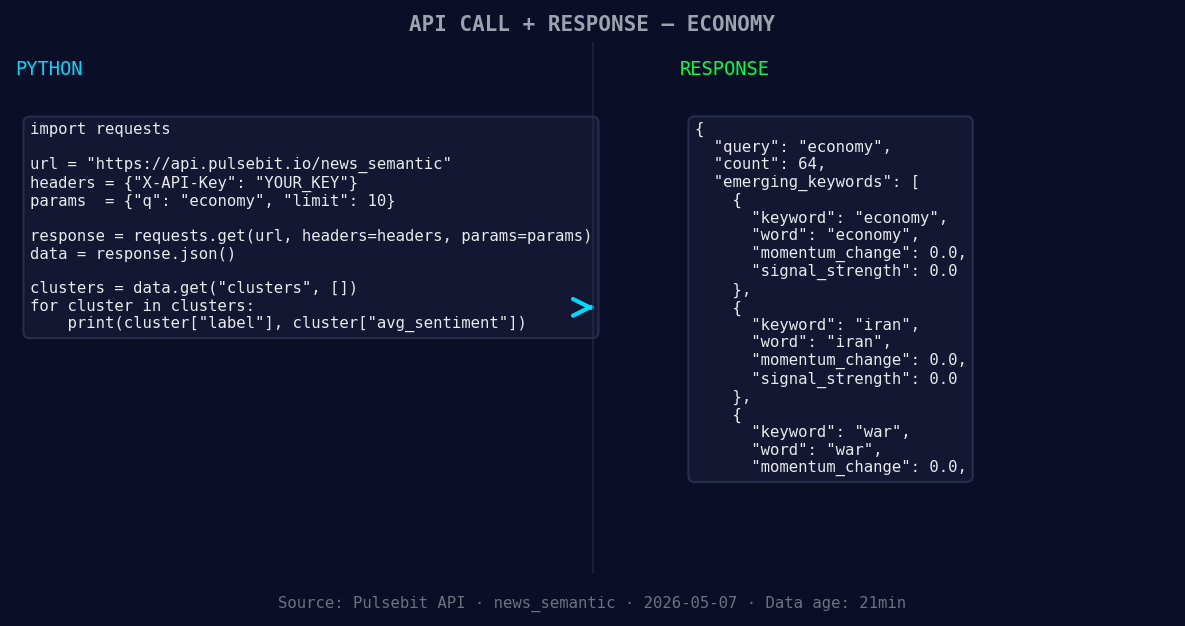
*Left: Python GET /news_semantic call for 'economy'. Right: returned JSON response structure (clusters: 3). Source: Pulsebit /news_semantic.*
# Step 1: Geographic origin filter for Spanish language articles
response = requests.get(
'https://api.pulsebit.com/v1/sentiment',
params={
'topic': topic,
'lang': 'sp',
'momentum': momentum,
'score': score,
'confidence': confidence
}
)
# Check the response
if response.status_code == 200:
data = response.json()
print("Spanish sentiment data:", data)
else:
print("Error fetching data:", response.status_code)
# Step 2: Meta-sentiment moment
meta_sentiment_input = "Clustered by shared themes: but, business, matters, economy, could."
meta_response = requests.post(
'https://api.pulsebit.com/v1/sentiment',
json={'text': meta_sentiment_input}
)
if meta_response.status_code == 200:
meta_data = meta_response.json()
print("Meta-sentiment analysis:", meta_data)
else:
print("Error in meta-sentiment analysis:", meta_response.status_code)
In this code, we initiate a GET request to filter our sentiment data by Spanish articles. This allows us to capture the leading narrative about the economy related to the Iran conflict. Next, we POST a string summarizing the clustered themes back to our API to evaluate the narrative's sentiment. This step helps us contextualize the emerging themes, allowing us to gauge public sentiment accurately.
Now that we have a mechanism to capture this momentum spike, let’s build on this pattern. Here are three specific builds to consider:
- Spanish Language Sentiment Feeds: Create a feed that continuously monitors sentiment for the economy in Spanish, using the geographic filter. Set a threshold of +0.300 for sentiment score to trigger alerts for significant changes.

Geographic detection output for economy. India leads with 3 articles and sentiment +0.08. Source: Pulsebit /news_recent geographic fields.
Meta-Sentiment Analysis Dashboard: Build a dashboard that visualizes meta-sentiment scores for clustered themes like "economy," "Iran," and "war." Use a threshold of 0.600 for confidence to display only the most reliable insights, helping you track narrative shifts effectively.
Gap Analysis Tool: Develop a tool that compares sentiment momentum across multiple languages. Specifically, contrast Spanish with Portuguese on themes like "business" and "matters." This will help identify where narratives are developing fastest and where your pipeline is lagging.
These builds will allow you to be proactive rather than reactive. By tapping into our API, you can close the gap on significant sentiment shifts, ensuring your strategies are informed by the latest insights.
To get started, check out our documentation at pulsebit.lojenterprise.com/docs. You can copy-paste the code above and run it in under 10 minutes to start catching those crucial sentiment shifts.


Top comments (0)