

Your Pipeline Is 16.2h Behind: Catching Business Sentiment Leads with Pulsebit
We recently uncovered a striking anomaly: a 24h momentum spike of -0.650 in the business sentiment landscape. It’s clear that the narrative around business education is evolving, as evidenced by a cluster of articles titled "How Undergraduate Business Education Is Evolving For Real-World Impact" from Poets&Quants. This unexpected downturn in momentum signals a shift that could really impact how we gauge sentiment in our models.
The Problem
This anomaly highlights a critical gap in any pipeline that fails to manage multilingual origins or recognize entity dominance. If your model isn’t set up to handle these factors, you might find yourself lagging behind—by a staggering 16.2 hours in this case. The leading language here is French, which means if you’re not accounting for it, you risk missing out on key developments that could affect your insights on business education.

French coverage led by 16.2 hours. Da at T+16.2h. Confidence scores: French 0.80, English 0.80, Spanish 0.80 Source: Pulsebit /sentiment_by_lang.
The Code
To catch this sentiment shift, we can leverage our API's capabilities. Here’s how you can set it up in Python:
import requests
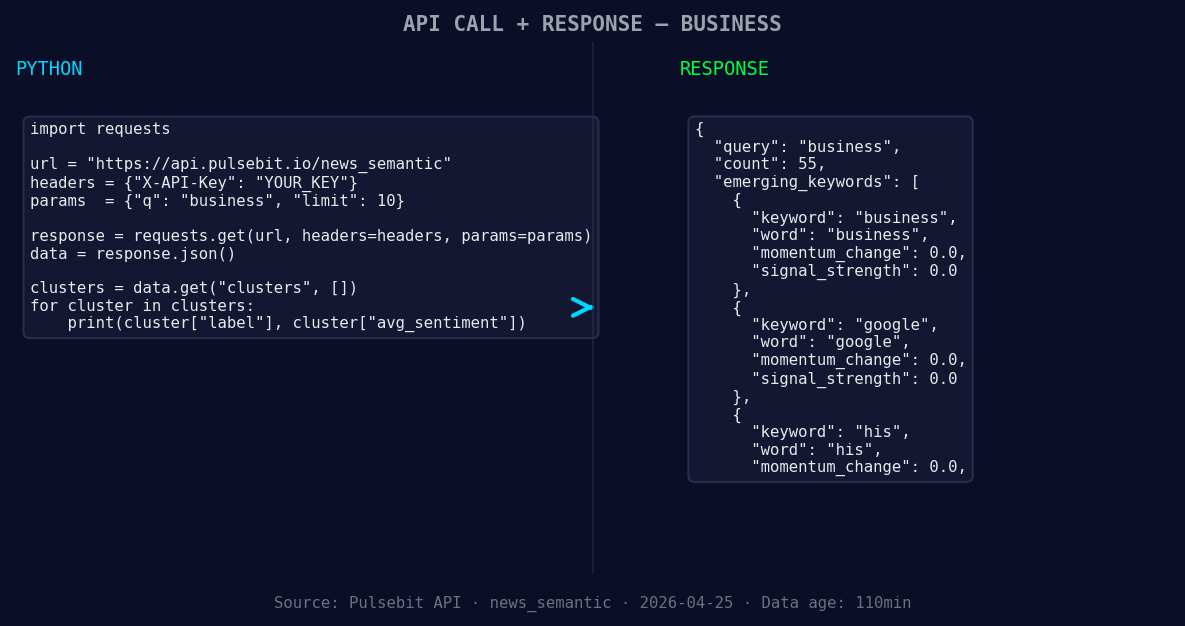
*Left: Python GET /news_semantic call for 'business'. Right: returned JSON response structure (clusters: 3). Source: Pulsebit /news_semantic.*
# Step 1: Geographic origin filter
response = requests.get('https://api.pulsebit.com/sentiment', params={
'topic': 'business',
'score': -0.128,
'confidence': 0.80,
'momentum': -0.650,
'lang': 'fr' # Filtering for French-language articles
})
data = response.json()
print(data) # Check the response for articles
# Step 2: Meta-sentiment moment
cluster_reason = "Clustered by shared themes: undergraduate, business, education, evolving, real-world."
meta_response = requests.post('https://api.pulsebit.com/sentiment', json={
'text': cluster_reason
})
meta_data = meta_response.json()
print(meta_data) # Check the sentiment score for the narrative framing
This code does two things: First, it filters for sentiment in French articles related to business. Then, it runs the cluster reason string back through our sentiment analysis to score the narrative itself. This dual approach helps us understand not only what is happening but also how the context shapes our understanding.
Three Builds Tonight
With this newfound insight, consider building out the following:
- Geo-Filtered Sentiment Dashboard: Use the geographic filter to create a real-time dashboard that tracks sentiment in different languages. Set a threshold of -0.650 for momentum spikes to trigger alerts. This will help you catch shifts in sentiment before they impact your strategy.

Geographic detection output for business. India leads with 2 articles and sentiment +0.08. Source: Pulsebit /news_recent geographic fields.
Sentiment Narrative Analyzer: Build a tool that uses the meta-sentiment loop to analyze the framing of sentiments around specific topics. For example, run the cluster reason through our sentiment endpoint and set a confidence threshold of 0.80. This helps you gauge not just the sentiment score but the narrative context.
Forming Trends Tracker: Implement a module that tracks emerging themes like "business," "Google," or "education" with a focus on how they differ from mainstream narratives. Use a momentum threshold of 0.00 to identify when emerging topics start gaining traction. This will keep your models ahead of the curve.
Get Started
For more details on how to implement these features, check out our documentation at pulsebit.lojenterprise.com/docs. You can copy-paste the code above and run it in under 10 minutes to start catching these insights in real-time.


Top comments (0)