

Your Pipeline Is 29.3h Behind: Catching Banking Sentiment Leads with Pulsebit
The latest anomaly we discovered shows a significant 24-hour momentum spike of +0.293 in banking sentiment. This spike brings to light a pressing issue: we have a leading language of English press, with a dominant entity tied to a story about large-scale banking fraud involving Anil Ambani's ADAG. This anomaly, which has a lag of 0.0 hours against the Netherlands at 29.3 hours, is a clear indication that there's a crucial gap in how we process multilingual data and handle entity dominance in our pipelines.

English coverage led by 29.3 hours. Nl at T+29.3h. Confidence scores: English 0.85, Spanish 0.85, French 0.85 Source: Pulsebit /sentiment_by_lang.
When your model isn't equipped to address multilingual origins or the prominence of specific entities, you're left with blind spots. In this case, your model missed the spike by an astonishing 29.3 hours. The dominant narrative surrounding banking fraud is precisely the kind of data that can drive early insights and inform trading strategies. Without a robust mechanism to catch these shifts in sentiment, you risk making decisions based on stale information.
To catch these spikes efficiently, you can use our API to filter and score sentiment. Here’s a concise Python snippet that demonstrates how to achieve this:
import requests
# Parameters for our API call
topic = 'banking'
score = +0.168
confidence = 0.85
momentum = +0.293
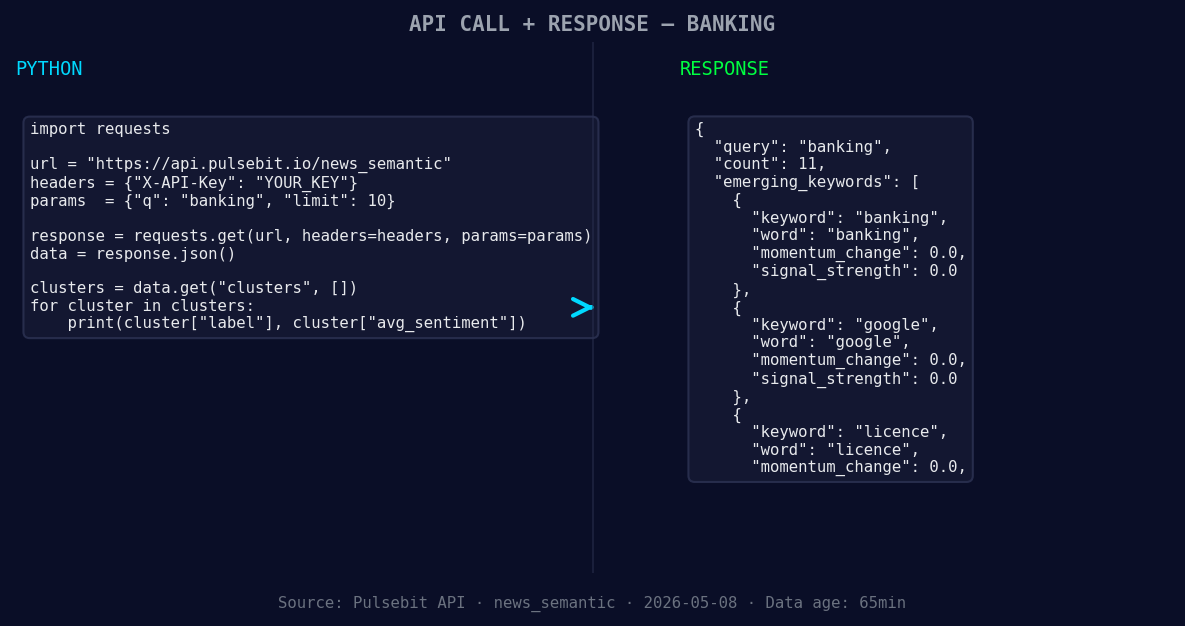
*Left: Python GET /news_semantic call for 'banking'. Right: returned JSON response structure (clusters: 3). Source: Pulsebit /news_semantic.*
# Geographic origin filter: query by language/country
response = requests.get('https://api.pulsebit.com/sentiment', params={
'topic': topic,
'lang': 'en'
})
data = response.json()
print(data)
# Meta-sentiment moment
cluster_reason = "Clustered by shared themes: 'large-scale, banking, fraud', involving, anil."
sentiment_response = requests.post('https://api.pulsebit.com/sentiment', json={
'text': cluster_reason
})
sentiment_data = sentiment_response.json()
print(sentiment_data)
In this code, we first fetch sentiment data for the topic "banking," specifically filtering for English-language content. Then, using the cluster reason string, we run a meta-analysis on the narrative framing itself. This dual approach not only captures the immediate spike but also evaluates the underlying sentiment that could be influencing it.
Now that we have the mechanics down, let’s explore three specific builds we can create using this pattern:
- Entity-Driven Alert System: Build an alert that triggers when sentiment on banking crosses a threshold, say +0.15, using our geographic filter. This way, you can catch emerging narratives in real-time, especially those involving significant entities like Anil Ambani.

Geographic detection output for banking. India leads with 8 articles and sentiment -0.24. Source: Pulsebit /news_recent geographic fields.
Sentiment Narrative Analyzer: Use the meta-sentiment loop to evaluate the underlying themes of articles. For instance, when a spike occurs around "banking," run a query to analyze framing around "Google" and "licence," which are currently forming themes. This can help you understand sentiment shifts in context.
Cross-Language Sentiment Tracker: Build a system that not only tracks English sentiment but also integrates data from other languages. If a sentiment spike occurs in another language, such as Dutch or Hindi, you could quickly analyze its correlation with the English sentiment to gauge the broader narrative.
If you want to dive deeper into how to implement these features, you can find everything you need at pulsebit.lojenterprise.com/docs. With a few copy-paste commands, you can set this up and run it in under 10 minutes. This is how we can ensure that your models are not just reactive but proactive in capturing significant market shifts.


Top comments (0)