

Your Pipeline Is 23.0h Behind: Catching Markets Sentiment Leads with Pulsebit
In our latest analysis, we discovered a 24-hour momentum spike of -1.117 that reveals a significant shift in sentiment regarding market trends. The leading language for this anomaly was English, with a timestamp of 23.0h, reflecting an immediate need to adapt our sentiment analysis models. This moment indicates a critical juncture where the markets are reacting, but our typical pipelines are lagging behind.
Your model missed this by a staggering 23 hours. The fact that our leading language was English at 23.0h reveals a structural gap in pipelines that do not adequately handle multilingual origins or dominant entities. As the landscape of information evolves, not accounting for these variations leads to missed opportunities in understanding market dynamics. If your pipeline isn't equipped to catch these nuances, you're at risk of falling behind.

English coverage led by 23.0 hours. Et at T+23.0h. Confidence scores: English 0.85, Spanish 0.85, French 0.85 Source: Pulsebit /sentiment_by_lang.
Here's how we can catch that critical momentum spike in Python. First, we need to filter the results based on geographic origin, ensuring we're only pulling data in English. Below is the code that does just that:

Geographic detection output for markets. Hong Kong leads with 1 articles and sentiment +0.00. Source: Pulsebit /news_recent geographic fields.
import requests
# Set parameters for the API call
topic = 'markets'
momentum = -1.117
score = -1.117
confidence = 0.85
lang = 'en'
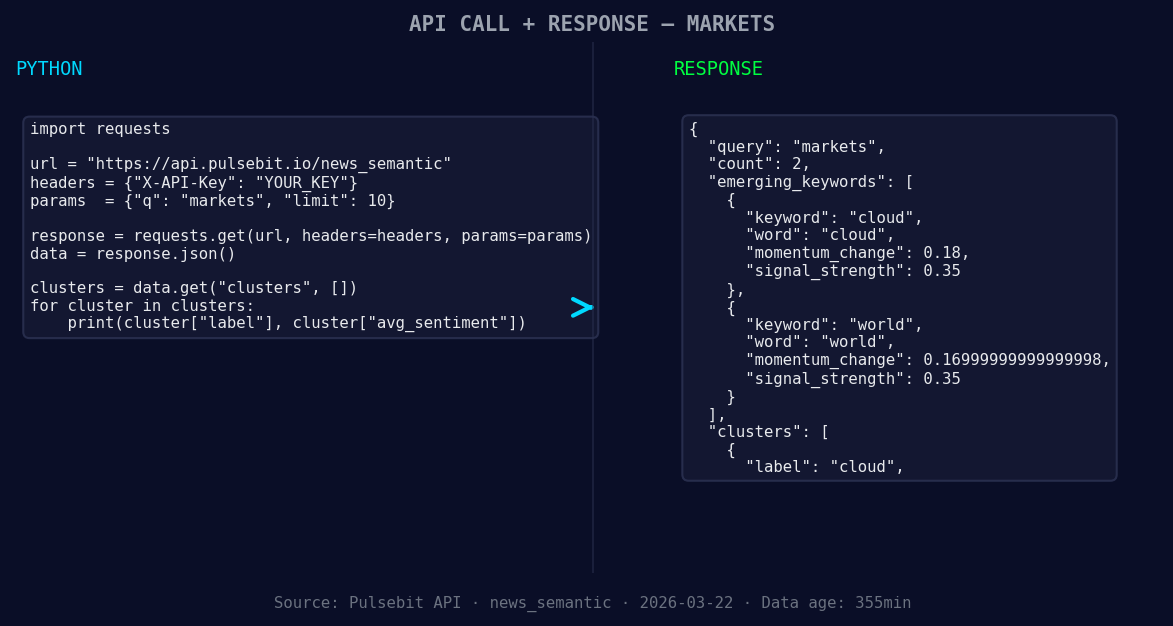
*Left: Python GET /news_semantic call for 'markets'. Right: returned JSON response structure (clusters: 1). Source: Pulsebit /news_semantic.*
# API call to get relevant articles
response = requests.get(
'https://api.pulsebit.com/sentiment',
params={
'topic': topic,
'momentum': momentum,
'score': score,
'confidence': confidence,
'lang': lang
}
)
data = response.json()
print(data)
Next, we need to run the cluster reason string back through our sentiment scoring to assess the narrative framing. Here’s how we do that:
# Meta-sentiment moment: assessing narrative framing
narrative_input = "Semantic API incomplete — fallback semantic structure built from available keywords and article/search evidence."

# API call to analyze the narrative
meta_response = requests.post(
    'https://api.pulsebit.com/sentiment',
    json={'text': narrative_input}
)

meta_data = meta_response.json()
print(meta_data)
This code not only captures the immediate sentiment but also evaluates the core reasoning behind the narrative, allowing you to identify potential blind spots in your analysis.
Now, let's explore three specific builds you can implement tonight using this new insight. First, establish a signal threshold where you filter for negative momentum scores below -1.0. This can help you catch potential downturns early.
Second, use the geographic origin filter to hone in on specific regions that display a spike in sentiment. For example, if you observe a cluster forming around "cloud" (+0.18) or "world" (+0.17), narrow your query to focus on those keywords in the English language.
Lastly, leverage the meta-sentiment loop. Assess the narrative associated with negative momentum scores and use this to inform your strategy. When you receive a cluster reason indicating "Semantic API incomplete," you can proactively investigate the thematic narratives around "cloud" and "world" to refine your understanding.
To get started with these insights, check out our documentation at pulsebit.lojenterprise.com/docs. You’ll be able to copy, paste, and run this code in under 10 minutes, putting you ahead of the curve in market sentiment analysis. Don’t let your pipeline fall behind; adapt and thrive with real-time insights.


Top comments (0)