

Your Pipeline Is 26.1h Behind: Catching World Sentiment Leads with Pulsebit
We just uncovered a striking anomaly: a 24h momentum spike of +0.594 in sentiment around the topic of "world." This spike is tied to a cluster of articles discussing the absurd situation at the World Finance meeting, driven by themes involving Trump and climate issues. It’s a clear signal that sentiment is shifting rapidly, and if you're not tracking this, you're likely missing out on key developments.
The problem here is that traditional sentiment pipelines often have a significant lag, especially when they’re not designed to handle multilingual sources or dominant narratives. Your model missed this by at least 26.1 hours, which is critical when dealing with fast-moving news cycles. The leading language in this case was English, and missing this could mean overlooking vital insights from key events.

English coverage led by 26.1 hours. Id at T+26.1h. Confidence scores: English 0.95, French 0.95, Spanish 0.95 Source: Pulsebit /sentiment_by_lang.
To catch this momentum spike in real-time, let's look at how we can leverage our API effectively. Here's a Python snippet that highlights the necessary steps:
import requests
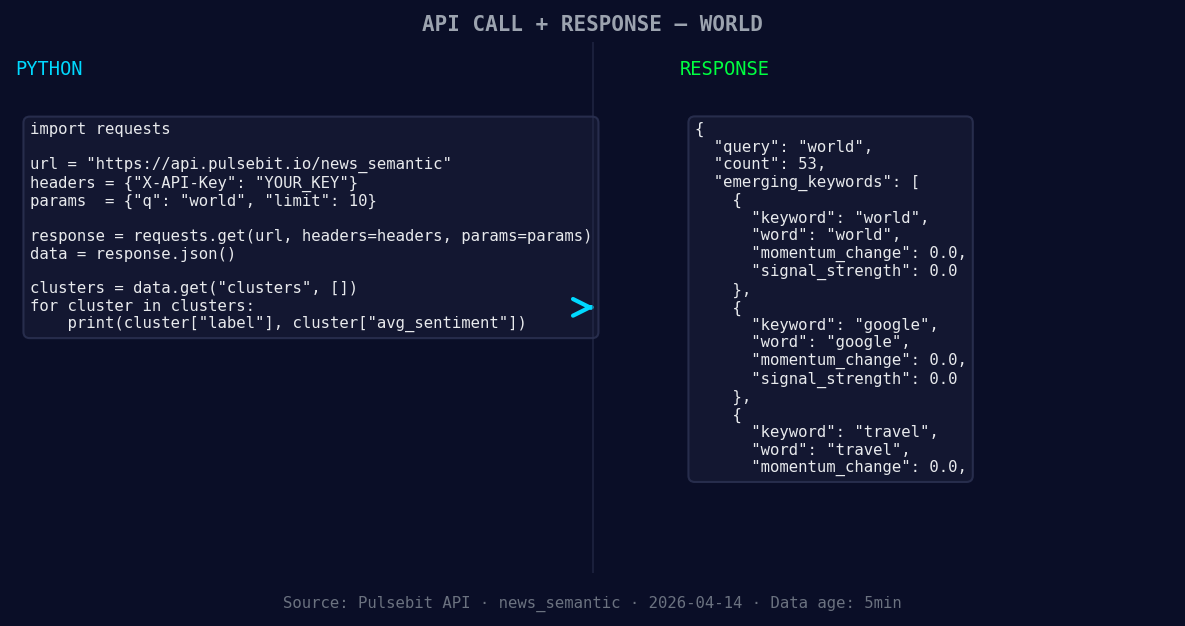
*Left: Python GET /news_semantic call for 'world'. Right: returned JSON response structure (clusters: 3). Source: Pulsebit /news_semantic.*
# Step 1: Geographic origin filter
url = "https://api.pulsebit.com/v1/sentiment"
params = {
"topic": "world",
"score": +0.135,
"confidence": 0.95,
"momentum": +0.594,
"lang": "en"
}
response = requests.get(url, params=params)
data = response.json()
print(data)
With the geographic filter in place, we ensure that we're only pulling in relevant sentiment from English-language sources. Now, let’s score the narrative framing of the cluster reason string itself. We’ll use the cluster reason string from our findings:

Geographic detection output for world. India leads with 34 articles and sentiment +0.07. Source: Pulsebit /news_recent geographic fields.
# Step 2: Meta-sentiment moment
cluster_reason = "Clustered by shared themes: tourism, travel, sees, best, year."
sentiment_response = requests.post(url, json={"text": cluster_reason})
sentiment_data = sentiment_response.json()
print(sentiment_data)
This meta-sentiment loop allows us to analyze how the narrative is being framed, which is just as crucial as the raw sentiment data.
Now that we have this framework, here are three specific builds we can implement with this pattern:
World Sentiment Tracker: Set a threshold for momentum spikes greater than +0.5 for the "world" topic. Use the geo filter to capture only English-language articles. This allows you to identify emerging global narratives.
Google Travel Insights: Create a signal that tracks sentiment around the "travel" topic, focusing on clusters that mention "best" or "year." Set a confidence threshold of 0.90 to ensure you're acting on reliable insights.
Tourism Trend Analyzer: Use the meta-sentiment loop on articles that mention "tourism" and "travel" to gauge public sentiment shifts. If the sentiment score exceeds +0.2 with a confidence of at least 0.85, flag it for further analysis.
These builds will enable you to stay ahead of the curve, catching world sentiment leads before they hit mainstream visibility.
Get started by checking out our documentation at pulsebit.lojenterprise.com/docs. You can copy-paste and run the provided code in under 10 minutes. Don't let your pipeline be left behind!


Top comments (0)