

Your Pipeline Is 19.4h Behind: Catching Culture Sentiment Leads with Pulsebit
We recently observed a remarkable anomaly: a 24-hour momentum spike of +0.237 centered on discussions around "Trans Women and Internet Culture." This spike, driven by a leading English press narrative, highlights the importance of staying attuned to emerging cultural conversations. With a sentiment score of +0.595 and a confidence level of 0.85, this data signals a notable shift in public discourse that we can't afford to overlook.
But what does this mean for your pipeline? If your model isn't equipped to handle multilingual origins or entity dominance, you may have missed this significant cultural shift by a staggering 19.4 hours. This gap is particularly concerning given that the leading language in this anomaly is English, with a direct impact on how you interpret sentiment around gender and internet discussions.

English coverage led by 19.4 hours. Sv at T+19.4h. Confidence scores: English 0.85, French 0.85, Spanish 0.85 Source: Pulsebit /sentiment_by_lang.
Let’s dive into how we can catch this momentum spike using our API. First, we need to filter our query to focus specifically on English-language articles that relate to the topic of culture. Here’s how you can do that:
import requests
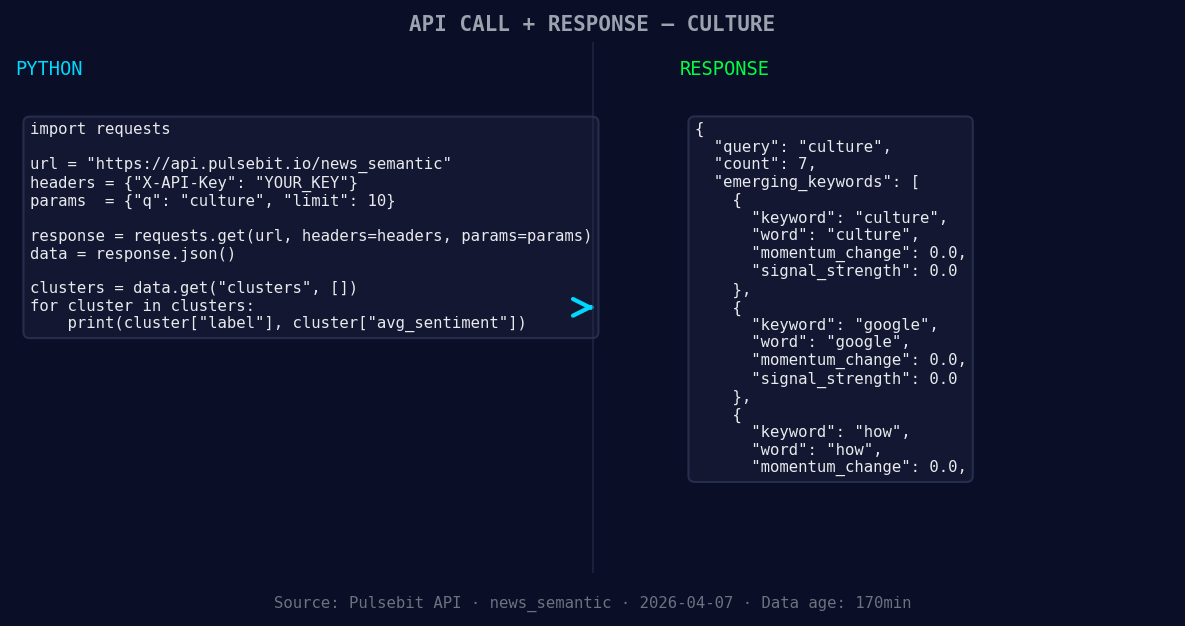
*Left: Python GET /news_semantic call for 'culture'. Right: returned JSON response structure (clusters: 3). Source: Pulsebit /news_semantic.*
url = "https://api.pulsebit.com/v1/articles"
params = {
"topic": "culture",
"lang": "en"
}
response = requests.get(url, params=params)
articles = response.json()
Now that we have our English-language articles, we should score the narrative framing behind the cluster reason. This allows us to gauge the overall sentiment around the themes of women, viral, trans, conversation, and internet. Here’s how we run that back through our sentiment scoring endpoint:
sentiment_url = "https://api.pulsebit.com/v1/sentiment"
narrative = "Clustered by shared themes: women, viral, trans, conversation, internet."
sentiment_response = requests.post(sentiment_url, json={"text": narrative})
sentiment_score = sentiment_response.json()
By executing these two snippets of code, you can efficiently capture the momentum around this cultural conversation and better inform your models.
Now that you have the basics, here are three specific builds you should consider implementing tonight:
- Geo-Filtered Sentiment Analysis: Enhance your existing sentiment models by using the geographic origin filter to capture sentiment from different regions, specifically focusing on English articles. This will help you identify regional variations in sentiment around the topic of culture.

Geographic detection output for culture. India leads with 3 articles and sentiment +0.78. Source: Pulsebit /news_recent geographic fields.
Meta-Sentiment Loop: Implement a routine that not only fetches sentiment scores for articles but also evaluates the sentiment of the framing narratives. This will give you a more nuanced understanding of how conversations are evolving, especially around forming themes like culture and trans issues.
Threshold Alerts for Emerging Topics: Set up alerts for when momentum spikes exceed a threshold (e.g., +0.2) in certain clusters. For instance, when sentiment around "women" or "viral" crosses this threshold, you can prompt your analytics team to investigate further and adapt your strategies accordingly.
In a world where cultural conversations can shift overnight, staying ahead of the curve is crucial. We can help you leverage these insights effectively.
For more details, check out our documentation at pulsebit.lojenterprise.com/docs. You can copy-paste the code snippets provided here and be up and running in under 10 minutes. Don't let your pipeline lag behind!


Top comments (0)