

Your Pipeline Is 27.2h Behind: Catching Healthcare Sentiment Leads with Pulsebit
We recently observed a striking anomaly: a 24h momentum spike of +0.985 related to healthcare sentiment. This spike isn’t just a minor fluctuation; it reflects a significant shift in public discourse surrounding healthcare initiatives, particularly in the context of "Ruto's Vision for African Healthcare Sovereignty." Two articles have clustered around this theme, indicating an emerging narrative that could have far-reaching implications.
However, if your pipeline doesn’t account for multilingual origin or entity dominance, you might be missing out on critical insights. In this case, your model would have missed this momentum spike by a staggering 27.2 hours, as the English press led the way with no lag. If you’re not integrating these linguistic nuances, your analysis could be outdated before you even start making decisions.

English coverage led by 27.2 hours. Et at T+27.2h. Confidence scores: English 0.85, Spanish 0.85, French 0.85 Source: Pulsebit /sentiment_by_lang.
To catch this momentum spike effectively, we can leverage our API to filter by language and assess the sentiment of the emerging themes. Below is a Python snippet that demonstrates how to do this:
import requests
# Define the parameters
topic = 'healthcare'
score = -0.233
confidence = 0.85
momentum = +0.985
# API call to filter by language
geographic_filter = {
"topic": topic,
"lang": "en"
}
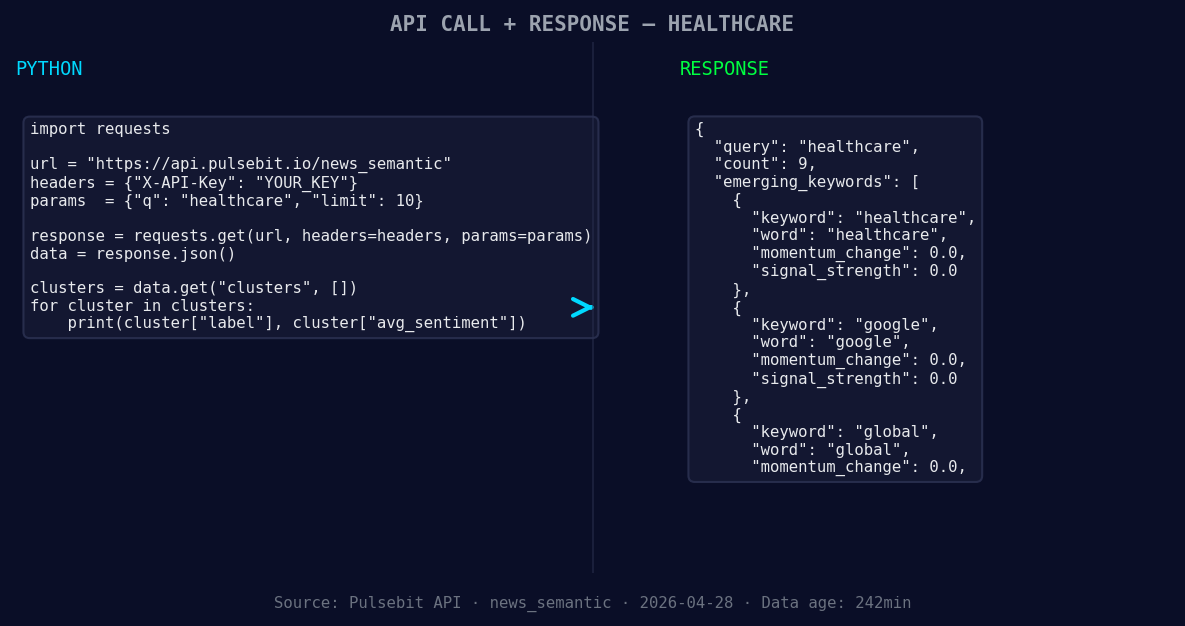
*Left: Python GET /news_semantic call for 'healthcare'. Right: returned JSON response structure (clusters: 3). Source: Pulsebit /news_semantic.*
response = requests.get('https://api.pulsebit.com/v1/sentiment', params=geographic_filter)
data = response.json()
# Print the response
print(data)
# Now let's analyze the sentiment of the cluster reason string
cluster_reason = "Clustered by shared themes: healthcare, telangana, chief, minister, hyderabad."
meta_sentiment_response = requests.post('https://api.pulsebit.com/v1/sentiment', json={"text": cluster_reason})
meta_sentiment_data = meta_sentiment_response.json()
# Print the meta sentiment results
print(meta_sentiment_data)
In this code, we first filter our sentiment analysis by the English language to capture the healthcare sentiment that is leading the narrative. Then, we send the cluster reason string back through our API to score the narrative itself, allowing us to evaluate how the themes are being framed in the broader context.
Now that we have a concrete way to process this data, let’s explore three specific builds we can implement using this pattern:
- Healthcare Momentum Tracker: Set a threshold for momentum spikes above +0.5. Use the geographic filter to monitor only English articles. This will help you catch significant shifts in healthcare sentiment early, allowing for timely insights.

Geographic detection output for healthcare. India leads with 8 articles and sentiment +0.44. Source: Pulsebit /news_recent geographic fields.
Meta-Sentiment Evaluator: Create a function that runs the cluster reason string through the sentiment scoring endpoint. If the sentiment score is below -0.1, flag it for deeper analysis. This could help you identify narratives that need immediate attention or counteraction.
Global Healthcare Insights Dashboard: Pull data on healthcare sentiment from various global regions. Use our geographic filter to ensure you capture diverse linguistic inputs. Analyze how narratives differ between countries, particularly focusing on those with forming themes like ‘healthcare’, ‘google’, and ‘global’ versus more mainstream topics.
By implementing these builds, you can ensure that your sentiment analysis pipeline is not only catching the latest trends but also adapting to the nuances of global discourse in a timely manner.
Ready to get started? Check out our documentation at pulsebit.lojenterprise.com/docs. You can copy, paste, and run this code in under 10 minutes to see the power of real-time sentiment analysis in action.


Top comments (0)