

Your Pipeline Is 28.8h Behind: Catching World Sentiment Leads with Pulsebit
We just noticed an intriguing anomaly: a 24h momentum spike of +0.532. This spike, indicating a significant shift in sentiment, is tied to the leading English press, which is currently ahead by 28.8 hours. The cluster story titled "Don’t Mention Climate: Trump Creates 'Beyond Absurd' Situation at World Finance," with two articles backing it, highlights how a few key themes can drive momentum in public discourse.
However, if your pipeline doesn't account for multilingual sources or the dominance of specific entities in your data, you might have missed this crucial insight by a staggering 28.8 hours. In this case, the leading language is English, and the dominant entity is Trump, whose presence in the narrative has shifted sentiment significantly. This gap can leave your model lagging behind the latest discussions and trends, making it vital to enhance your data processing capabilities.

English coverage led by 28.8 hours. Id at T+28.8h. Confidence scores: English 0.95, French 0.95, Spanish 0.95 Source: Pulsebit /sentiment_by_lang.
To catch these sentiment shifts, we can leverage our API. Below is a Python snippet that captures this momentum spike. We’ll query for the topic "world" and apply a geographic origin filter to focus on English-language articles.

Geographic detection output for world. India leads with 42 articles and sentiment +0.01. Source: Pulsebit /news_recent geographic fields.
import requests
# Define parameters
topic = 'world'
score = +0.026
confidence = 0.95
momentum = +0.532
lang = 'en'
# API call to fetch sentiment data
response = requests.get(f'https://api.pulsebit.com/sentiment?topic={topic}&lang={lang}&score={score}&confidence={confidence}')
data = response.json()
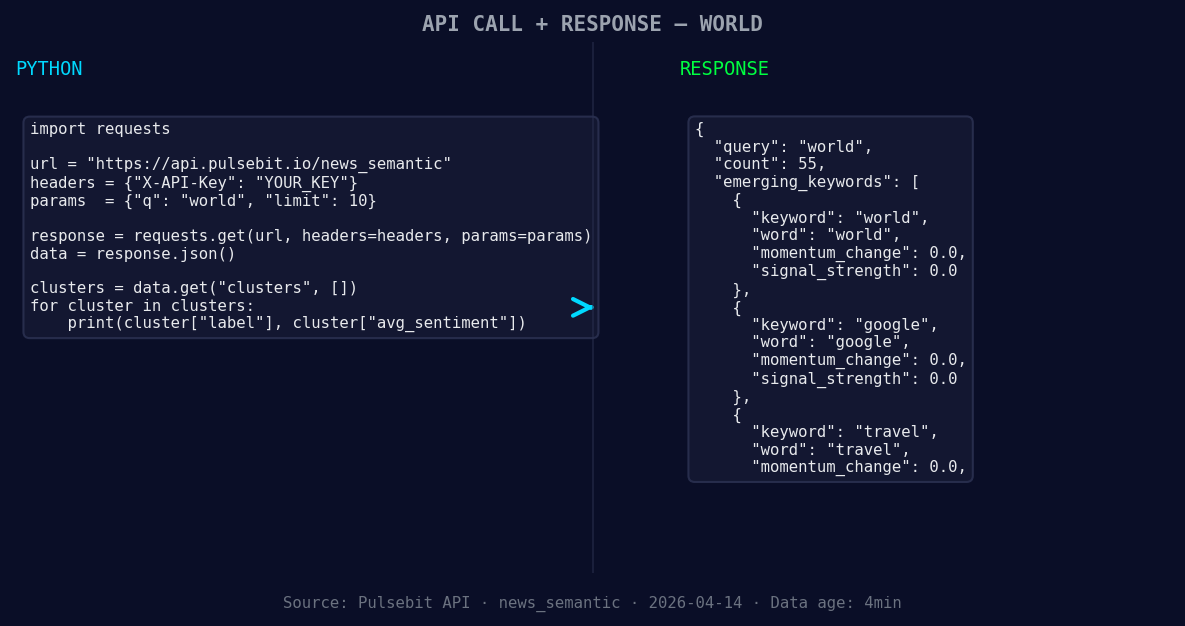
*Left: Python GET /news_semantic call for 'world'. Right: returned JSON response structure (clusters: 3). Source: Pulsebit /news_semantic.*
# Output response
print(data)
Next, we want to analyze the narrative framing itself. We’ll take the cluster reason string and run it through our sentiment API to score it. Here’s how you can do that:
# Meta-sentiment moment
meta_sentiment_input = "Clustered by shared themes: tourism, travel, sees, best, year."
meta_response = requests.post('https://api.pulsebit.com/sentiment', json={'text': meta_sentiment_input})
meta_data = meta_response.json()

# Output meta sentiment response
print(meta_data)
By implementing these snippets, you not only catch the emerging narratives but also score the framing, giving you a clearer picture of the underlying sentiments driving the conversation.
Now that we’ve established how to capture these spikes, here are three specific builds you can implement tonight:
Geo-Filtered Trends: Use the geographic origin filter to create a trend analysis dashboard for English-speaking regions. Set a threshold of a momentum spike greater than +0.5 to trigger alerts, focusing on articles related to "world" and "travel."
Meta-Sentiment Analysis: Build a meta-sentiment scoring system by feeding cluster narratives through our sentiment endpoint. Use a threshold of +0.025 sentiment score and +0.95 confidence to identify narratives that are shaping clusters around travel and tourism.
Comparative Analysis Tool: Construct a tool that compares emerging themes across languages. For instance, analyze the "world" topic alongside "travel" and "tourism," focusing on sentiment shifts over 24 hours. If you notice a score difference of more than 0.02 between languages, flag it as a potential insight for deeper investigation.
These builds are not just theoretical; they can provide actionable insights that keep you ahead of the curve.
To get started with these capabilities, check out our documentation at pulsebit.lojenterprise.com/docs. You should be able to copy-paste and run these examples in under 10 minutes.


Top comments (0)