

Your pipeline just missed a significant anomaly: a 24h momentum spike of +0.382 related to the topic of "world." The Spanish press is leading this sentiment with a notable article about Disney's new CEO and a €2.18 billion overhaul of a theme park. The fact that this spike is being driven by a single Spanish article highlights an interesting gap in how multilingual content is processed. It’s intriguing to see how a single entity can dominate sentiment in a specific language, but if your model isn’t tuned for this, you’re likely lagging behind — in this case, by 28 hours.

Spanish coverage led by 28.0 hours. Et at T+28.0h. Confidence scores: Spanish 0.85, French 0.85, English 0.85 Source: Pulsebit /sentiment_by_lang.
If your sentiment analysis pipeline isn’t designed to handle multilingual sources or entity dominance, you might be completely missing out on critical insights. In this case, the Spanish language coverage led the conversation, yet your model could have completely overlooked it due to a lack of geographic filters or entity prioritization. Your model missed this by a full 28 hours, and the dominant entity here is Disney’s CEO, which is a pivotal figure in this news cycle.

Geographic detection output for world. India leads with 31 articles and sentiment +0.00. Source: Pulsebit /news_recent geographic fields.
Here's how we can catch this momentum spike using our API. First, we’ll set up a geographic filter to query the Spanish articles specifically:
import requests
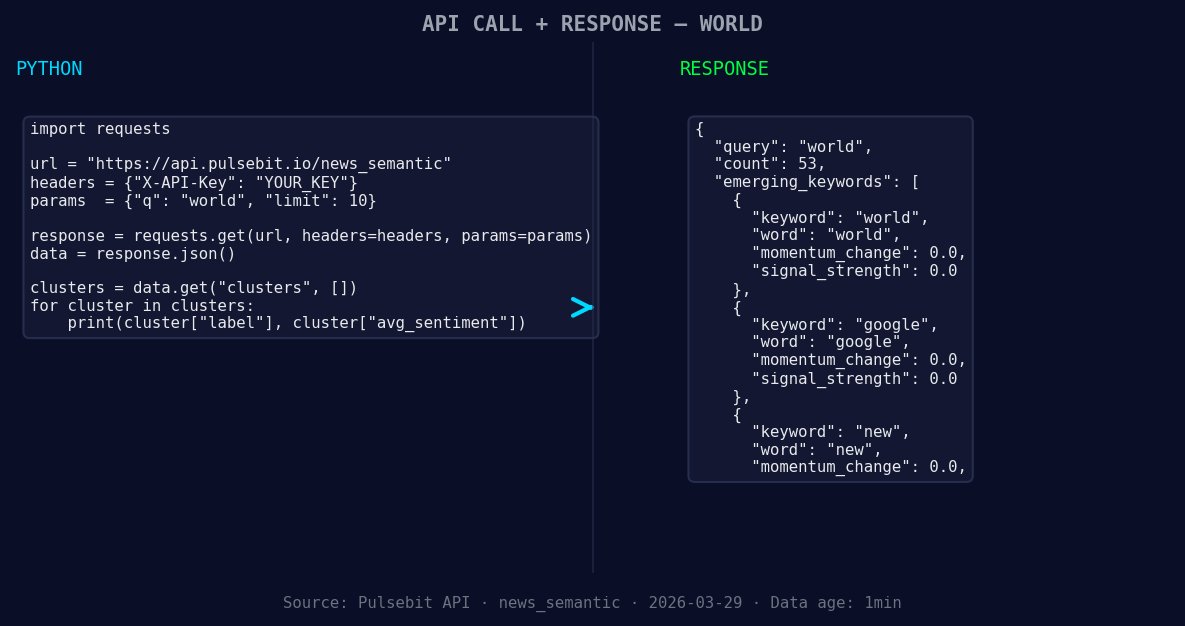
*Left: Python GET /news_semantic call for 'world'. Right: returned JSON response structure (clusters: 3). Source: Pulsebit /news_semantic.*
# Geographic origin filter
url = "https://api.pulsebit.lojenterprise.com/sentiment"
params = {
"topic": "world",
"lang": "sp", # Filter by Spanish
}
response = requests.get(url, params=params)
data = response.json()
# Print out the relevant data points
print(data)
Next, we need to run the cluster reason string back through our sentiment analysis endpoint to score the narrative framing itself. This is crucial for understanding how the themes are clustered:
# Meta-sentiment moment
meta_sentiment_url = "https://api.pulsebit.lojenterprise.com/sentiment"
narrative = "Clustered by shared themes: new, ceo, caps, billion, euro."
meta_response = requests.post(meta_sentiment_url, json={"text": narrative})
meta_data = meta_response.json()

# Print out the sentiment score and confidence
print(meta_data['sentiment_score'], meta_data['confidence'])
So what can we build with this newfound insight? Here are three specific ideas:
Geographic Sentiment Tracker: Use the geographic origin filter to monitor how sentiment varies by country. Set a signal threshold of +0.3 for significant momentum changes. This will help you capture fast-moving stories in non-English contexts before they hit mainstream channels.
Meta-Sentiment Analysis Tool: Create a tool that automatically scores narrative frames based on clustered themes. Whenever a spike is detected with a momentum score above +0.3, run the cluster reason through our sentiment endpoint to gauge the underlying framing. This can help identify whether the narrative is positive, negative, or neutral.
Anomaly Alerts: Implement an alert system that triggers whenever sentiment momentum exceeds +0.3 for a specific topic and language. This can serve as an early warning system for emerging stories of interest that may not be on your radar yet.
If you’re ready to get started with these insights, check out our documentation at pulsebit.lojenterprise.com/docs. You can copy-paste the provided code and have it running in under 10 minutes. Let’s not let significant stories like Disney’s new CEO slip through the cracks again!


Top comments (0)