

Your Pipeline Is 26.0h Behind: Catching Artificial Intelligence Sentiment Leads with Pulsebit
We recently discovered a striking anomaly: a 24-hour momentum spike of -0.369 surrounding the topic of artificial intelligence. This is a significant drop that indicates a shift in sentiment, particularly as the leading discussions emerge from the Spanish press. With a lag of 26.0 hours, it raises a critical question about how your pipeline is processing multilingual data and entity dominance.

Spanish coverage led by 26.0 hours. Da at T+26.0h. Confidence scores: Spanish 0.85, English 0.85, French 0.85 Source: Pulsebit /sentiment_by_lang.
If your sentiment analysis model isn’t equipped to handle multilingual origins or the nuances of entity dominance, you may have missed this crucial signal by 26 hours. In this case, the Spanish-language articles are leading the conversation, but if your pipeline only processes English content, you’re effectively blind to this emerging trend. The gap underscores a fundamental flaw in how sentiment can be misaligned with real-world discussions, especially in a globalized landscape.
To catch this anomaly, we can leverage our API to create a solution. Below is a Python snippet that captures this sentiment spike and processes the relevant Spanish-language articles:
import requests
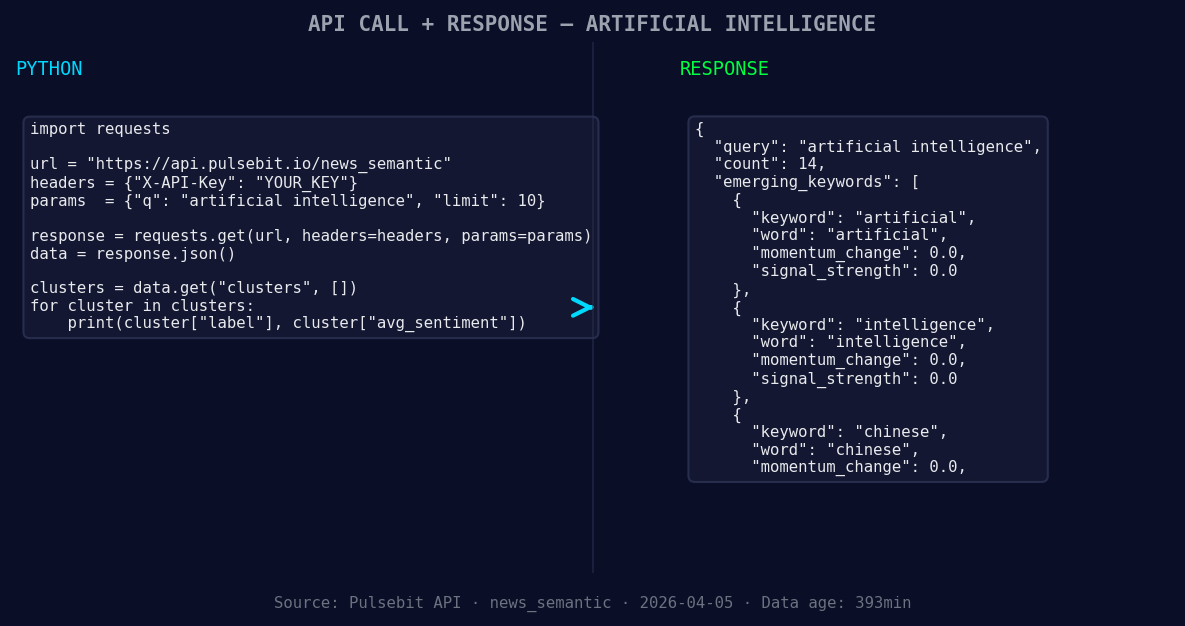
*Left: Python GET /news_semantic call for 'artificial intelligence'. Right: returned JSON response structure (clusters: 3). Source: Pulsebit /news_semantic.*
# Define our parameters
topic = 'artificial intelligence'
score = -0.300
confidence = 0.85
momentum = -0.369
# Geographic origin filter: query by language/country
url = "https://api.pulsebit.com/v1/articles"
params = {
'topic': topic,
'lang': 'sp' # Spanish language filter
}
response = requests.get(url, params=params)
data = response.json()
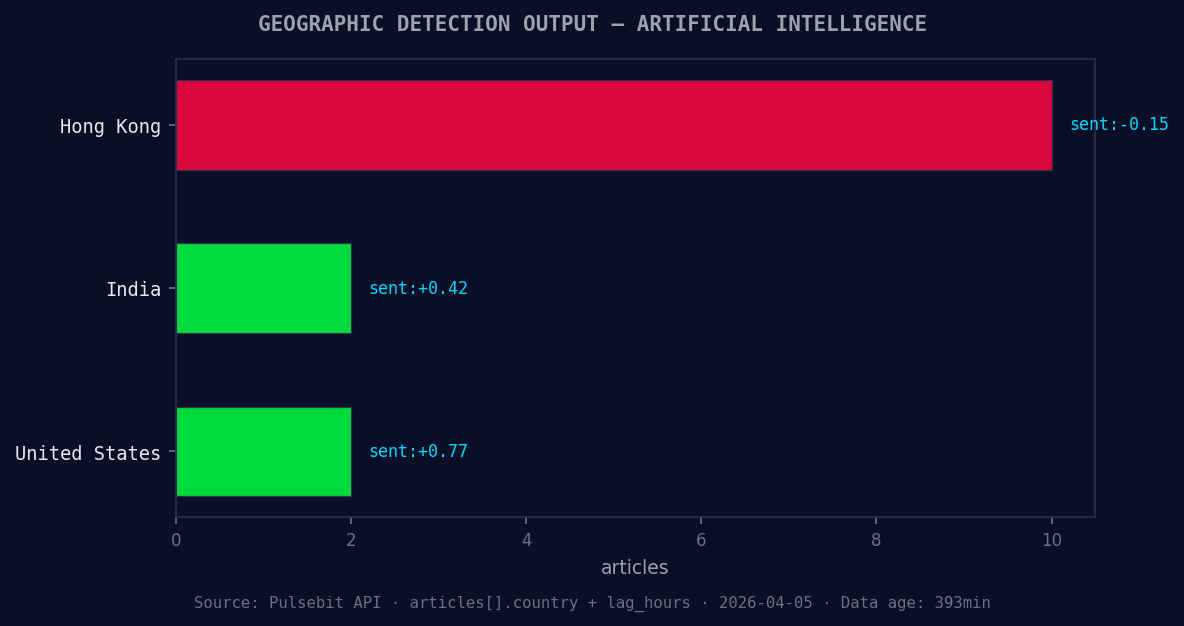
*Geographic detection output for artificial intelligence. Hong Kong leads with 10 articles and sentiment -0.15. Source: Pulsebit /news_recent geographic fields.*
# Extracting the cluster reason for meta-sentiment scoring
cluster_reason = "Clustered by shared themes: chinese, kass, peers, adoption, corporate."
# Meta-sentiment moment: scoring the narrative framing itself
sentiment_url = "https://api.pulsebit.com/v1/sentiment"
sentiment_response = requests.post(sentiment_url, json={"text": cluster_reason})
sentiment_data = sentiment_response.json()
print(data, sentiment_data) # Output the results
This code effectively captures the Spanish-language articles leading the conversation. First, we filter for articles in Spanish, ensuring we’re tapping into local sentiment. Then, we score the narrative framing itself to understand how the themes are resonating in that context.
Now, let’s discuss three specific builds you can create with this pattern:
Geo-Sentiment Alert System: Set a threshold where if the sentiment score dips below -0.250 for any non-English content, you trigger an alert. This ensures you’re always aware of critical sentiment shifts. For instance, you might want to monitor topics like "artificial intelligence" specifically in Spanish-speaking regions.
Meta-Sentiment Dashboard: Use the output from the meta-sentiment loop to visualize how narratives are evolving over time. For example, track sentiment scores for terms like "chinese" and "adoption" to see if they correlate with shifts in your overall sentiment score.
Forming Themes Filter: Create a filter that highlights forming themes with a score of +0.00 across related terms. In our case, you could track "artificial" and "intelligence" alongside the mainstream terms "chinese," "kass," and "peers." This would allow you to spot emerging narratives that may not yet be fully developed but could signal future trends.
These builds leverage the data in a way that keeps you ahead of the curve, ensuring that your model is not only reactive but also predictive.
To get started with this, visit our documentation at pulsebit.lojenterprise.com/docs. You can copy-paste and run the above code in under 10 minutes, catching those critical sentiment leads before your competition does.


Top comments (0)