

Your Pipeline Is 28.4h Behind: Catching World Sentiment Leads with Pulsebit
We recently uncovered a striking anomaly: a 24h momentum spike of +0.469. This spike indicates a significant shift in sentiment that you might have missed, especially if your pipeline isn’t tuned to handle multilingual origins or the dominance of certain entities. With the Spanish press leading the charge, this shift was apparent a full 28.4 hours before many of us caught wind of it. If your model isn’t equipped to process these nuances, you risk falling behind the curve.

Spanish coverage led by 28.4 hours. Sl at T+28.4h. Confidence scores: Spanish 0.85, English 0.85, French 0.85 Source: Pulsebit /sentiment_by_lang.
When your sentiment analysis pipeline overlooks multilingual sources, your model may miss critical information by as much as 28.4 hours. In this case, the leading language was Spanish, and the narrative was centered around Pope Leo's comments amidst a Trump controversy in Cameroon. This highlights a structural gap where a lack of language filtering and entity tracking can leave your insights stale and irrelevant.
Here’s how we can catch this momentum spike using our API. First, we’ll filter for articles in Spanish, focusing on the topic of "world" with a signal score of +0.082 and a confidence level of 0.85. Below is the Python code that accomplishes this:
import requests
# Set the parameters for the API call
params = {
"topic": "world",
"score": +0.082,
"confidence": 0.85,
"momentum": +0.469,
"lang": "sp" # Filter for Spanish language
}
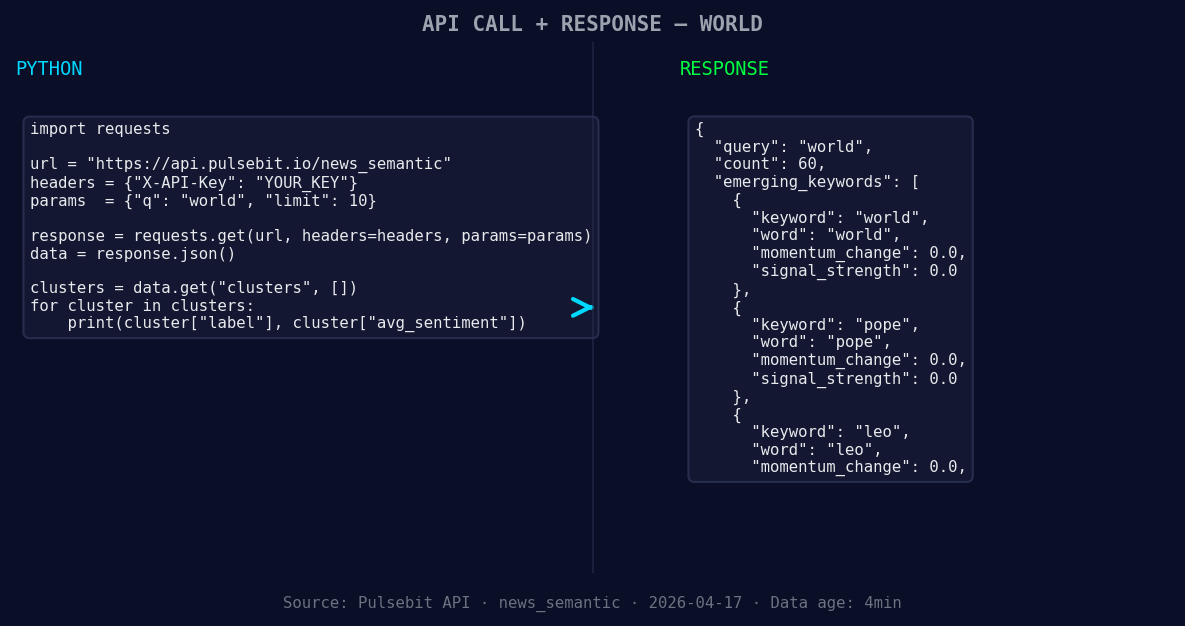
*Left: Python GET /news_semantic call for 'world'. Right: returned JSON response structure (clusters: 3). Source: Pulsebit /news_semantic.*
# Make the API call to fetch relevant articles
response = requests.get("https://api.pulsebit.com/v1/articles", params=params)
articles = response.json()
# Display the articles retrieved
print(articles)
Next, we need to analyze the narrative framing itself. We’ll run the cluster reason string through our sentiment endpoint to examine the themes more deeply. Here’s how you can do that:
# Prepare the cluster reason string for sentiment analysis
cluster_reason = "Clustered by shared themes: pope, leo, cameroon, world, trump."

# Make the API call to analyze the sentiment of the narrative
sentiment_response = requests.post("https://api.pulsebit.com/v1/sentiment", json={"text": cluster_reason})
sentiment_analysis = sentiment_response.json()

# Display the sentiment analysis results
print(sentiment_analysis)
Now, with this approach in mind, here are three specific builds that leverage this pattern:
Geo-Filtered Alert System: Set a threshold for any topic with a momentum spike greater than +0.4 for Spanish articles. If the condition is met, trigger an alert for analysts to review the content related to "world" (e.g., articles with momentum greater than +0.469).
Meta-Sentiment Dashboard: Create a dashboard that visualizes the sentiment scores of narratives clustered around specific themes. Use the meta-sentiment API call to score narratives, focusing on clusters like "pope" and "trump" to see how sentiments shift.
Trending Topics Tracker: Implement a tracking system that logs topics with momentum over +0.2 and compares them against mainstream narratives (like "news" and "education"). If a topic has a significant divergence, flag it for further investigation.
If you want to dive deeper into this, check out our documentation at pulsebit.lojenterprise.com/docs. With just a few minutes of coding, you can set up this system and start catching sentiment leads that are otherwise buried under language barriers.

Geographic detection output for world. India leads with 45 articles and sentiment -0.09. Source: Pulsebit /news_recent geographic fields.


Top comments (0)