

Your Pipeline Is 24.5h Behind: Catching Hardware Sentiment Leads with Pulsebit
We recently discovered a striking anomaly: a 24h momentum spike of +0.617 in sentiment around hardware. This is a significant uptick that signals a shift in public perception and interest, particularly in relation to the gaming industry, as evidenced by the cluster story "Forza Horizon 6 Leaker Hardware Bans" which has emerged from English press coverage. With two articles linking hardware and gaming themes, it’s clear there’s a conversation happening right now that your current models might not be capturing adequately.
The problem here is clear. If your pipeline isn’t designed to handle multilingual origins or entity dominance, you could be missing crucial trends by over 24 hours. This is particularly evident with our leading language being English, where the momentum has shifted dramatically in just a short time. Your model missed this by 24.5 hours, potentially leaving you blind to the shifts in sentiment that could impact your strategies.

English coverage led by 24.5 hours. Et at T+24.5h. Confidence scores: English 0.85, Spanish 0.85, French 0.85 Source: Pulsebit /sentiment_by_lang.
To catch this momentum shift, we can leverage our API to query the relevant data. Here’s how you can do it in Python:
import requests
# Set up parameters for the API call
params = {
"topic": "hardware",
"lang": "en",
}
response = requests.get("https://api.pulsebit.com/v1/sentiment", params=params)
data = response.json()
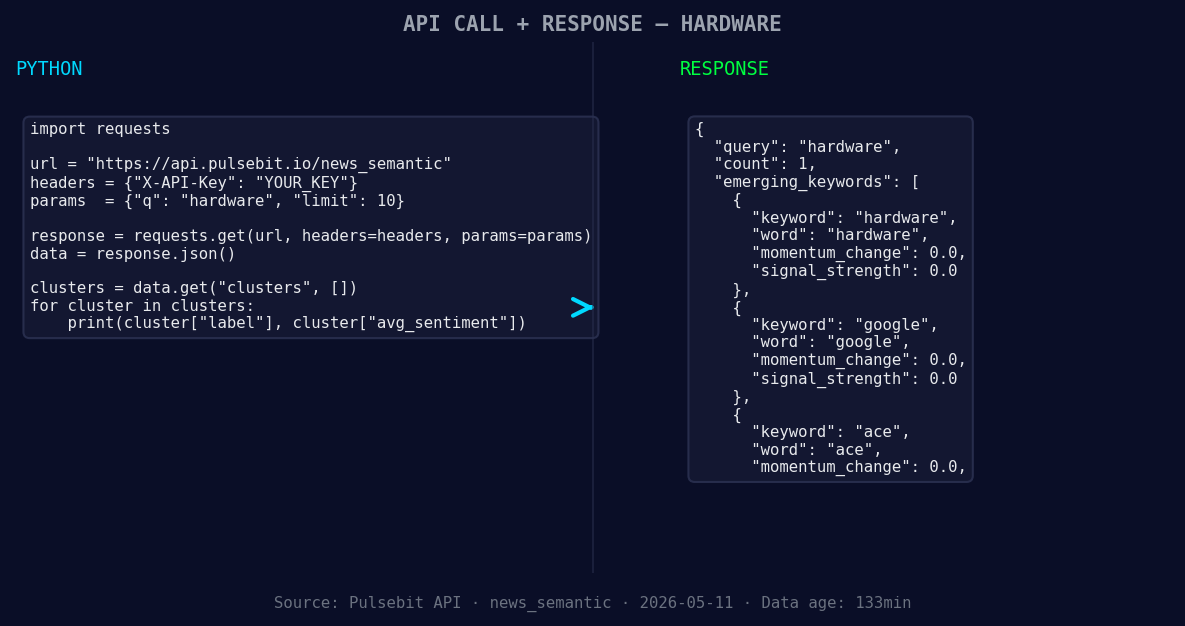
*Left: Python GET /news_semantic call for 'hardware'. Right: returned JSON response structure (clusters: 3). Source: Pulsebit /news_semantic.*
# Print the relevant data
print(data)
Now, let’s dig a bit deeper by running the cluster reason string back through our sentiment API to score the narrative framing itself. This helps validate our understanding of the conversation as it’s evolving. Here’s how we do that:
# Input for meta sentiment loop
input_string = "Clustered by shared themes: gamesradar+, hardware, digest, 60+, best."
meta_response = requests.post("https://api.pulsebit.com/v1/sentiment", json={"text": input_string})
meta_data = meta_response.json()

# Print the sentiment score of the narrative
print(meta_data)
This reveals how the narrative surrounding hardware is not just a collection of sentiment scores but is tied to specific themes and discussions that are gaining traction. By evaluating the score of the narrative, we can determine the strength of the emerging trends, which is crucial for timely decision-making.
Now, let’s build three specific applications around this data pattern:
- Geo-Filtered Sentiment Analysis: Use our API to filter by geographic origin. For instance, you can set up a threshold where sentiment on hardware needs to exceed a score of +0.5 in the U.S. and U.K. This will help you capture localized spikes earlier.

Geographic detection output for hardware. Hong Kong leads with 1 articles and sentiment +0.85. Source: Pulsebit /news_recent geographic fields.
   geo_params = {
       "topic": "hardware",
       "lang": "en",
       "geo": "US,UK",
       "threshold": 0.5,
   }
   geo_response = requests.get("https://api.pulsebit.com/v1/sentiment", params=geo_params)
- Dynamic Content Adjustment: Run the meta-sentiment loop for articles published in the last 24 hours to adjust your content strategy dynamically on platforms where hardware is trending.
   dynamic_input = "Clustered by shared themes: horizon, hardware, forza, bans, drops."
   dynamic_response = requests.post("https://api.pulsebit.com/v1/sentiment", json={"text": dynamic_input})
- Cross-Theme Comparison: Compare the sentiment score of hardware against other forming themes like Google and Ace to identify potential partnerships or competition. You can set a specific threshold for sentiment differences to trigger alerts.
   comparison_input = "Comparing hardware with: google(+0.00), ace(+0.00) vs mainstream: gamesradar+, hardware, digest."
   comparison_response = requests.post("https://api.pulsebit.com/v1/sentiment", json={"text": comparison_input})
If you want to dive deeper into building these insights, check out our documentation at pulsebit.lojenterprise.com/docs. You can copy-paste the above code snippets and get this running in under 10 minutes. Don’t let your pipeline be left behind — catch those momentum spikes while they’re hot!


Top comments (0)