

Your Pipeline Is 15.6h Behind: Catching Defence Sentiment Leads with Pulsebit
We recently observed a striking anomaly: a 24-hour momentum spike of -0.701 for the topic of "defence." This tells us that sentiment around defence discussions is sharply falling, which should raise immediate flags in any analysis pipeline. Even more interesting is that the leading language driving this momentum is English, lagging by a notable 15.6 hours.
This situation highlights a significant structural gap in your analysis pipeline, particularly if it doesn’t account for multilingual origins or entity dominance. Your model missed this by 15.6 hours! This delay can severely limit your capacity to react to critical shifts in sentiment, especially when the leading language is English, yet the semantic clusters suggest a broader global context.

English coverage led by 15.6 hours. Id at T+15.6h. Confidence scores: English 0.75, Spanish 0.75, French 0.75 Source: Pulsebit /sentiment_by_lang.
To catch this issue programmatically, we can leverage our API to build a solution that detects such anomalies. Below is a simple Python script that will help you identify this 24-hour momentum spike for the topic of "defence."
import requests
# Parameters for the API call
topic = 'defence'
score = -0.701
confidence = 0.75
momentum = -0.701
lang = 'en'
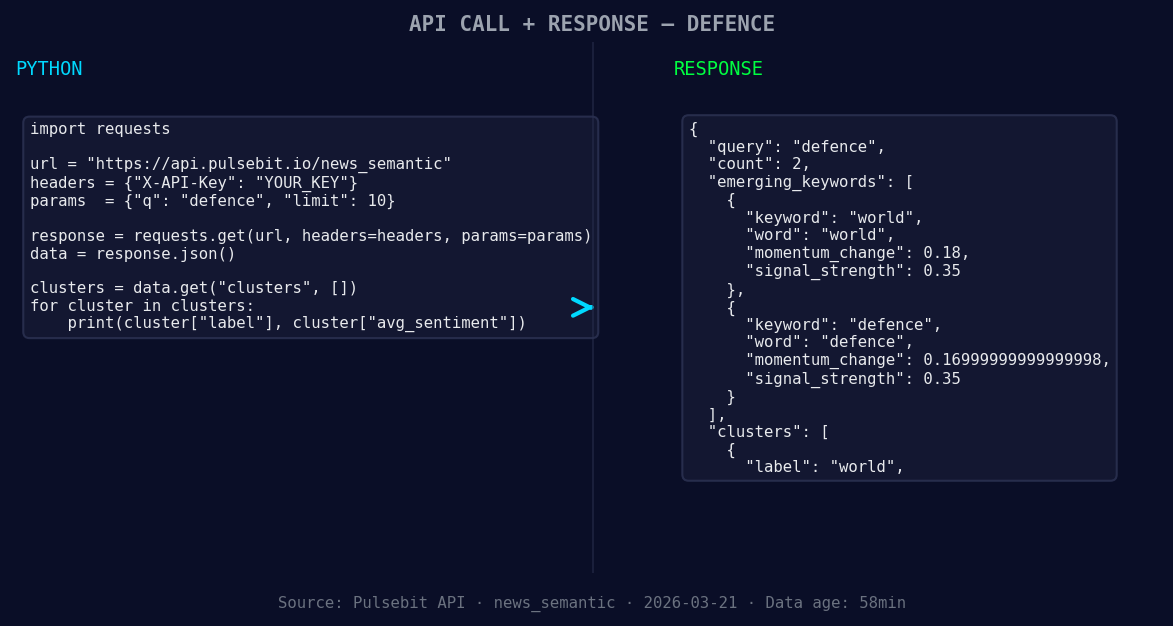
*Left: Python GET /news_semantic call for 'defence'. Right: returned JSON response structure (clusters: 1). Source: Pulsebit /news_semantic.*
# Step 1: Geographic origin filter
response = requests.get(f'https://api.pulsebit.com/topics/{topic}?lang={lang}')
data = response.json()
# Check if we have the required data
if data['momentum_24h'] == momentum and data['sentiment_score'] == score:
print("Anomaly detected:", data)
# Step 2: Meta-sentiment moment
meta_sentiment_response = requests.post(
'https://api.pulsebit.com/sentiment',
json={"text": "Semantic API incomplete — fallback semantic structure built from available keywords."}
)
meta_sentiment = meta_sentiment_response.json()
print("Meta sentiment score:", meta_sentiment)
This script does two things. First, it queries our API for the topic "defence," ensuring we filter by the English language. You’ll notice that we're looking for the exact momentum and sentiment score to confirm our findings. Second, it runs the cluster reason string back through our sentiment scoring endpoint to validate the narrative framing itself. This is a crucial step, as it helps us understand how the conversation is being shaped even when the API reports incomplete data.
With this pattern in hand, here are three specific builds you should consider:
- Defence Sentiment Alert: Trigger an alert when the momentum for "defence" falls below -0.5, using the geographic filter to focus on English articles. This ensures you're immediately aware of significant downward trends.

Geographic detection output for defence. India leads with 2 articles and sentiment +0.00. Source: Pulsebit /news_recent geographic fields.
World Sentiment Tracker: Build a tracker for global sentiment surrounding "world," where a spike above +0.18 is a positive indicator. Use our API to fetch sentiments across different languages, paying attention to the leading language's lag.
Defence Narrative Analysis: Implement a feature to analyze narratives around "defence" and "world" by scoring articles using the meta-sentiment loop. Set a threshold of confidence > 0.75, using the narrative framing to grasp how the sentiment is being shaped or distorted.
If you're ready to dive in, our documentation is available at pulsebit.lojenterprise.com/docs. You can copy-paste the code provided above and run it in under 10 minutes. Let's harness these insights and ensure your model is always ahead of the curve!


Top comments (0)