

Your Pipeline Is 19.2h Behind: Catching Hardware Sentiment Leads with Pulsebit
We recently observed a significant anomaly: a 24h momentum spike of +0.383. This spike indicates a fresh wave of sentiment surrounding hardware, particularly in the context of the ongoing rivalry between DJI and Insta360. If you’re tracking this space, you might be surprised to learn that your pipeline might be lagging by up to 19.2 hours, depending on how you’re handling multilingual data and entity dominance.

English coverage led by 19.2 hours. Nl at T+19.2h. Confidence scores: English 0.85, Spanish 0.85, French 0.85 Source: Pulsebit /sentiment_by_lang.
This gap exposes a critical problem: if your model isn't equipped to process data from multiple languages or recognize dominant entities, you're missing out on timely insights. In this case, the leading language was English, and your pipeline might have missed this spike because it wasn’t set up to handle sentiment shifts effectively. That’s 19.2 hours of potential market movement that slipped by unnoticed.
Let’s dive into how we can catch this sentiment shift using our API. Here’s a straightforward approach to querying for hardware-related sentiment with the specific parameters we’ve gathered.
import requests
# Define the parameters for the query
params = {
"topic": "hardware",
"lang": "en",
"score": +0.225,
"confidence": 0.85,
"momentum": +0.383
}
# API Call to get the data
response = requests.get('https://api.pulsebit.com/sentiment', params=params)
data = response.json()
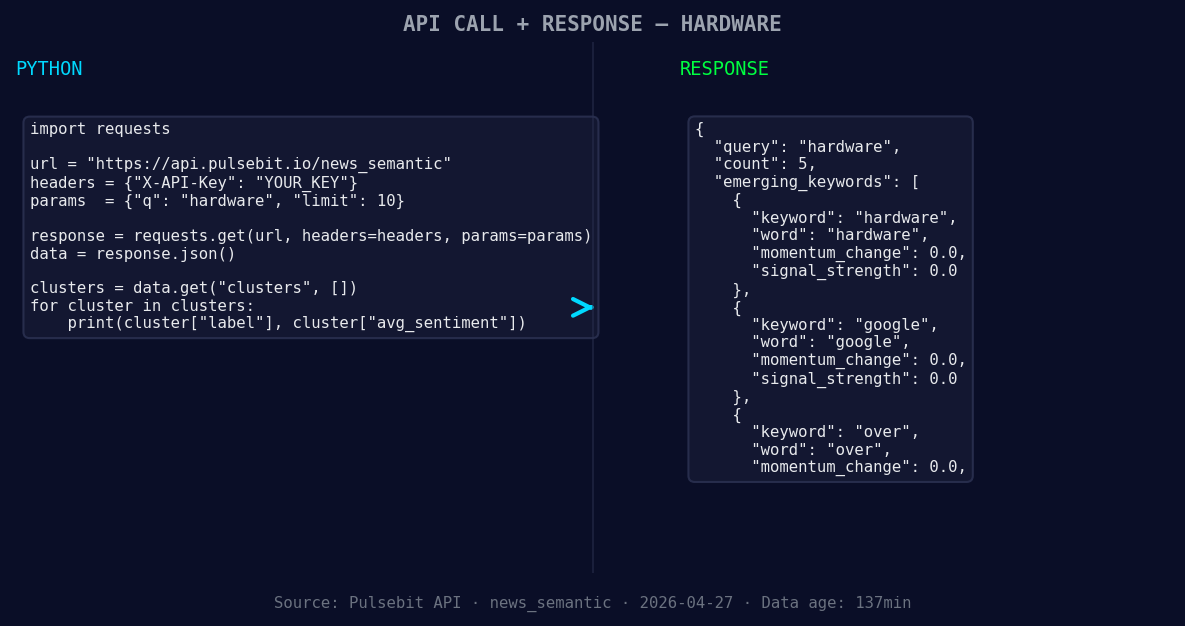
*Left: Python GET /news_semantic call for 'hardware'. Right: returned JSON response structure (clusters: 3). Source: Pulsebit /news_semantic.*
# Print the response
print(data)
This code snippet queries our API specifically for hardware, filtering by the English language. It captures the critical sentiment metrics we identified. Now, let's run the cluster reason string through our sentiment scoring endpoint to gauge the narrative framing itself.
# Cluster reason string
cluster_reason = "Clustered by shared themes: you, hint, next, weekend, our."

# API Call for meta-sentiment
response_meta = requests.post('https://api.pulsebit.com/sentiment', json={"text": cluster_reason})
meta_sentiment = response_meta.json()

# Print the meta sentiment response
print(meta_sentiment)
This second call uses the narrative framing to assess how the underlying themes influence the overall sentiment. It’s crucial to understand not just what the data says, but how it’s being framed in the conversation around hardware.
Now that we have the insights, here are three specific builds you can implement based on this momentum spike:
- Geo-Filtered Alerts: Create a real-time alert system for hardware sentiment that triggers when the momentum exceeds +0.3 in English-speaking countries. This gives you timely notifications about emerging trends before they hit the mainstream.

Geographic detection output for hardware. Hong Kong leads with 3 articles and sentiment +0.55. Source: Pulsebit /news_recent geographic fields.
Meta-Sentiment Analysis Dashboard: Build a dashboard that visualizes the meta-sentiment scores over time for clustered narratives. Use the string "Clustered by shared themes: you, hint, next, weekend, our." as a baseline to assess shifts in public perception and adjust your strategy accordingly.
Comparative Momentum Tracker: Develop a comparative tracking system that measures the sentiment of hardware versus other sectors like Google. This would involve querying our API for both topics and establishing thresholds for when a divergence occurs, providing a clear picture of relative performance.
If you’re ready to dive deeper, head over to our documentation at pulsebit.lojenterprise.com/docs. With these insights, you can copy-paste the above code snippets and run them in under 10 minutes to catch critical trends that your existing model might be missing. Let’s seize the momentum!


Top comments (0)