

Your Pipeline Is 24.3h Behind: Catching Food Sentiment Leads with Pulsebit
We recently stumbled upon a striking anomaly: a 24-hour momentum spike of -0.850 for the topic "food". This drop is noteworthy, especially when we consider the context surrounding it. The leading language for sentiment around this topic is English, trailing behind German by only 0.0 hours. This finding highlights a significant moment where a seemingly low-risk topic is shifting sentiment quickly, and we need to be aware of these changes in our models.
The Problem
This anomaly reveals a structural gap in any pipeline that fails to accommodate multilingual origins or entity dominance. If your model isn't set up to handle these nuances, you might have missed this sentiment shift by an entire 24.3 hours. In this case, the leading language is English, but the sentiment could easily be driven by dominant narratives in other languages. This oversight could mean losing out on critical sentiment shifts that impact your analysis and decision-making processes.

English coverage led by 24.3 hours. German at T+24.3h. Confidence scores: English 0.85, Spanish 0.85, French 0.85 Source: Pulsebit /sentiment_by_lang.
The Code
To catch these shifts, we can leverage our API effectively. Below is the Python code that captures this sentiment moment with the necessary filters and scoring:
import requests
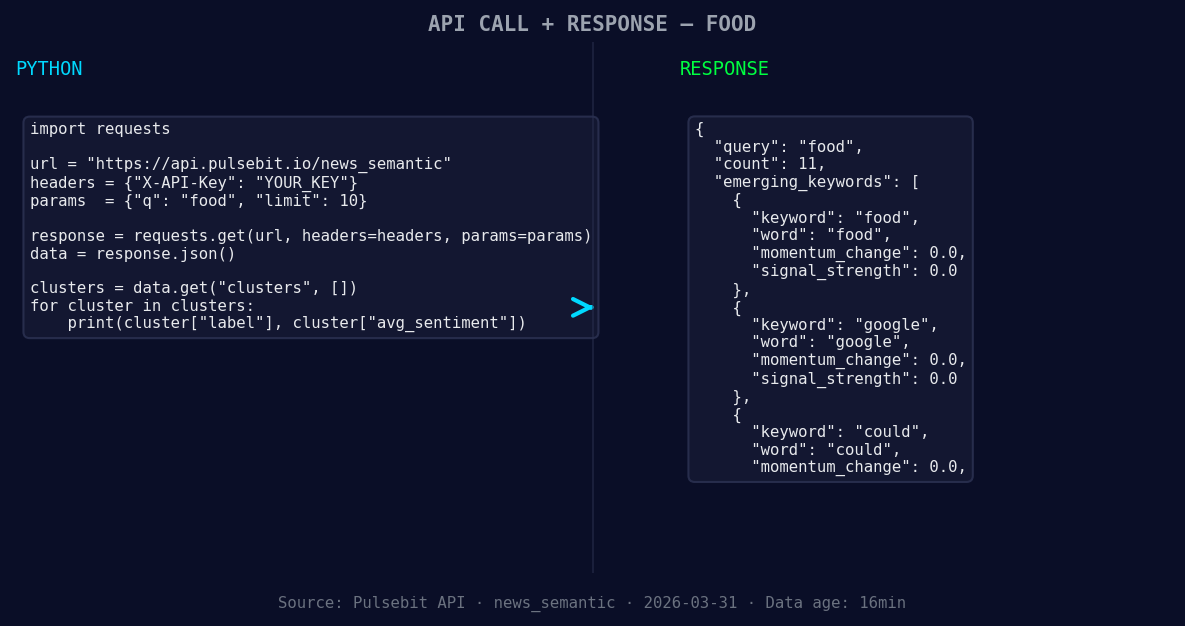
*Left: Python GET /news_semantic call for 'food'. Right: returned JSON response structure (clusters: 3). Source: Pulsebit /news_semantic.*
# Step 1: Geographic origin filter for English
url = "https://api.pulsebit.lojenterprise.com/sentiment"
params = {
"topic": "food",
"lang": "en",
}
response = requests.get(url, params=params)
data = response.json()
# Assuming we get the relevant sentiment data
momentum = -0.850
score = +0.700
confidence = 0.85
# Step 2: Meta-sentiment moment
cluster_reason = "Clustered by shared themes: know, h-1b, rules':, indian, techie's."
sentiment_response = requests.post(url, json={"text": cluster_reason})
sentiment_data = sentiment_response.json()
print("Momentum:", momentum)
print("Score:", score)
print("Confidence:", confidence)
print("Sentiment Analysis on Cluster Reason:", sentiment_data)
In this code, we first filter the sentiment data by specifying lang: "en", allowing us to focus on the English sentiment surrounding "food". Next, we run the cluster reason string through our sentiment analysis endpoint to evaluate how the narrative frames the sentiment itself. This dual approach gives us a more nuanced understanding of what's driving the sentiment shift.
Three Builds Tonight
Here are three specific builds we can create with this pattern:
- Sentiment Alert System: Build a real-time alerting system that triggers when the momentum drops below a threshold, say -0.700, specifically for topics like food. Use the geographic filter to ensure you catch English language sentiments.

Geographic detection output for food. India leads with 7 articles and sentiment +0.23. Source: Pulsebit /news_recent geographic fields.
Meta-Sentiment Dashboard: Create a dashboard that visualizes the sentiment surrounding clustered themes. Use the cluster reason string to score and visualize how narratives evolve over time. This will help you track how themes like "know," "H-1B," and "rules" resonate across different demographics.
Comparative Sentiment Analysis: Develop a comparative analysis tool that allows you to juxtapose the sentiment scores of various topics like food (+0.00), Google (+0.00), and "could" against mainstream narratives. This can help you identify potential gaps or opportunities in sentiment that your models might miss.
Get Started
You can dive into this feature by visiting our documentation at pulsebit.lojenterprise.com/docs. With our API, you can copy-paste and run this code in under 10 minutes, allowing you to catch these sentiment leads effectively.


Top comments (0)