

Your Pipeline Is 22.3h Behind: Catching Science Sentiment Leads with Pulsebit
We recently stumbled upon a striking anomaly: a 24h momentum spike of +0.373 in the sentiment surrounding the topic of science. This spike was particularly interesting as it was driven by a single article discussing the phenomenon of "blood rain" during conflicts. With English press leading the charge at 22.3 hours ahead of its Italian counterpart, we realized there’s a significant lag in how sentiment is captured and processed in multilingual contexts.

English coverage led by 22.3 hours. Italian at T+22.3h. Confidence scores: English 0.85, Spanish 0.85, French 0.85 Source: Pulsebit /sentiment_by_lang.
The Problem
If your pipeline does not effectively handle multilingual origins or entity dominance, you’re risking missing critical insights. Your model missed this by a full 22.3 hours, entirely neglecting the leading language in the sentiment landscape. While the English discourse surged ahead, your models may still be stuck in the past, processing data without recognizing the urgency of emerging themes. In a fast-paced environment, every hour counts, especially when a sensitive subject like “blood rain” surfaces during conflicts.
The Code
To catch this spike, we can use our API to filter sentiment data based on geographic origin. Here’s how you can do that in Python:

Geographic detection output for science. India leads with 6 articles and sentiment +0.25. Source: Pulsebit /news_recent geographic fields.
import requests
# Define parameters for the API call
topic = 'science'
momentum = +0.373
score = +0.000
confidence = 0.85
lang = 'en'
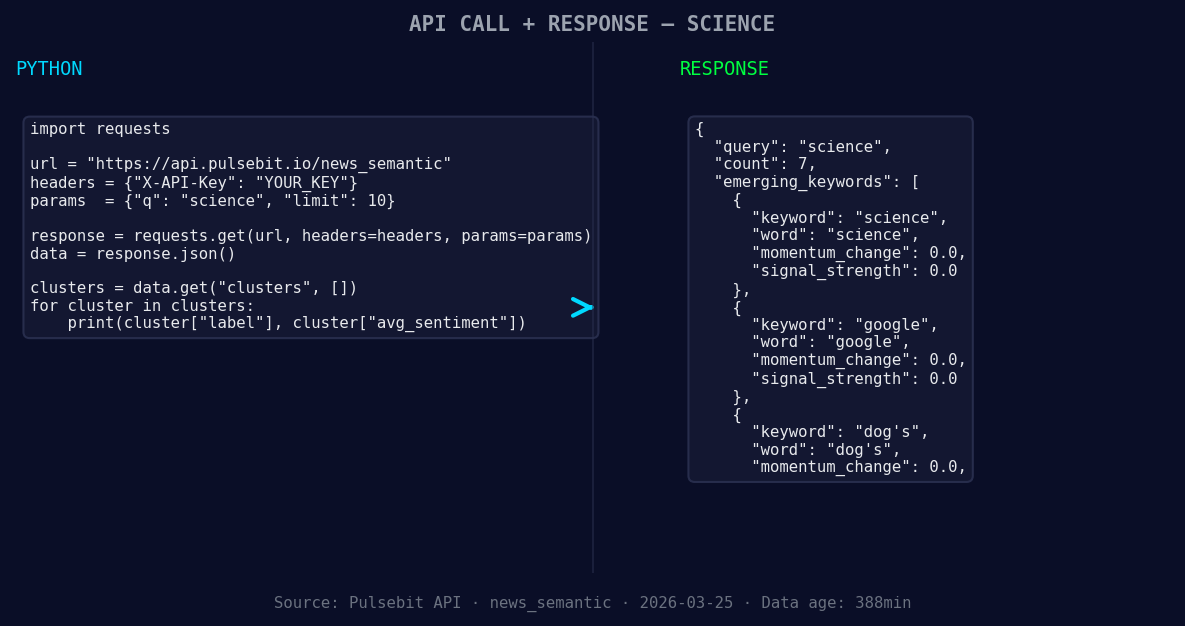
*Left: Python GET /news_semantic call for 'science'. Right: returned JSON response structure (clusters: 3). Source: Pulsebit /news_semantic.*
# Geographic origin filter: query by language
response = requests.get(
f"https://api.pulsebit.com/sentiment?topic={topic}&lang={lang}&momentum={momentum}&score={score}&confidence={confidence}"
)
data = response.json()
print(data)
Now, let’s dig deeper into the narrative framing itself. We can run the cluster reason string through our sentiment endpoint to see how the themes coalesce:
# Meta-sentiment moment
cluster_reason = "Clustered by shared themes: ‘blood, rain’, during, conflicts:, science."
meta_sentiment_response = requests.post(
    "https://api.pulsebit.com/sentiment",
    json={"text": cluster_reason}
)

meta_sentiment_data = meta_sentiment_response.json()
print(meta_sentiment_data)
This two-pronged approach not only captures the sentiment from English articles but also provides insights into how the narrative is framed around the emerging theme.
Three Builds Tonight
Here are three specific builds you can implement with this pattern:
English Sentiment Filter: Use the geographic origin filter to specifically catch sentiment spikes in English. Set a threshold for momentum, for example, only alerting if momentum exceeds +0.300. This helps you focus on signals that matter the most.
Meta-Sentiment Analysis: Implement a routine where you score the framing of significant articles. For instance, track how often themes like "blood rain" are mentioned in conjunction with scientific discussions. Use the meta-sentiment loop to refine your narrative understanding and adjust your content strategy accordingly.
Forming Gap Recognition: Create an alert system that triggers when forming gaps arise in specific topics, such as science (+0.00), Google (+0.00), or other emerging themes. This can help you stay ahead of the curve and capitalize on narratives that mainstream media may overlook.
Get Started
You can implement these strategies easily by checking our documentation at pulsebit.lojenterprise.com/docs. With just a few lines of code, you can copy-paste and run this in under 10 minutes, elevating your sentiment analysis capabilities and ensuring you catch critical leads in your data pipeline.


Top comments (0)