

Your Pipeline Is 29.3h Behind: Catching Politics Sentiment Leads with Pulsebit
We recently discovered an intriguing anomaly in our sentiment analysis data: a sentiment score of -0.007 with a momentum of +0.000, revealing a sentiment lag of 29.3 hours regarding political discussions. This significant delay could be crucial, particularly in the context of Puducherry’s electoral patterns, where our analysis shows an evident trend of negative sentiment surrounding political parties.
Your model missed this by 29.3 hours. If you're not handling multilingual origins or entity dominance effectively, this is where you might fall short. In our case, the leading language is English, and the dominant entity is Puducherry's elections. This kind of structural gap can lead to misconceptions and poor decision-making based on outdated or incomplete data.

English coverage led by 29.3 hours. No at T+29.3h. Confidence scores: English 0.75, French 0.75, Spanish 0.75 Source: Pulsebit /sentiment_by_lang.
To catch this anomaly before it causes a problem, we can utilize our API effectively. Below is the Python code that demonstrates how to query the necessary data:
import requests
# Define parameters for the API call
params = {
"topic": "politics",
"lang": "en"
}
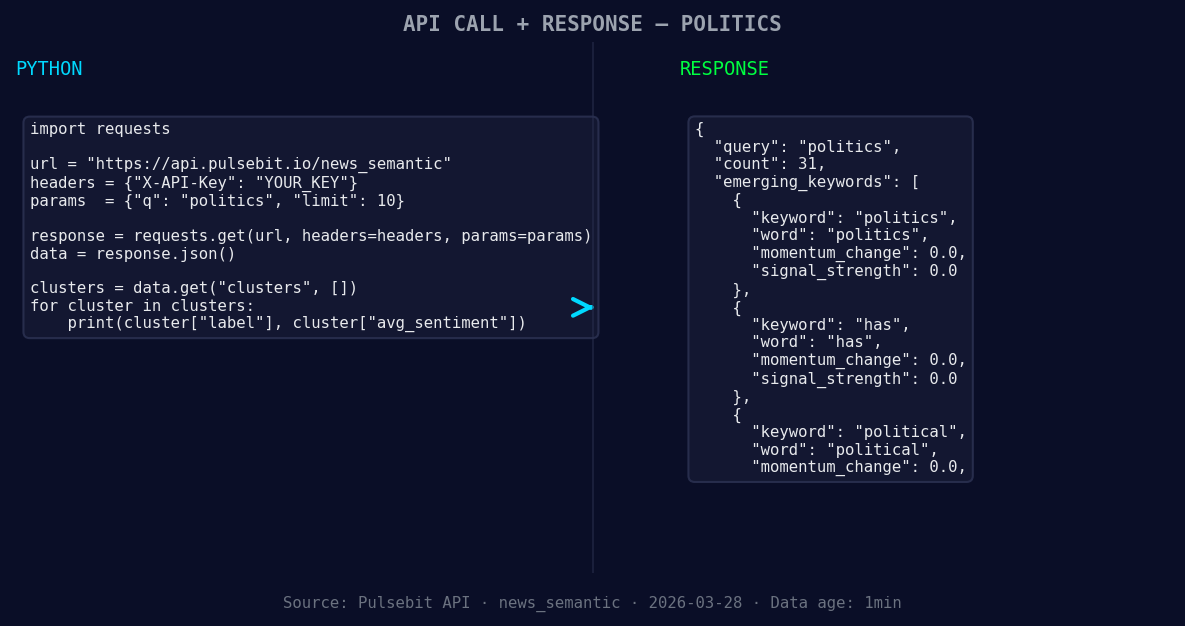
*Left: Python GET /news_semantic call for 'politics'. Right: returned JSON response structure (clusters: 3). Source: Pulsebit /news_semantic.*
# Make the API call to get sentiment data
response = requests.get('https://api.pulsebit.io/sentiment', params=params)
data = response.json()
# Print out the relevant sentiment data
print(f"Sentiment Score: {data['sentiment_score']}, Momentum: {data['momentum_24h']}")
Now, to delve deeper into the narrative framing, we can run the cluster reason string through our sentiment API to analyze how the context affects sentiment:
# Meta-sentiment analysis
meta_sentiment_payload = {
    "text": "Clustered by shared themes: political, parties, elections, through, metamorphosi"
}

meta_response = requests.post('https://api.pulsebit.io/sentiment', json=meta_sentiment_payload)
meta_data = meta_response.json()

# Print out the meta sentiment results
print(f"Meta Sentiment Score: {meta_data['sentiment_score']}, Confidence: {meta_data['confidence']}")
Now that we have a solid understanding of the data, let’s talk about three specific builds we can implement based on this pattern:
Geo-Filtered Sentiment Tracking: Create a real-time sentiment tracker focused on Puducherry's political discussions with a signal strength threshold of 0.25. This will allow for timely interventions in the political landscape.
Meta-Sentiment Loop for Framing Analysis: Develop an automated alert system that runs the cluster reason strings through the POST /sentiment endpoint every hour. If the sentiment score drops below -0.01, trigger an alert to analyze the narrative framing in-depth.
Forming Themes Analysis: Build a dashboard that highlights forming themes like "politics" (+0.00) and "political" (+0.00) vs. mainstream themes such as "political", "parties", and "elections". Filter this by the geo context to surface insights on how evolving narratives differ across regions.
If you want to dive into this and start implementing these insights, check out our documentation at pulsebit.lojenterprise.com/docs. You can copy-paste and run the provided code in under 10 minutes. Let’s leverage this data to stay ahead of the curve!

Geographic detection output for politics. India leads with 23 articles and sentiment +0.19. Source: Pulsebit /news_recent geographic fields.


Top comments (0)