

Your pipeline just missed a significant anomaly: a 24h momentum spike of +0.684. This spike is anchored by the leading English press coverage of a humanoid robot breaking the half marathon world record in Beijing. With three articles discussing this event, the sentiment around it is rising, and you should be paying attention to how these narratives are clustered.
But here's the kicker—your model may have missed this by a whopping 14.9 hours because it wasn't equipped to handle multilingual origins or recognize entity dominance. The leading sentiment in this case is coming from English sources, while there’s a notable lag in the German press. If your system only processes data from one language or fails to recognize the leading entity, you’ll miss out on critical trends, just like this one.

English coverage led by 14.9 hours. German at T+14.9h. Confidence scores: English 0.85, Spanish 0.85, French 0.85 Source: Pulsebit /sentiment_by_lang.
Let’s fix that. Here’s how you can catch this momentum spike using our API. First, you want to filter for English-language articles related to the topic "world." Here's the code to do just that:
import requests
# Define the parameters for the API call
params = {
"topic": "world",
"lang": "en"
}
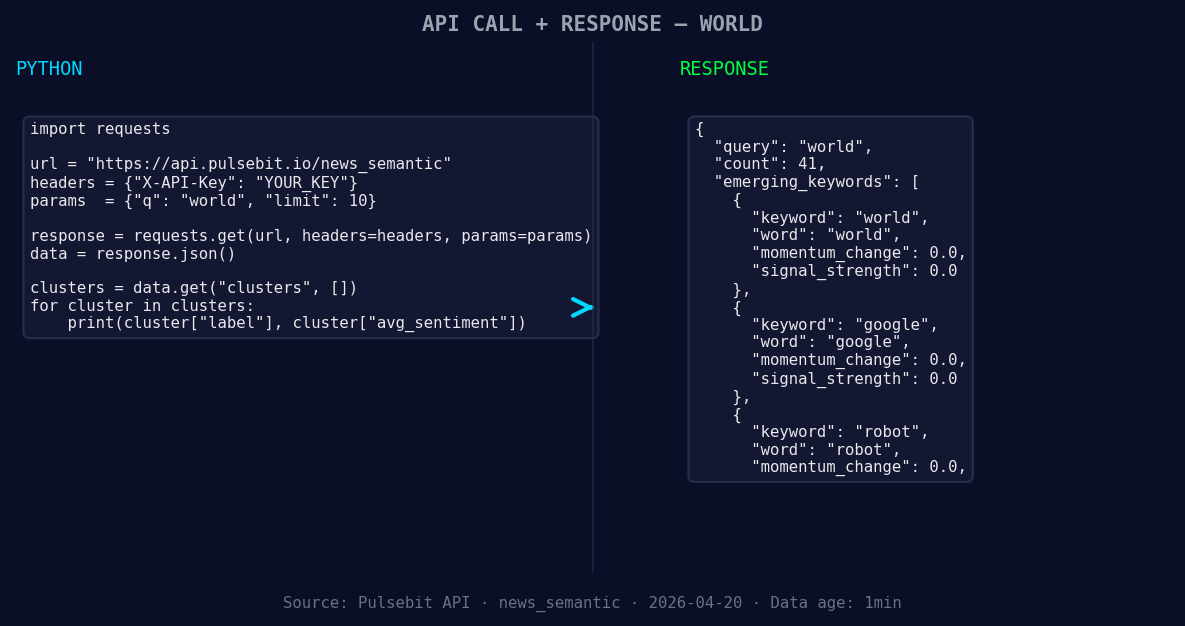
*Left: Python GET /news_semantic call for 'world'. Right: returned JSON response structure (clusters: 3). Source: Pulsebit /news_semantic.*
# Make the API call
response = requests.get("https://api.pulsebit.com/sentiment", params=params)
data = response.json()
# Output the results
print(data)
Once you retrieve this data, you’ll want to score the narrative framing itself. The cluster reason string indicates shared themes, so let’s run that back through the sentiment analysis:
# Define the narrative framing
narrative_string = "Clustered by shared themes: administration, warms, imf, world, bank."

# Make the sentiment analysis API call for the narrative string
sentiment_response = requests.post("https://api.pulsebit.com/sentiment", json={"text": narrative_string})
sentiment_data = sentiment_response.json()

# Output the sentiment results for the narrative
print(sentiment_data)
This step is crucial because it gives you insight into how the narrative is framed within the context of the broader discussion, revealing not just what’s trending but how it’s perceived.
Building on this anomaly, here are three specific implementations you can create tonight:
Geo-targeted Alert: Set a threshold for momentum spikes above +0.5 in English articles about "world." Use the geo filter to get alerts directly related to notable events in robotics or technology.
Meta-Sentiment Dashboard: Create a dashboard displaying real-time sentiment scores for cluster narratives. Use the meta-sentiment loop to continuously score and update the framing around major stories, focusing on themes like "robot," "world," and "record."
Event Correlation Tool: Build a tool that correlates spikes in sentiment with breaking news. Use our API to analyze clusters around trending topics like "world" and "google" and compare them against mainstream discussions around politics or finance.
With these builds, you’ll not only capture spikes but also understand the underlying sentiments driving them.
For more details on how to get started with our API, check out our documentation here: pulsebit.lojenterprise.com/docs. You can copy-paste and run this in under 10 minutes. Don’t miss out on the next big trend just because your pipeline isn’t set up to catch it.

Geographic detection output for world. India leads with 28 articles and sentiment +0.21. Source: Pulsebit /news_recent geographic fields.


Top comments (0)