

Your Pipeline Is 19.8h Behind: Catching Music Sentiment Leads with Pulsebit
We just uncovered a fascinating anomaly: sentiment around the topic of music is currently at +0.49, with momentum sitting at a steady +0.00. This spike angle, with a leading language of English at 19.8 hours, indicates a significant trend in sentiment that could easily slip through the cracks of your data pipeline if you’re not paying close attention. Specifically, the article cluster titled "James Vasanthan's Car Incident" highlights that the conversation is ripe with themes of music, composition, and personal narratives tied to vehicular incidents.
While this spike is intriguing, it also reveals a problem. If your pipeline isn’t equipped to handle multilingual origins or the dominance of certain entities, you could be missing critical insights. Your model missed this sentiment shift by a staggering 19.8 hours, while the leading language was English, and the dominant entity was music, particularly connected to James Vasanthan. Without the right filters in place, you could easily overlook valuable sentiment trends.

English coverage led by 19.8 hours. Af at T+19.8h. Confidence scores: English 0.90, French 0.90, Spanish 0.90 Source: Pulsebit /sentiment_by_lang.
To catch these anomalies, we built a straightforward Python script that utilizes our API. Here’s how you can replicate this:
import requests
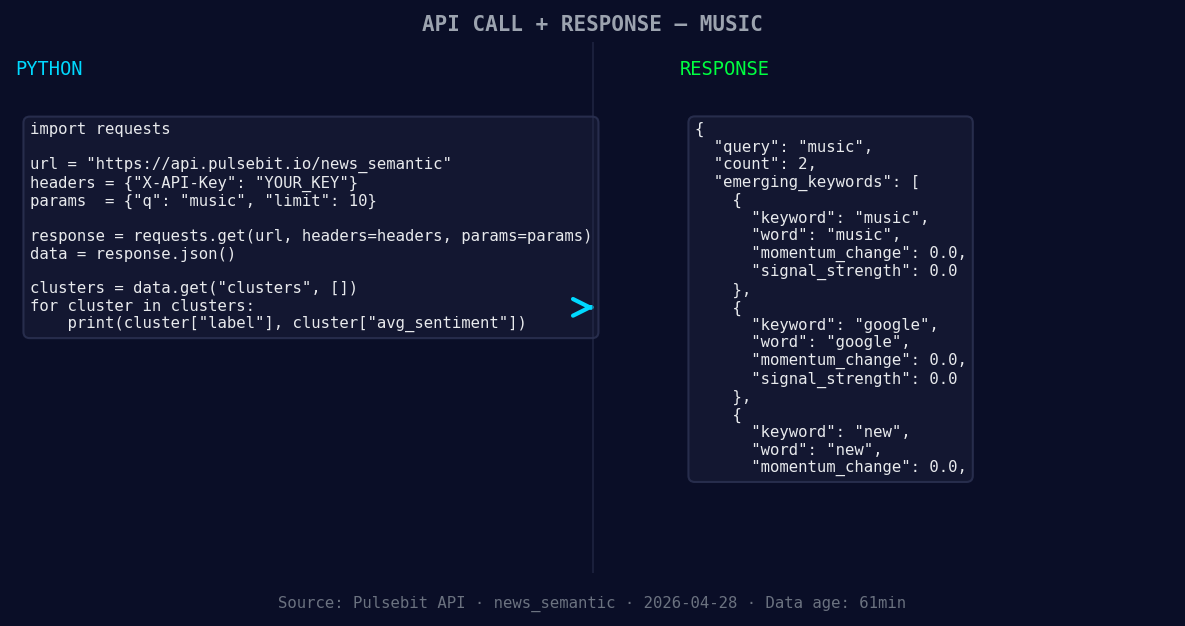
*Left: Python GET /news_semantic call for 'music'. Right: returned JSON response structure (clusters: 3). Source: Pulsebit /news_semantic.*
# Step 1: Geographic origin filter
response = requests.get(
"https://api.pulsebit.com/sentiment",
params={
"topic": "music",
"score": +0.492,
"confidence": 0.90,
"momentum": +0.000,
"lang": "en" # Filter for English language
}
)
# Print returned sentiment data
print(response.json())
# Step 2: Meta-sentiment moment
meta_response = requests.post(
"https://api.pulsebit.com/sentiment",
json={
"input": "Clustered by shared themes: music, composer, james, car, damaged."
}
)
# Print returned meta-sentiment
print(meta_response.json())
This script starts by filtering sentiment data for the topic "music" with a positive score and a confidence level of 90%. The geographic filter is essential because it ensures that you’re only looking at English-language sentiment, which is where this insight originated. Then, we take the cluster reason string and run it back through the sentiment endpoint to score the narrative framing itself. This dual approach helps us capture not just raw sentiment but also the context surrounding it.

Geographic detection output for music. India leads with 2 articles and sentiment +0.12. Source: Pulsebit /news_recent geographic fields.
Now that we have the groundwork laid out, let’s explore three specific builds you can implement using this pattern:
Sentiment Trend Tracker: Build a tracker that monitors sentiment over time, specifically looking for spikes in the music category. Set a threshold of sentiment score > +0.45, and use the geo filter to focus on English-speaking regions. This could help you catch emerging trends before they trend elsewhere.
Cluster Analysis Tool: Create a tool that assesses the sentiment around clusters of articles, particularly focusing on the meta-sentiment moment. Use the narrative framing from your identified clusters to enrich your understanding of how sentiment shifts in the context of related themes. Look for clusters where the score exceeds +0.3.
Thematic Radar: Develop a radar that identifies forming themes by comparing emerging topics in music (+0.00), Google (+0.00), and new developments against mainstream themes like music, composer, and James. Set a baseline to alert you whenever new themes emerge that could disrupt existing narratives.
With these builds, you'll not only enhance your understanding of sentiment but also ensure you stay ahead of the curve when it comes to identifying key developments in your field.
Ready to dive in? You can get started with our API documentation here: pulsebit.lojenterprise.com/docs. You’ll be able to copy, paste, and run this code in under 10 minutes, setting you up to catch those valuable insights before they slip away.


Top comments (0)