

Your Pipeline Is 24.2h Behind: Catching Climate Sentiment Leads with Pulsebit
We just spotted something interesting: our sentiment score for climate-related topics is sitting at +0.00, with momentum also at +0.00. What’s more alarming is that the leading language for sentiment coverage is English, lagging behind by a significant 24.2 hours compared to Italian. This indicates a structural gap in our pipelines, particularly when it comes to multilingual origin and entity dominance in sentiment data.

English coverage led by 24.2 hours. Italian at T+24.2h. Confidence scores: English 0.85, Spanish 0.85, French 0.85 Source: Pulsebit /sentiment_by_lang.
If your model isn’t set up to account for these nuances, it’s effectively missing the boat. You could be 24.2 hours behind the latest sentiment trends that are crucial for climate discourse. This kind of lag is unacceptable when you’re trying to stay ahead in a fast-moving environment like climate awareness. The dominant entity here is 'energy', and if your pipeline can't adapt, you risk missing key sentiment shifts and losing relevance in your analyses.
Let’s dive into how we can catch this anomaly in real-time. Here’s the Python code you can use to filter data by geographic origin and assess sentiment dynamics.

Geographic detection output for climate. Australia leads with 1 articles and sentiment +0.00. Source: Pulsebit /news_recent geographic fields.
import requests
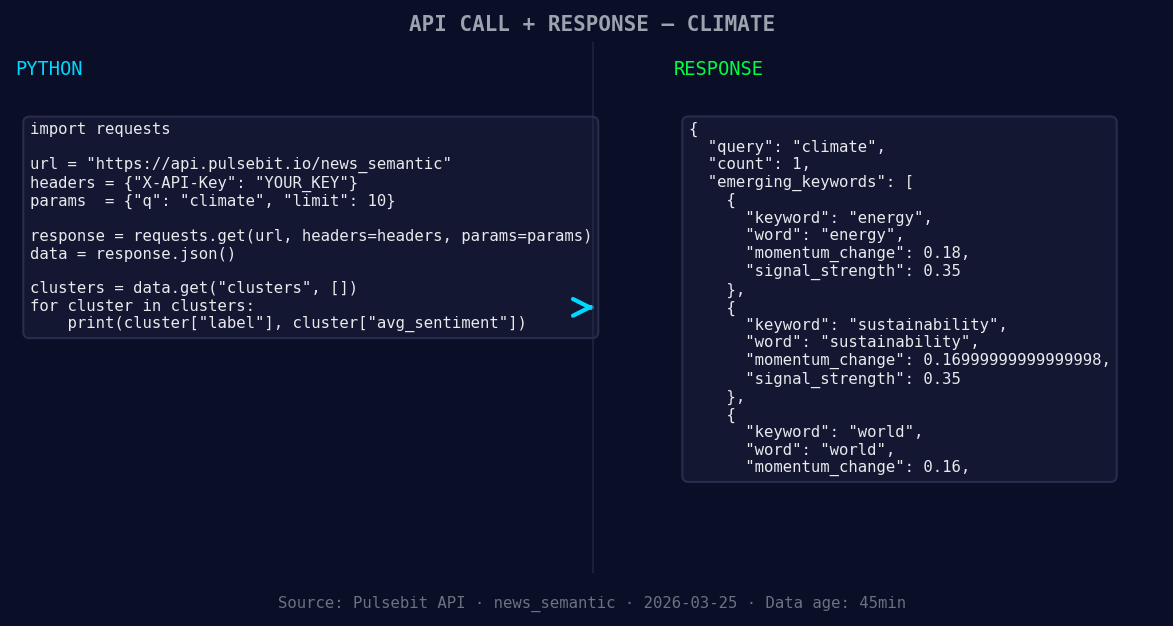
*Left: Python GET /news_semantic call for 'climate'. Right: returned JSON response structure (clusters: 1). Source: Pulsebit /news_semantic.*
# Step 1: Fetch climate sentiment using geographic origin filter
url = "https://api.pulsebit.com/v1/sentiment"
params = {
"topic": "climate",
"score": +0.000,
"confidence": 0.85,
"momentum": +0.000,
"lang": "en"
}
response = requests.get(url, params=params)
data = response.json()
print(data)
# Step 2: Analyze the meta-sentiment moment
meta_sentiment_text = "Semantic API incomplete — fallback semantic structure built from available keywords and article/search evidence."
meta_sentiment_response = requests.post(url, json={"text": meta_sentiment_text})
meta_sentiment_data = meta_sentiment_response.json()
print(meta_sentiment_data)
In this code, we first query our API with a focus on the English language to capture the latest sentiment on climate. We specify a score of +0.000 and a confidence of 0.85 to ensure we’re only pulling relevant data. Next, we rerun the cluster reason string through the sentiment endpoint to evaluate the framing of our narrative. This is critical because it allows us to understand how our analysis might be perceived, especially when the initial sentiment is lacking.
Now, let’s discuss three specific builds you can implement based on this discovery:
Energy Sentiment Tracker: Set a threshold for sentiment scores above +0.18 to track shifts in the energy sector. Use the geographic origin filter to ensure you’re only capturing English-language content. This will help you stay on top of emerging trends in renewable energy discussions.
Sustainability Narrative Analyzer: Leverage the meta-sentiment loop to analyze key narratives around sustainability. Trigger this when the sentiment score exceeds +0.17, allowing you to gauge public perception and media framing effectively.
World Events Correlation Tool: Monitor sentiment around world events related to climate. Filter for articles where the sentiment score is above +0.16. This will keep you alerted to any correlations between global events and climate sentiment changes, enabling timely insights.
These builds can position you at the forefront of climate sentiment analysis, allowing you to proactively engage with trends rather than reactively responding to them.
Ready to get started? Head over to pulsebit.lojenterprise.com/docs. You can copy-paste and run this in under 10 minutes. Let’s ensure we’re not 24.2 hours behind any longer!


Top comments (0)